Blood Safety in Chinese Hospitals: Screening and Donation System for Surgery
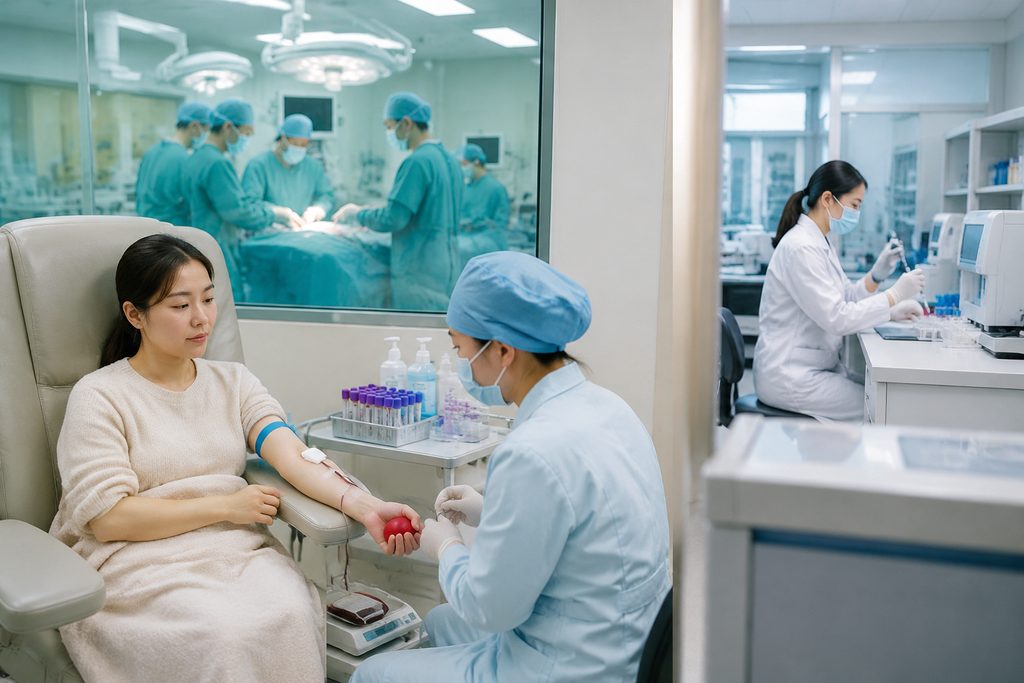
When 42-year-old Michael first heard the diagnosis, he had no idea where to start looking for treatment. A complex cardiac procedure. The quote from his local hospital left him reeling. Then a friend mentioned China. The technology was world-class, the surgeons highly experienced, and the blood safety China surgery cost equation was dramatically different. But one question stopped him cold: how safe is the blood supply? It is the question that keeps every rational patient awake at night. You can research the surgeon. You can tour the facility. The blood that flows into your veins during surgery—that requires a different kind of trust. Our team has spent years mapping exactly how that system works, and what it means for you.
Key Takeaways
- China’s blood donation screening rate for HIV, Hepatitis B, Hepatitis C, and syphilis is 100%, matching or exceeding WHO protocols with nucleic acid testing (NAT) that detects infections within a 7-10 day window.
- All blood for transfusion in accredited Chinese hospitals is sourced exclusively from government-regulated, non-remunerated voluntary donors—paid donation was criminalized in 1998.
- The primary barrier for international patients is not safety, but navigating a system where cultural and linguistic walls obscure the rigorous standards that are already in place.
- Understanding the full blood safety architecture—from donor screening to pre-transfusion compatibility testing—is the prerequisite before comparing any surgery costs.
The Problem: When “Is It Safe?” Becomes the Only Question
Approximately 1 in every 6 surgical patients worldwide requires a perioperative blood transfusion, according to the World Health Organization. For major orthopedic or cardiac procedures, that probability climbs sharply. And when you are considering treatment across borders, the anxiety compounds. A 2023 survey by the Medical Tourism Association found that fear of blood-borne infection was the second most cited barrier to seeking care abroad, trailing only concerns about surgical competency.
This is not abstract. The specter of contaminated blood is visceral. It connects to decades-old tragedies in various countries where lapses in screening led to mass HIV and hepatitis transmissions. Patients carry that collective memory. They ask: what are the China blood donation screening standards? Is donated blood safe in Chinese hospitals? These are not paranoid questions. They are the right questions. The answers exist in a dense lattice of regulations, testing protocols, and quality control mechanisms that few outsiders ever see clearly.
Who We Are
Before 1998, China had a mixed system. Paid donors existed. The Blood Donation Law of the People’s Republic of China eliminated that entirely, effective October 1, 1998. Since then, all clinical blood must come from voluntary, non-remunerated donors. Why does this matter for blood safety China surgery cost considerations? Because global epidemiological data consistently shows that voluntary donor pools have infection rates up to 90% lower than paid or family-replacement donor pools. The economic incentive to lie about risk factors vanishes.
This was not a cosmetic change. Provinces were mandated to shut down commercial blood stations. Government-run blood centers now operate as the sole legal collection points. When a unit of blood enters the system, its origin is traceable to a specific donor at a specific center on a specific date. The chain of custody is unbroken.
Nucleic Acid Testing: Closing the Window Period
Here is the technical heart of the matter. Traditional serological testing looks for antibodies. It takes time for an infected body to produce them. For HIV, that window period can stretch to 22 days. For Hepatitis C, up to 70 days. During that window, a donor could test negative and still transmit infection. That was the old world.
China’s blood centers now deploy nucleic acid testing (NAT) as a universal screening tool. NAT does not wait for antibodies. It amplifies and detects the viral genetic material itself—RNA or DNA. This slashes the window period dramatically. For HIV, detection is possible within 7-10 days of infection. For Hepatitis B and C, the window shrinks proportionally. A 2022 study published in Transfusion Medicine Reviews analyzing NAT implementation across Chinese blood centers reported a residual transmission risk for HIV of less than 1 in 1 million donations. That is the number that matters.
And this is not limited to elite hospitals in Shanghai or Beijing. The NAT mandate covers blood centers nationwide. The technology is standardized.
Pre-Transfusion Compatibility: The Final Gate
Even after a unit passes donor screening and laboratory testing, it is not released for a specific patient without one more step. The hospital transfusion department performs a crossmatch. Your blood sample is physically mixed with the donor unit. The technicians look for agglutination—clumping that signals an incompatible reaction.
This is universal practice. But in top-tier Chinese hospitals, the process is often automated with gel card technology or solid-phase adherence assays, reducing the risk of human interpretation error. The leading hospitals in our rankings maintain transfusion reaction rates below 0.1%, consistent with international benchmarks set by the AABB (formerly the American Association of Blood Banks). The question “how does China test blood for surgery” has a multi-layered answer, and the final layer is personalized to your own veins.
What You Need to Know Before Going Alone
The system is robust. But accessing it as an international patient without local knowledge introduces friction points that have nothing to do with safety and everything to do with navigation. These barriers are real. Ignoring them does not make them disappear.
- Language and Documentation: Blood transfusion consent forms, donor history questionnaires, and compatibility reports are written in Mandarin. A standard translation app will not capture the medico-legal nuances. You need someone who can read the lab panels and confirm that the unit designated for your surgery has cleared NAT screening and crossmatch. This is not a luxury. It is a safety checkpoint.
- Regional Variation in Accreditation: Not all hospitals are equal. China’s Ministry of Health accredits hospitals on a three-tier system, with Tier 3A representing the highest level. Within that tier, a subset of hospitals achieves additional international accreditation, such as JCI (Joint Commission International). For medical tourism China surgery blood safety, selecting a JCI-accredited or equivalent hospital ensures that transfusion practices are audited against global standards. The top private international hospitals often hold dual accreditation, adding a layer of external oversight.
- Blood Type Rarity and Sourcing: Rh-negative blood occurs in less than 0.5% of the Han Chinese population, compared to roughly 15% in Caucasian populations. If you are Rh-negative and require a significant transfusion, the blood center may need advance notice to source compatible units from a smaller donor registry. This does not compromise safety, but it does demand logistical planning. Walking in without preparation is a gamble you do not want to take.
How We Help You Navigate This
These barriers exist for structural reasons. A rigorous system generates paperwork. A diverse country generates regional variation. A different genetic landscape generates supply quirks. None of this reflects on the quality of care. But all of it can derail a medical journey if unaddressed. We solve for each layer.
Before you travel, our team confirms the blood bank protocols at your target hospital. We verify that the facility uses NAT screening, that it sources exclusively from government-regulated centers, and that its transfusion service holds current accreditation. We translate the blood safety documentation into plain English. We flag your blood type against local donor demographics so that if you are Rh-negative, the hospital’s transfusion committee is alerted before you board the plane.
During your treatment, we remain a point of contact. If a transfusion is ordered, we ensure you understand exactly what is being administered and why. After recovery, we maintain your transfusion records for your home physician. The goal is continuity. You should never have to wonder what happened while you were under anesthesia.
Frequently Asked Questions
Is donated blood safe in Chinese hospitals compared to Western standards?
In accredited Tier 3A and JCI-certified hospitals, the safety profile is comparable to that of blood supplies in the United States, Western Europe, or Australia. The universal NAT screening protocol, combined with the voluntary donor system, produces a residual HIV transmission risk estimated at less than 1 per million units. The key variable is hospital selection, not national blood policy. Choose a top-ranked institution and the safety architecture is sound.
What are the actual China blood donation screening standards?
Every donation is tested for HIV (antibody and NAT), Hepatitis B (HBsAg and NAT), Hepatitis C (antibody and NAT), syphilis, and alanine aminotransferase (ALT) as a marker of liver health. In some regions, screening for HTLV and malaria is also performed based on donor travel history. The standards are codified in the national “Technical Operating Procedures for Blood Stations,” which is updated regularly to reflect evolving epidemiology.
How do I find the best hospital for safe blood transfusion China?
Look for three markers. First, Ministry of Health Tier 3A classification. Second, JCI accreditation or an equivalent international quality certification. Third, a documented transfusion committee with published adverse reaction rates. Our hospital rankings database filters for these criteria, allowing you to cross-reference surgical specialty with transfusion safety infrastructure. A hospital that excels in cardiac surgery but has a weak transfusion service is not a complete solution. The systems must be integrated.
Does the lower blood safety China surgery cost mean corners are cut?
No. The cost differential stems from structural economic factors—lower labor costs for skilled technicians, government-subsidized blood center operations, and the high-volume efficiency of centralized testing. A unit of leukoreduced red blood cells that costs several hundred dollars in the US might cost a fraction of that in China, but the testing protocol is not diluted. The economics do not require cutting safety corners; they reflect a fundamentally different cost base.
Your Next Step
Blood safety is not a mystery. It is a measurable, auditable, verifiable system. The standards in China’s top hospitals are published, peer-reviewed, and enforced. The challenge is not the existence of those standards—it is accessing and interpreting them from six thousand miles away. That is the gap we close. If you are weighing a surgical decision, do not let an answerable question become an obstacle. Get the data. Understand the protocols. Then decide.
Looking for a specific doctor or treatment in China? Tell us what you need — we’ll help you find the right option at no charge.
For more medical information and treatment options in China, visit tochinamed.com (ToChinaMed).