Chinese Hospital Pharmacy: How to Fill Prescriptions and Get Medications as an Inpatient
Key Takeaways
- Inpatient medications in Chinese hospitals are dispensed exclusively through the in-house pharmacy; external prescriptions are generally not accepted for admitted patients.
- The total inpatient pharmacy cost China hospital patients pay is bundled into the final discharge bill, often at prices 40-70% lower than US list prices for equivalent pharmaceuticals.
- Foreign patients face a critical language barrier: medication instructions, pharmacy labels, and discharge summaries are legally provided in Mandarin Chinese.
- You cannot simply walk into a ward with your own supply of prescription drugs; all medications must pass through the hospital’s internal safety verification system.
The Problem: You Are Admitted, But How Do You Actually Get Your Medicine?
You’ve probably imagined the hard part is over once you secure a hospital bed in a foreign country. The reality inside a Chinese hospital ward hits differently. A nurse arrives. She speaks Mandarin. She holds a treatment plan you cannot read. And the medication you’ve been taking for years—the one sitting in your bag—cannot be administered until the hospital pharmacy clears it. This moment stops many international patients cold. The inpatient pharmacy cost China hospital systems charge is not the issue. It is the procedure. The opacity. The fear of taking something wrong. According to the China National Health Commission, over 67 million inpatient admissions occurred in 2023. A growing fraction involves non-Chinese speakers. Yet the medication dispensing workflow was designed almost exclusively for domestic patients. You need to know how it works before the IV line goes in.
Who We Are
We are not a hospital. We do not provide medical treatment or clinical diagnoses. We are your logistical architects—we bridge the gap between you and China’s top-tier medical expertise. Our team has spent years mapping the exact workflows of hospital pharmacies across major Chinese cities. We know which forms you need to sign, when the pharmacy closes for inventory, and how to verify a medication’s brand name against its Chinese generic equivalent. That is what we bring to your bedside.
Why the Inpatient Pharmacy System Here Delivers Results
The Chinese inpatient pharmacy model is not broken. It is just different. And in many ways, it delivers safety and cost advantages that Western systems struggle to match. The core principle is centralized control. When you are admitted, the hospital assumes full responsibility for every substance entering your body. That means no outside meds without verification. It also means blister-packed, unit-dose dispensing directly from the hospital’s own inventory. Errors drop. Costs become predictable. Here is how that plays out.
Closed-Loop Medication Safety
In a typical US hospital, a doctor writes an order, a pharmacist reviews it, and a nurse administers the drug. Errors creep in at handoff points. A 2023 study in BMJ Quality & Safety found that nearly 5% of hospital medication administrations involve a mistake. Chinese tertiary hospitals have aggressively adopted closed-loop electronic systems. The physician’s order goes straight to the inpatient pharmacy. A pharmacist verifies it against the patient’s diagnosis and lab values. The drug is dispensed in a barcoded single-dose package. The nurse scans the barcode at the bedside. If the drug, dose, timing, or patient does not match, the system locks. This workflow is standard at hospitals ranked in the Fudan China Hospital Rankings. The technology is not unique. But the compliance rate is. Nurses simply cannot override the scan. The result is a medication error rate that, in several published audits from Shanghai hospitals, falls below 0.5%.
Cost Transparency That Arrives at Discharge
You will not pay a separate pharmacy bill. Every dose—every saline bag, every antibiotic vial, every pain tablet—is logged to your inpatient account. The inpatient pharmacy cost China hospital patients incur is consolidated into a single itemized statement at discharge. Our team has reviewed hundreds of these statements. A day’s worth of IV antibiotics can run ¥120-400 ($16-55). The same drugs in the US inpatient setting can bill at $200-800 per day. These are not loss-leader prices. They reflect national volume-based procurement policies. The Chinese government negotiates drug prices centrally for public hospitals. A 2024 tender for cardiovascular drugs cut prices by an average of 53%. Foreign patients benefit from these same negotiated rates. The pharmacy does not charge a premium for your passport.
How to Get Prescription Filled as Inpatient in Chinese Hospital: The Ward-Level Workflow
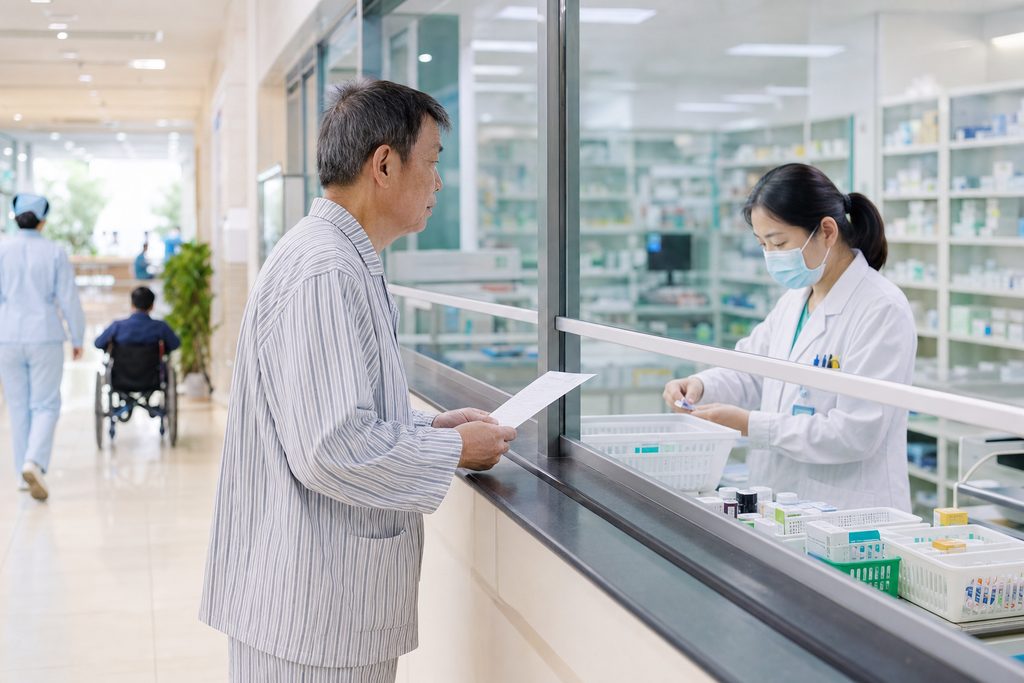
This is the part no guidebook explains. The question of how to get prescription filled as inpatient in Chinese hospital settings has a specific answer: you do not fill it yourself. A family member or companion does not run to a retail pharmacy. The ward nurse initiates everything. After the morning rounds, the attending physician adjusts your medication orders in the electronic system. The inpatient pharmacy receives the order within seconds. A pharmacist reviews it. If the drug is stocked—and in a large tertiary hospital, over 95% of formulary drugs are—it is dispensed within 30-60 minutes. A pharmacy technician delivers it to your ward. The nurse checks it, stores it in a locked medication cart, and administers it according to your schedule. You never touch the pill bottle. This can feel disempowering. But it eliminates the risk of double-dosing, missed doses, or drug interactions that happen when patients self-medicate during admission.
Can Foreign Patients Use Hospital Pharmacy in China? The Clear Answer
Yes. Absolutely. But the path is narrower than you might expect. The question can foreign patients use hospital pharmacy in China comes up in every initial consultation we hold. The pharmacy itself does not discriminate. Your passport status is irrelevant to the pharmacist reviewing the order. The barrier is upstream. You need a Chinese medical institution to admit you and generate a valid prescription order. Walk-in retail pharmacies outside the hospital will sell you many drugs over the counter. But inside the hospital, the pharmacy serves only patients under active treatment by that hospital’s licensed physicians. So the real question is not about pharmacy access. It is about hospital access. Once you are admitted, the pharmacy treats you like any other patient. The same formulary. The same prices. The same safety checks. Our role is getting you to that admission point with the right documentation and the right specialist.
What Is the Procedure for Getting Medicine in a Chinese Hospital Ward: A Timeline
Let us walk through a real admission. You arrive at a top-tier hospital in Beijing or Shanghai. The international patient center registers you. You see your attending physician. A treatment plan is agreed upon. You are moved to an inpatient ward. At this point, the medication procedure begins. The ward nurse collects your current medication list—including any drugs you brought from home. These are documented and physically secured. They will not be administered until the hospital pharmacy verifies them. This is not bureaucracy for its own sake. Counterfeit medications are a global problem. The hospital is legally required to ensure every drug given to you is authentic and safe. The nurse sends your home medication details to the pharmacy. A pharmacist cross-references them against the Chinese formulary. If equivalents exist, the pharmacy dispenses them. If a drug is not available in China, the attending physician must decide on a therapeutic alternative. This process can take 4-12 hours. It is the single most common source of anxiety for our patients. Knowing what is the procedure for getting medicine in a Chinese hospital ward means understanding this delay is normal. It is not a sign of neglect. It is a safety protocol.
Understanding the Chinese Hospital Pharmacy Price List for Inpatients
Patients often ask us for a Chinese hospital pharmacy price list for inpatients before they travel. We understand why. You want to budget. The honest answer is that no single published list exists for foreign patients. Public hospital drug prices are set by provincial tender results. They are posted on hospital notice boards in Chinese. They are not translated. They change quarterly. What we can tell you is the pricing logic. For drugs on the National Reimbursement Drug List, the hospital sells at the tender price plus a regulated markup—typically zero to 15%. For innovative drugs not on the list, the hospital may charge the manufacturer’s list price. Either way, the inpatient pharmacy cost China hospital patients pay is visible on the daily itemized statement. You can request this statement every 24 hours from the ward nurse station. Check it. Question any line you do not understand. Our team reviews these daily for our patients. We have caught billing errors—a duplicate charge for a single dose, a wrong room rate—and had them corrected before discharge. The system is transparent if you know how to read it.
The International Patient Medication Process China Hospital Staff Expect You to Follow
The international patient medication process China hospital staff follow is not a separate pathway. It is the same process with extra verification steps. Your foreign medication list must be translated into Chinese. Not by you. By a certified medical translator or the hospital’s international department. Drug names must include both brand and generic names in English, and the corresponding Chinese generic name. A 250mg tablet of metformin is 二甲双胍片. If your translator writes “diabetes pill,” the pharmacist will reject it. We have seen this happen. The patient waits. The dose is missed. This is why we prepare a bilingual medication reconciliation document for every patient before they board the plane. It includes the drug name in English and Chinese, the strength, the dosing schedule, and the diagnosis it treats. The hospital pharmacy accepts this. The verification time drops from hours to minutes. That is not a marketing claim. That is operational reality.
What You Need to Know Before Going Alone
The barriers are real. We list them not to frighten you, but because pretending they do not exist helps no one.
- Language on Labels: Every inpatient medication you receive will have a label printed in Mandarin Chinese. The drug name, the dose, the administration instructions—all in characters. If you cannot read it, you cannot verify it. This is a patient safety issue. You need someone at your bedside who can read the label and confirm it matches what your doctor ordered.
- Home Medication Restrictions: You cannot simply continue your home medication regimen while admitted. The hospital pharmacy must supply all drugs. If your specific brand is not available, you will receive the Chinese generic equivalent. The active ingredient is the same. The pill may look different. This causes distress. We prepare patients for this visually—showing them photos of the Chinese generic version before they travel.
- Discharge Medication Gap: You are discharged with a prescription. But the inpatient pharmacy does not fill discharge prescriptions. You must go to the hospital’s outpatient pharmacy, or a retail pharmacy, to get your take-home meds. The outpatient pharmacy may have different stock. The retail pharmacy may not accept a foreign credit card. These are solvable problems. But they catch people off guard at 4 PM on a Friday.
How We Help You Navigate This
We do not fill your prescription. We make sure the right prescription reaches the right pharmacy at the right time. Before you travel, we reconcile your medication list with the hospital’s formulary. We identify any drugs that have no Chinese equivalent and flag them for your attending physician. During your admission, we review your daily pharmacy charges and reconcile them against the doctor’s orders. We sit with you and explain what each line item means. At discharge, we escort you to the correct pharmacy, ensure your prescriptions are filled, and translate the administration instructions into English. We also verify that the discharge medication list matches what your home physician will need to continue your care. The international patient medication process China hospital systems require does not have to be a source of fear. It just needs a translator—in the literal and logistical sense.
Frequently Asked Questions
Most international travel insurance policies exclude pre-existing conditions and elective admissions. If your admission is planned, you need a specialized expatriate health plan or a medical tourism insurance product that offers direct billing with Chinese hospitals. We help patients verify coverage before travel. Do not assume your policy works. Call the insurer. Ask specifically about direct billing with a Chinese Tier 3 hospital. Get the answer in writing.
This is common for drugs approved only by the FDA or EMA but not yet by China’s National Medical Products Administration. The attending physician will propose a therapeutic alternative that is available. In rare cases, for life-sustaining medications with no alternative, the hospital may permit the use of a personally imported supply. This requires a special application, a certificate of authenticity, and a hospital ethics committee review. It is not guaranteed. We have navigated this successfully for oncology patients on targeted therapies. It takes time. Start the conversation weeks before your planned admission.
You can bring them. You cannot take them. All personal medications must be declared to the ward nurse upon admission. They will be stored securely and reviewed by the hospital pharmacy. If the pharmacy clears them—and if they are deemed medically necessary and unavailable in the hospital formulary—the nurse may administer them according to the physician’s orders. You will never self-administer. This is a non-negotiable safety rule in every accredited Chinese hospital.
You have the right to ask. Before the nurse administers any medication, you can request to see the barcoded package. Ask the nurse or your interpreter to read the drug name and dose aloud. Compare it to the treatment plan your doctor explained. If something does not match, say so. The nurse will stop and verify. Chinese hospital staff are trained in patient identification protocols. Your question is not a challenge to their competence. It is a standard safety check. Use it.
Your Next Step
Getting medication as an inpatient in a Chinese hospital is not like walking into a CVS. It is a closed, highly regulated, and remarkably safe system once you understand its logic. The prices are fair. The safety checks are rigorous. The language barrier is the true obstacle—not the quality of care. If you are considering treatment in China, understanding how the pharmacy works is not optional. It is central to your safety and peace of mind. For a deeper look at how hospital rankings can guide your choice of institution, see our searchable database of China’s top 100 hospitals. And if you need help navigating the medication process for a planned admission, tell us what you need — we will help you find the right option at no charge.
For more medical information and treatment options in China, visit tochinamed.com (ToChinaMed).