Returning to China for Revision Surgery: Coordinating Hardware Removal With Your Original Surgeon
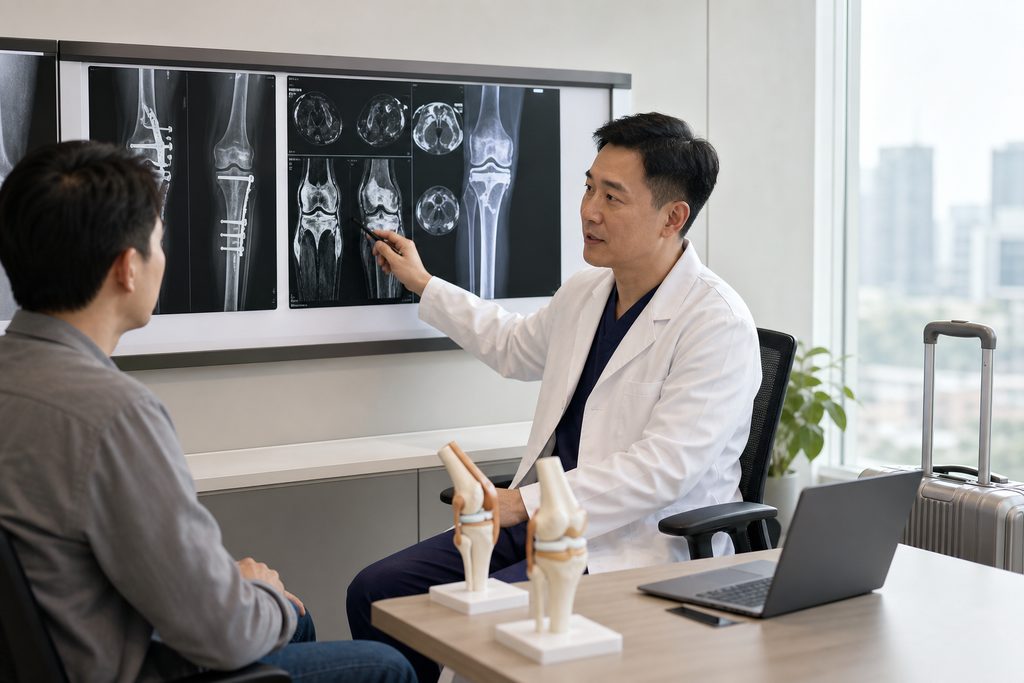
A patient in the United States faces a $18,000 facility fee for a simple outpatient hardware removal. Meanwhile, a major public hospital in Shanghai bills the entire procedure at a fraction of that cost—often under $3,000. The surgeon is the same specialist who implanted the device in the first place. That stark difference is why many international patients now look east for follow-up orthopedic care.
Key Takeaways
- Coordinating directly with your original surgeon in China can reduce your revision surgery cost China original surgeon by 50-70% compared to Western hospital fees, while ensuring clinical continuity.
- Chinese orthopedic centers handle revision volumes that dwarf Western hospitals; a surgeon at Beijing Jishuitan Hospital may perform over 400 hardware removals annually.
- Navigating the S2 visa category, medical record transfers, and hospital registration alone creates significant administrative friction that can delay care by weeks.
- Successful coordination hinges on confirming your original surgeon’s current availability and precisely translating your implant records before travel.
The Problem: A System That Penalizes Loyalty
You trusted a surgeon with a complex fracture fixation or a total joint replacement years ago. Now the hardware hurts. A plate is prominent. An intramedullary nail causes anterior knee pain. Your local orthopedist in London or Los Angeles recommends removal—but they want new imaging, a new consultation, and a fresh surgical plan. They don’t know the exact implant system used. They don’t have the specialized extraction tools. And they’ll charge you a premium for the uncertainty.
Approximately 15% of orthopedic trauma patients eventually require symptomatic hardware removal, according to a 2022 systematic review in the Journal of Orthopaedic Trauma. That’s a lot of people stuck with a metal problem and no clean path back to the surgeon who knows their anatomy best. The original surgeon holds the operative note, the implant batch number, and the three-dimensional memory of your bone quality. Discarding that continuity is medically wasteful. But most Western healthcare systems make reconnecting with an overseas surgeon nearly impossible. They are not built for transnational continuity of care.
Who We Are
We are not a hospital. We do not provide medical treatment or clinical diagnoses. We are your logistical architects—we bridge the gap between you and China’s top-tier medical expertise. Our team handles the administrative architecture that makes returning to your original surgeon feasible: verifying the surgeon’s current hospital affiliation, facilitating secure transfer of your archived records, and structuring your stay so you arrive prepared, not panicked. We work for you, not for any single institution.
Why Returning to Your Original Surgeon in China Delivers Results
Surgical Volume That Breeds Specific Expertise
A senior trauma surgeon at a high-volume Chinese orthopedic center may remove 10 to 15 implants per week. That’s over 500 procedures a year focused exclusively on extraction. A general orthopedist in a Western community hospital might do 20. The difference matters when a locking screw strips or bone has overgrown a plate. Volume doesn’t just build speed. It builds a mental library of intraoperative problem-solving. Your original surgeon has already operated on your specific anatomy once. That prior knowledge is a clinical asset no second-opinion surgeon can replicate, regardless of their credentials.
Implant-Specific Instrumentation Without the Guesswork
Every implant system—Synthes, Stryker, Smith & Nephew, domestic Chinese manufacturers like Double Medical or Weigao—requires a specific extraction set. If your local surgeon doesn’t have the exact screwdriver interface or broken screw removal kit, a 30-minute procedure turns into a two-hour ordeal. Your original surgeon’s hospital stocks the instrumentation for the implant they placed. No guesswork. No ordering a loaner tray at the last minute. The operating room team knows the setup. That operational familiarity is a hard efficiency that directly lowers your risk of complications like cold-welded screw retention or iatrogenic fracture.
The Revision Surgery Cost China Original Surgeon Equation
Let’s talk numbers. In the United States, a straightforward forearm plate removal can generate a bill exceeding $15,000 when you combine surgeon fees, anesthesia, and facility charges. A more complex femoral nail extraction often exceeds $25,000. The same procedure at a top-tier Chinese public hospital—performed by your original surgeon—typically ranges from $2,500 to $5,000 all-inclusive. That’s not a discount for lower quality. It’s a structural price difference driven by lower labor costs, high patient throughput, and a nonprofit hospital financing model that doesn’t prioritize facility fee markups. You are paying for technical skill and institutional efficiency, not a marble lobby.
What You Need to Know Before Going Alone
The clinical logic is sound. The financial case is compelling. But the administrative path is full of friction points that can derail your plans if you tackle them solo.
- Visa Category Confusion: There is no “medical visa” for China in the way some countries issue them. For short-term private medical treatment, the S2 visa is the applicable category—it covers private affairs including medical care. You’ll need an invitation letter from the hospital and documentation proving the medical necessity. Embassy requirements shift, and a generic invitation letter often gets rejected. We handle this documentation loop so your application is complete the first time.
- Surgeon Availability Black Hole: Your original surgeon may have moved hospitals. Chinese senior surgeons frequently rotate between affiliated institutions or accept directorships at new centers. A patient emailing a hospital’s generic international department address from five years ago will likely get no response. We verify the surgeon’s current appointment, confirm their operating schedule, and establish a direct clinical communication channel before you book a flight.
- Implant Record Fragmentation: Your medical record from 2018 might be archived in a hospital system that has since upgraded its electronic health record platform. The implant sticker with the lot number might exist only as a paper document in a basement storage room. We facilitate the retrieval and certified translation of these records. Without them, your surgeon cannot legally or safely proceed with extraction.
How We Help You Navigate This
These barriers are not malicious. They are the natural result of healthcare systems designed for domestic patients, not international returnees. Our process starts with a single, structured inquiry. You tell us your original surgeon’s name, the hospital where your initial surgery was performed, and the approximate date. We trace the surgeon. We confirm their current affiliation. We open a case with the hospital’s medical records department to locate your operative note and implant documentation.
Once we confirm the surgeon is willing and available, we structure the timeline. We coordinate the pre-admission testing schedule so you only need to be on the ground for the minimum necessary period—typically three days pre-op and two to three days post-op for a simple hardware removal. We arrange your hospital registration, deposit payment guidance, and discharge medication pickup. After you return home, we facilitate a single follow-up telehealth check with your surgeon to review the final pathology or post-operative x-ray. You are never navigating a Chinese hospital app or a payment kiosk in a language you don’t read alone.
Frequently Asked Questions
Yes, and this is the ideal scenario. Your original surgeon holds the operative record, implant specifications, and direct anatomical knowledge of your case. The key logistical step is confirming they still practice at an accessible hospital and have operating privileges there. We verify this before any travel commitment is made.
For a straightforward procedure like forearm or ankle plate removal, the total hospital bill typically falls between $2,500 and $5,000 USD. More complex cases—such as a deep intramedullary femoral nail or a pelvic implant—may range from $5,000 to $8,000. These figures include surgeon fees, anesthesia, operating room costs, and a short inpatient stay. They exclude travel and lodging.
This is common. Surgeons change phone numbers, hospital affiliations, and email addresses. We trace them through their current institutional appointment. We use the Chinese-language medical directory systems and hospital public records that are not indexed in English-language search engines. This tracing process usually takes our team three to five business days.
Clinical recommendations evolve. Your surgeon may review your current imaging and determine that the hardware can stay in place, or that a different approach is now standard. The consultation process we facilitate includes a current clinical assessment—not just a rubber stamp on an old plan. You retain full autonomy to accept or decline the updated recommendation. No one proceeds to an operating room without your explicit, informed consent.
Your Next Step
Returning to China for revision surgery isn’t nostalgia. It’s a rational clinical decision backed by continuity of care, implant-specific expertise, and a cost structure that respects your financial reality. The surgeon who built your reconstruction knows how to dismantle it safely. Our role is to make sure the administrative machinery doesn’t stand between you and that expertise. If you’re considering medical tourism revision surgery China packages or simply want to book hardware removal surgery China original surgeon, start with a single, no-obligation inquiry. We’ll tell you honestly whether reconnecting with your surgeon is feasible—and what it will take to get you back on the table, safely and affordably.
Looking for a specific doctor or treatment in China? Tell us what you need — we’ll help you find the right option at no charge.
For more medical information and treatment options in China, visit tochinamed.com (ToChinaMed).