Bed-to-Bed Transfer to China: A Complete Logistics Guide for International Patients
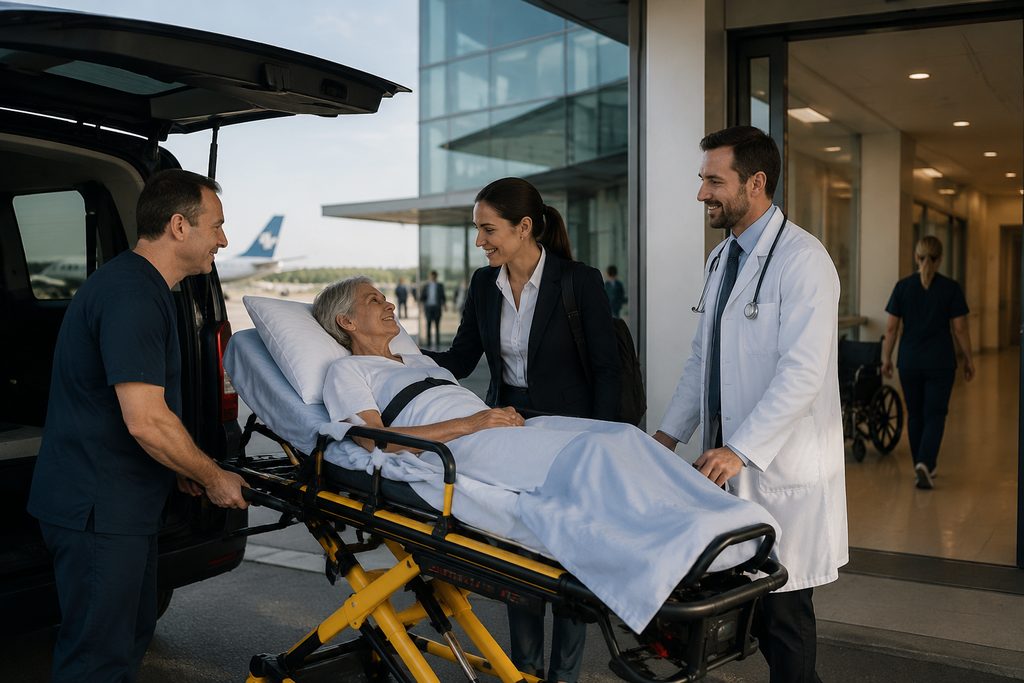
While patients in Canada wait a median 27.4 weeks between specialist referral and treatment, surgeons at Shanghai’s Fudan University-affiliated hospitals often schedule complex oncology procedures within 10 days of confirmed diagnosis. The Fraser Institute’s 2023 survey documents that wait against clinical pathways where diagnostic-to-treatment intervals are measured in days, not seasons. That gap drives the search query you typed. You want to know if a bed-to-bed transfer from your home to a Chinese hospital is viable, what it costs, and how the logistics actually work on the ground. Our team fields these questions daily. We built this guide to give you the unvarnished operational picture — no gloss, no sales pitch.
Bed-to-Bed Transfer to China: The Short Answer
A complete bed-to-bed international patient transfer to China — ambulance at origin, medical escort on a commercial flight or dedicated air ambulance, and ambulance handoff to a Chinese hospital ward — typically costs between $25,000 and $180,000 USD, depending on distance, patient acuity, and flight type. The process takes 72 hours to 10 days from initial medical review to physical admission in a Chinese hospital bed. Those are the numbers. The caveat is that medical transfer to China cost varies enormously based on whether you need a commercial stretcher with a nurse escort or a fully equipped ICU-configured air ambulance with a physician and perfusionist on board. No two cases are identical.
Who This Is Right For — and Who It Isn’t
We are direct about eligibility because a transfer that exceeds a patient’s physiological reserve helps no one. Here is the candid profile.
Typically a good candidate:
- Stable enough to tolerate 8–14 hours of cabin-altitude pressure, even with supplemental oxygen.
- Seeking a specific procedure unavailable or waitlisted at home — proton therapy for pediatric brain tumors, certain robotic pancreatic resections, or advanced limb-salvage orthopedics.
- Has a confirmed accepting physician and bed at the destination hospital before departure.
- Possesses a documented clinical summary translated into Mandarin, plus radiology images in DICOM format.
- Family or a professional case manager is available on the ground in China for the first 72 hours.
Typically not a good candidate:
- Requiring vasoactive infusion titration that cannot be paused during aircraft loading.
- Intracranial pressure unstable or monitored via external ventricular drain that is not clamped for transport.
- Active, uncontrolled sepsis with qSOFA score ≥2 at the time of planned departure.
- No confirmed accepting hospital — showing up at a Chinese emergency department via international ambulance is not a plan.
- Expecting a full-service concierge that replaces family decision-making. We coordinate logistics; medical decisions remain between you and the treating teams.
Being explicit about the second list is what makes the first list credible. We have declined transfer requests when the risk of deterioration at 35,000 feet exceeded any plausible benefit at the destination.
The Options, Compared
There is no single “bed-to-bed ambulance China” service. There are three distinct modalities, and patients frequently confuse them. The table below separates them by clinical capability, cost band, and realistic timeline.
| Modality | Clinical Capability | Typical Cost (USD) | Door-to-Door Timeline |
|---|---|---|---|
| Commercial Medical Escort (nurse or paramedic in business class, patient ambulatory or wheelchair) |
Oxygen, basic monitoring, oral/IV medications. No stretcher. No invasive lines. | $8,000–$25,000 | 5–10 days |
| Commercial Stretcher Service (block of economy seats removed, patient on secured stretcher with medical team) |
Portable ventilator, suction, multi-channel monitoring, limited infusion pumps. Cabin altitude still 6,000–8,000 ft equivalent. | $25,000–$65,000 | 7–14 days |
| Dedicated Air Ambulance (Learjet 35/45 or Gulfstream configured as flying ICU) |
Sea-level cabin pressure, full ICU capability including IABP, ECMO transport-trained perfusionist, blood gas analyzer on board. | $80,000–$180,000+ | 72 hours–7 days |
Most patients we assist use commercial stretcher services. Air ambulance is reserved for true ICU-to-ICU transfers where the patient cannot tolerate any cabin-altitude hypoxia. If you can sit upright for 20 minutes, you probably do not need a Learjet. But if your ejection fraction is under 20% and you are on two inotropes, you absolutely do. The right column is not a status symbol — it is a clinical decision.
How Does International Patient Transfer to China Work: The 6-Stage Operational Sequence
This is the section that answers the query “how does international patient transfer to China work” with the granularity you need if you are actually planning this. Every stage has a failure mode. We name them.
Stage 1: Clinical Pre-Authorization (Days 1–3)
The destination hospital reviews your records before agreeing to accept you. This is not a formality. Chinese tertiary hospitals — the ones you want for complex care — reject incomplete dossiers. You will need a translated discharge summary, recent labs (within 14 days), current medication list with dosages, and all relevant imaging in DICOM format on a CD or secure upload link. The accepting department chief typically reviews the case within 48 hours. If they accept, they issue a signed admission confirmation letter with a reserved bed. Without that letter, do not book a flight.
Stage 2: Visa Documentation (Days 2–5)
The S2 visa is the short-stay category used for private medical treatment in China. It is not called a medical visa in official Chinese immigration terminology — that is a common misstatement. The S2 requires an invitation letter from the hospital, proof of sufficient funds, and a passport valid for at least six months beyond your planned stay. Processing times vary by embassy: Bangkok and Singapore often issue within 2–3 business days; London, Ottawa, and Washington D.C. can take 5–10 business days. Expedited processing is available at some posts for an additional fee. We never guarantee approval — visas are sovereign decisions — but a complete package with the hospital invitation letter has a high approval rate.
Stage 3: Medical Evacuation to China for Surgery — Transport Planning (Days 3–7)
“Medical evacuation to China for surgery” is the phrase families use when they call us. The operational reality is a detailed transport plan. The flight physician reviews your current vitals, medication schedule, and oxygen requirement at cabin altitude. If you need a stretcher, the commercial airline requires 72–96 hours’ notice to remove seats and install the stretcher unit. Ground ambulances are booked at both ends — these are not regular patient transport vans. They are ICU-equipped units with a physician or critical care paramedic on board. The handoff protocol at the Chinese airport matters: the receiving hospital’s ambulance team meets the aircraft on the tarmac in most major Chinese cities (Beijing Capital, Shanghai Pudong, Guangzhou Baiyun). That requires airport security clearance arranged 48 hours in advance.
Stage 4: The Flight Itself (8–16 Hours)
The medical team manages vitals, administers scheduled medications, and documents everything in a transfer log. Cabin altitude on commercial flights is typically equivalent to 6,000–8,000 feet, which reduces arterial oxygen saturation by 3–5% in patients with normal lungs — more in those with pulmonary compromise. The transport physician adjusts FiO₂ accordingly. For patients on commercial stretchers, the team has access to portable suction, a transport ventilator, and battery-powered infusion pumps. The log is handed to the receiving Chinese ICU team. There is no “gap” in monitoring.
Stage 5: Tarmac-to-Bed Handoff (1–3 Hours Post-Landing)
This is where “bed to bed ambulance China” becomes literal. The receiving hospital’s ambulance meets the aircraft on the tarmac. The transport team briefs the receiving team. The patient is transferred to the Chinese ambulance stretcher. Vital signs are rechecked. The ambulance drives directly to the hospital — typically 30–60 minutes in major cities, longer if traffic is severe. The patient is wheeled directly to the reserved bed. Nursing handoff includes medication reconciliation, pressure sore assessment, and a full systems review. The transport team does not leave until the receiving nurse signs the transfer-of-care document.
Stage 6: Admission and Treatment Commencement (Day of Arrival)
The admitting team repeats labs, imaging, and clinical assessment according to their protocols — even if you bring recent results. This is standard practice in Chinese tertiary hospitals and should not be interpreted as distrust. Treatment begins within 24–48 hours of admission in most cases. For surgical patients, the pre-operative workup is often compressed into 48 hours if the case was pre-reviewed and the OR slot was reserved.
China Hospital Bed Transfer Logistics: What the Paperwork Actually Requires
We have seen transfers delayed by five days because of a missing document. Here is the non-negotiable checklist for China hospital bed transfer logistics:
- Passport: Valid for at least six months beyond planned discharge date. Photocopy of the bio page sent to the hospital 72 hours before arrival.
- Hospital Admission Confirmation Letter: Signed and stamped by the admitting department. This is the single most important document. Without it, you are a tourist, not a patient.
- Translated Medical Summary: Professional translation into Mandarin. Google Translate is not acceptable for clinical documents. The summary must include diagnosis, treatment history, current medications with generic names, allergies, and the specific reason for seeking care in China.
- DICOM Imaging Files: On CD or uploaded to a secure cloud folder. Radiology departments in China will re-read the scans themselves — they need the raw DICOM files, not JPEG screenshots.
- Payment Guarantee: Most Chinese hospitals require a deposit before admission for international patients. The amount varies by procedure — $10,000 to $50,000 USD is typical. Wire transfer confirmation or a credit card pre-authorization is required. Some hospitals accept international health insurance with direct billing arrangements; most do not. Check before you travel.
- Emergency Contact in China: A local phone number — family member, friend, or case manager — who can be reached 24/7 for the first week.
We have a single-sentence rule for families: if you cannot produce every document on this list within two hours of request, you are not ready to travel.
Medical Transfer to China Cost: A Line-by-Line Breakdown
The medical transfer to China cost question is the one everyone asks first and the one with the least standardized answer. Here is what you are actually paying for, with ranges based on cases we have coordinated in the past 18 months.
| Cost Line Item | Range (USD) | What Drives Variance |
|---|---|---|
| Clinical pre-review and case coordination | $1,500–$4,000 | Complexity of case, number of specialties involved |
| Visa support and documentation | $200–$800 | Embassy fees, expedited processing, courier charges |
| Ground ambulance (origin city) | $800–$3,000 | Distance, ICU vs. basic life support, wait time |
| Commercial stretcher service (intercontinental) | $15,000–$45,000 | Route, airline fees for seat removal, medical team size |
| Air ambulance (dedicated jet) | $70,000–$160,000 | Aircraft type, distance, medical team composition, fuel stops |
| Ground ambulance (China destination) | $500–$2,000 | Airport tarmac access fees, distance to hospital, traffic |
| Hospital admission deposit | $10,000–$50,000 | Procedure type, estimated length of stay, hospital tier |
| Medical translation and interpretation | $500–$2,500 | Volume of records, ongoing interpretation needs during admission |
These figures do not include the actual treatment cost in China — just the transfer. Treatment costs vary widely: a robotic-assisted radical prostatectomy at a top-tier public hospital may run $18,000–$25,000 USD all-inclusive, while a complex cardiac procedure with a prolonged ICU stay can exceed $60,000. These are still fractions of U.S. cash-pay prices. But they are real numbers you need to budget for. We advise families to have 20–30% contingency above the quoted transfer and treatment estimates. Transfers rarely go exactly to plan, and the contingency is what keeps a stressful situation from becoming a crisis.
Practical Considerations: Language, Follow-Up, and the Return Journey
Most patients focus entirely on getting to China. The return journey matters just as much. If you are discharged after a major surgery, you may not be fit to fly commercial in a standard seat. You may need a medical escort on the return flight, or — in some cases — a stretcher service home. Budget for this. It is not included in the inbound transfer quote unless explicitly stated.
Language is the other practical reality. In top-tier Chinese hospitals, the attending physicians often speak functional medical English. Nursing staff, administrative clerks, and cafeteria workers generally do not. You will need an interpreter for the first few days — not a translation app, but a human being who can clarify medication instructions, explain meal options, and help you understand what the ward nurse is asking at 2 a.m. Some hospitals have international patient departments with English-speaking coordinators. Most public hospitals — even the famous ones — do not. We connect families with vetted medical interpreters in the destination city. It is a line item worth planning for.
Insurance is another variable. A small number of international health insurance plans have direct billing arrangements with specific private hospitals in China — mostly the Joint Commission International-accredited facilities in Shanghai and Beijing. The majority of plans operate on a reimbursement model: you pay the hospital upfront and submit claims afterward. Confirm this with your insurer before you travel. A surprise $30,000 deposit demand at the admissions desk is not the time to discover your policy excludes overseas inpatient care.
For patients considering specific treatment categories, our platform maintains independent resources. If you are exploring oncology options, our article on pancreatic cancer treatment protocols in China provides context on regimen availability. For those evaluating hospital quality, our hospital rankings database draws on the Fudan University annual assessment — the most authoritative public evaluation of Chinese tertiary hospitals. We do not recommend specific hospitals; we give you the data to make your own informed choice.
Frequently Asked Questions
You can, but the friction is substantial. Airlines require a fit-to-fly certificate signed by a physician within 72 hours of departure. Stretcher installations must be coordinated with the airline’s medical desk — a department that does not take calls from patients directly in most cases. The Chinese hospital admission letter requires a relationship with the admitting department; cold emails to hospital general addresses rarely get a response within two weeks. A medical escort company does not perform magic. It executes a known sequence of calls, documents, and clearances that would take an individual weeks to navigate for the first time. Whether that time and uncertainty is worth the coordination fee is a personal calculation.
The transport physician is trained in critical care and carries a full resuscitation kit, including advanced airway equipment, defibrillator, and emergency medications. If the patient destabilizes, the team stabilizes in the air. The aircraft diverts to the nearest suitable airport only if stabilization is impossible — a rare event because transport physicians are selected specifically for their ability to manage in-flight deterioration. The receiving hospital is notified of any changes while the aircraft is still airborne. This is not a commercial flight with a first-aid kit. It is a mobile ICU with a physician whose sole job is to keep you alive between two hospitals.
Are there hidden costs in medical transfer to China that families routinely miss?
Yes. Three in particular. First, the return transfer — many families budget only for the inbound
For more medical information and treatment options in China, visit tochinamed.com (ToChinaMed).