Physical Therapy After Joint Surgery in China: A Recovery Guide
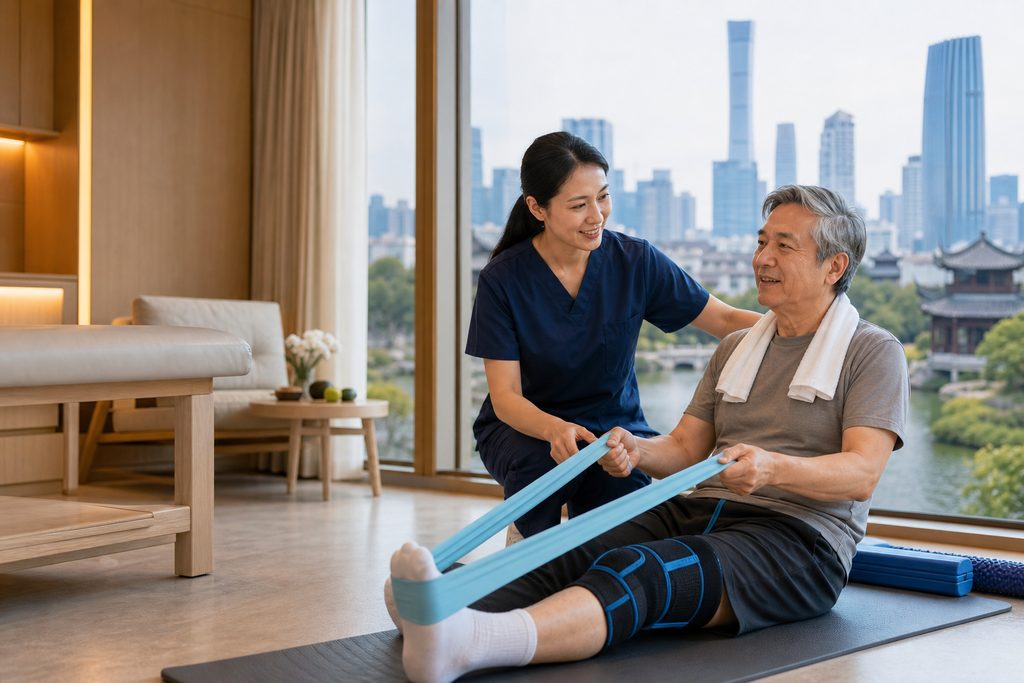
While patients in Canada wait a median 28.6 weeks for orthopedic surgery, surgeons at Beijing Jishuitan Hospital routinely perform over 300 joint replacements per month — with clinical outcomes that match or exceed Western benchmarks. That contrast carries straight into rehabilitation. Physical therapy after knee replacement cost China runs roughly a third to half of what the same protocol costs in the United States, yet the question international patients ask first is rarely about money. It is about whether the rehab will actually work.
Our team has spent years documenting how joint surgery rehabilitation actually functions across Chinese hospitals — public and private, Tier 1 and international. This guide covers what happens after the operating room, what you should budget, where the best programs sit, and what can go wrong. No sugarcoating. Just the sequence, the numbers, and the decisions that matter.
How This Actually Works, Step by Step
You land in Shanghai or Beijing for surgery, or you arrive already recovering from a procedure done elsewhere. Either way, the rehabilitation pathway in China follows a predictable sequence. Here is what actually happens.
First, you submit your surgical records, imaging, and current functional status. A rehabilitation physician — not a general practitioner — reviews them. In most Chinese tertiary hospitals, physiatry is a separate department with its own intake process. You may need document translation. Budget two to four days for that if your records are not already in Chinese or English.
Second, you attend an in-person assessment. This includes range-of-motion measurement, gait analysis, strength testing, and a review of your surgical notes. The assessment typically takes 60 to 90 minutes. The physiatrist then writes a rehabilitation prescription: frequency, duration, modalities, and goals.
Third, therapy begins. Inpatient programs run daily. Outpatient programs run three to five times per week. A typical knee replacement protocol in a Chinese rehabilitation department includes manual therapy, continuous passive motion early on, progressive resistance training, balance work, and gait retraining. Hip protocols add abductor strengthening and posterior hip precautions depending on surgical approach.
Fourth, you get reassessed every two weeks. The plan adjusts based on measured progress — not subjective feeling. Discharge happens when you hit functional milestones: independent transfers, safe stair negotiation, a target walking distance, and a home exercise program you can actually perform.
Physical Therapy After Knee Replacement Cost China: What the Numbers Actually Show
The price question deserves a straight answer. Physical therapy after knee replacement cost China varies by hospital tier, city, and whether you choose inpatient or outpatient rehabilitation. Public tertiary hospitals in Shanghai charge approximately 150 to 400 RMB per outpatient physiotherapy session — roughly 20 to 55 USD. Private international hospitals charge 800 to 2,500 RMB per session, or 110 to 350 USD. A full two-week inpatient rehabilitation stay at a public hospital, including therapy, nursing, and a shared room, often lands between 15,000 and 40,000 RMB — about 2,100 to 5,600 USD.
Compare that to the United States, where a single outpatient physical therapy session averages 100 to 150 USD without insurance, and a two-week inpatient rehab stay can exceed 30,000 USD. The gap is real. But cost is not the whole story.
What matters more is session density. Chinese rehabilitation departments tend to prescribe more frequent sessions over a shorter total duration. A patient might receive two sessions per day during an inpatient stay — something rare in Western outpatient models. That intensity can accelerate early recovery, though it does not suit every patient. Older patients or those with significant comorbidities may do better with lower frequency and longer duration.
Is Physical Therapy After Hip Surgery Safe in China?
We hear this question constantly. The honest answer: yes, with conditions. Safety depends on where you go, who supervises your therapy, and how well your surgical team communicates with your rehab team.
China’s top rehabilitation departments — those attached to hospitals like Huashan Hospital in Shanghai, China Rehabilitation Research Center in Beijing, and West China Hospital in Chengdu — operate with structured protocols, licensed physiotherapists, and regular physician oversight. The Chinese Association of Rehabilitation Medicine sets national standards, and many large departments now train therapists in evidence-based Western protocols alongside traditional approaches.
But not every facility is equal. Smaller private clinics may employ staff with limited formal training. Some use a heavier mix of traditional Chinese medicine modalities — acupuncture, tuina, cupping — which can help with pain and swelling but should not replace progressive exercise. Ask directly: who holds the therapy license, what is the therapist-to-patient ratio, and does the physiatrist review your chart weekly.
Also, communication gaps are a real safety risk. If your surgical notes are in English and the rehab team reads only Chinese, details can slip. Use a hospital with documented English-language coordination, or bring a translator familiar with medical terminology. Our team has seen too many avoidable setbacks from a single misunderstood precaution.
A Realistic Timeline
Recovery from joint replacement follows a biological timeline that no amount of intensity can shortcut. Here is what a realistic rehabilitation pathway in China looks like for an international patient.
| Stage | Timeframe | What Happens | What People Forget |
|---|---|---|---|
| Pre-arrival preparation | 2–4 weeks before travel | Collect surgical records, imaging CDs, current medication list; request English or Chinese translations | Translation takes longer than expected; imaging format may not open on Chinese hospital systems — convert to DICOM or bring a laptop |
| Arrival and assessment | Day 1–3 | Physiatry intake, functional baseline testing, rehab prescription written | Jet lag and travel fatigue affect baseline measurements; rest one day before assessment if possible |
| Early rehabilitation | Week 1–2 | Daily therapy; pain control; edema management; early range-of-motion work; gait training with assistive device | Swelling peaks around day 3–5 post-op; pushing through sharp pain is counterproductive |
| Progressive strengthening | Week 3–6 | Resistance training added; balance work; stair training; transition from walker to cane | Muscle atrophy from pre-op inactivity slows this phase; expect plateaus, not linear progress |
| Advanced functional training | Week 6–12 | Higher-intensity strengthening; walking distance increases; return to light daily activities | Overconfidence is the biggest risk here; joint feels better than it is structurally ready for |
| Return home and maintenance | Month 3–6 | Home exercise program; telehealth check-ins if arranged; gradual return to full activity | Most patients stop doing home exercises around month 4; that is when stiffness creeps back |
How long is physical therapy after joint replacement in China? The structured, supervised phase typically runs 6 to 12 weeks. Full functional recovery — walking without aids, negotiating stairs confidently, returning to recreational activity — takes 3 to 6 months for most patients. Some continue periodic therapy sessions for up to a year.
What Can Go Wrong — and What Happens Then
Rehabilitation is not a straight line. Here are the failure modes we see most often, and what actually happens when they occur.
Stiffness. The most common complication after knee replacement is arthrofibrosis — excessive scar tissue limiting motion. If range of motion stalls despite therapy, the physiatrist may recommend a manipulation under anesthesia, usually performed by the surgical team. This is not a sign of failed rehab; it happens in roughly 4 to 7 percent of knee replacements globally. Chinese hospitals handle it routinely.
Infection. Any joint surgery carries a small infection risk. If a rehab team notices persistent swelling, warmth, or fever, therapy pauses and the patient returns to the surgical team for evaluation. Do not ignore these signs to keep a therapy schedule. The schedule can wait.
Falls. Balance deficits after hip surgery are common. A fall during rehab can damage the prosthesis or cause a fracture. Good departments use parallel bars, gait belts, and one-on-one supervision during early sessions. If a fall happens, imaging is ordered immediately, and therapy is modified while results come back.
Dislocation after hip replacement. Depending on surgical approach, posterior hip precautions may apply for 6 to 12 weeks. A therapist who is not aware of your surgical approach may push you into a dangerous range of motion. This is exactly why communication between surgeon and therapist matters so much.
Therapy mismatch. Sometimes the program simply does not fit. Maybe the intensity is too high, or the therapist relies on passive modalities when you need active exercise. In China, you can request a reassessment or a change of therapist within the same department. You are not locked into one provider. But you do need to speak up — cultural norms in Chinese medical settings sometimes discourage patients from questioning the plan. Do it anyway. Politely, but do it.
Best Rehab Hospital for Joint Surgery Shanghai: How to Evaluate Your Options
The phrase “best rehab hospital for joint surgery Shanghai” gets typed into search engines thousands of times per month. The truth: there is no single best. There are better and worse matches for your specific situation.
Shanghai has three categories of rehabilitation providers. Public tertiary hospitals — Huashan Hospital, Shanghai Ninth People’s Hospital, and Ruijin Hospital — run the most experienced rehabilitation departments. They handle high volumes, which means their therapists have seen nearly every complication. They also cost the least. But English support varies, and outpatient departments can feel crowded and fast-paced.
Private international hospitals — Jiahui International Hospital, Shanghai United Family Hospital, and ParkwayHealth — offer English-speaking staff, longer session times, and more personalized attention. They cost significantly more. For patients who value communication ease and a calmer environment, the premium may be worth it. For patients on a budget, public hospitals deliver excellent clinical quality with more friction.
Specialized rehabilitation hospitals — like Shanghai Yangzhi Rehabilitation Hospital — focus exclusively on rehab. They often have more advanced equipment and dedicated inpatient floors. But they may have less direct integration with your surgical team if you had surgery elsewhere.
When evaluating any option, ask these questions: How many joint replacement patients does the department treat per year? Who supervises the therapy — a physiatrist or only therapists? What is the therapist-to-patient ratio during sessions? Can the team read and respond to English-language surgical notes? What is the protocol for communicating setbacks to the surgeon? The answers tell you more than any ranking list.
Medical Tourism Rehabilitation China Joint Surgery: What International Patients Actually Experience
Generally yes, with appropriate screening. Chinese rehabilitation departments treat large numbers of older patients — often in their 70s and 80s — and are experienced with age-related complications like frailty, osteoporosis, and cardiovascular comorbidity. A thorough pre-admission assessment is essential. If you have significant medical complexity, choose a hospital with on-site internal medicine coverage rather than a standalone rehab clinic.
The minimum meaningful supervised program is about two to three weeks. That gets you through the early mobility phase and establishes a home exercise foundation. But leaving before six weeks means you will miss the progressive strengthening phase, which is where long-term function is built. A reasonable compromise for many international patients is a two-week inpatient stay, followed by four to six weeks of outpatient therapy, then a structured home program.
This is common. Chinese rehabilitation departments accept post-surgical patients regardless of where the surgery was performed. You will need complete surgical records and a clearance letter from your surgeon confirming you are fit to travel and participate in rehabilitation. The assessment process is the same. One caution: if complications arise, the rehab team will refer you to a local orthopedic surgeon, not your original one — so choose a hospital with strong orthopedic backup.
It depends entirely on your policy. Most standard international health insurance plans exclude treatment in China unless you have a global plan or a medical tourism rider. Chinese domestic insurance does not apply to foreign patients. Self-pay is the norm. Before committing, request a written cost estimate from the hospital and submit it to your insurer for a coverage determination. Do not rely on verbal assurances from anyone.
Your Next Step
Rehabilitation after joint surgery in China can be excellent, affordable, and well-structured — if you choose the right setting and go in with clear expectations. The key is matching your clinical needs, budget, and communication requirements to the right hospital tier. That is exactly the kind of decision we help international patients make.
ToChinaMed is an independent information platform. We do not charge patients, we do not take referral fees, and we are not affiliated with any hospital. We document what is available, compare options objectively, and help you understand the landscape — including China’s top-ranked rehabilitation hospitals and private international hospitals with strong English-language support. If you want help finding the right rehab option, tell us what you need — we will help you find the right option at no charge.
Recovery is a long road. The right rehabilitation program makes it shorter, safer, and more complete. You now know what to look for, what to ask, and what to budget. The rest is up to you.
Frequently Asked Questions
Yes. The hospitals used for international patients are JCI-accredited and follow the same international safety standards as top hospitals in the US and Europe. Surgical teams perform high volumes of procedures — often more than their Western counterparts — which studies show leads to better outcomes.
Costs vary by procedure and hospital, but international patients typically save 40-80% compared to US prices — even when factoring in travel and accommodation. A consultation with our team will give you an exact, all-inclusive quote with no hidden fees.
Send us your existing medical reports to get started. We handle everything from hospital selection and appointment scheduling to visa assistance and post-operative recovery planning. Your medical records are reviewed by the specialist before you even book a flight.
For more medical information and treatment options in China, visit tochinamed.com (ToChinaMed).