Liver Cancer Screening in China: AFP, Ultrasound, and FibroScan for High-Risk Patients
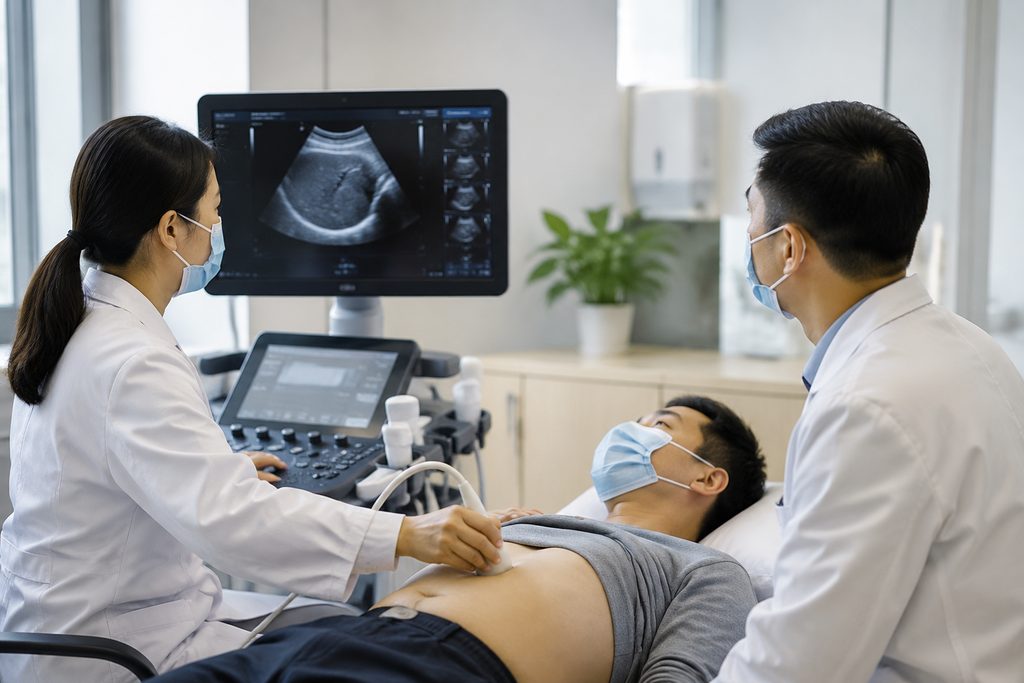
When 52-year-old David, a chronic hepatitis B carrier from Manchester, started researching where to get his next abdominal scan, he hit a wall. His NHS trust offered surveillance every 12 months. His hepatologist wanted six. The private quote back home made him wince — over £800 for a single triphasic CT, and that was before the blood work. David’s case is not rare. For the roughly 350 million people worldwide living with chronic hepatitis B or C, the shadow of hepatocellular carcinoma (HCC) is a constant companion. And for many, the gap between the recommended screening interval and what is actually affordable or available at home feels like a chasm. That gap is what we help bridge.
Key Takeaways
- China’s high-volume liver centers perform more HCC surveillance ultrasounds in a month than many Western hospitals do in a year, driving both clinical accuracy and cost efficiency.
- The total out-of-pocket liver cancer screening cost China for a comprehensive package — AFP, ultrasound, and FibroScan — typically ranges from $150 to $350 USD, a fraction of equivalent private-pay rates in the US or UK.
- Language barriers and fragmented hospital booking systems make independent navigation genuinely difficult; a local coordinator is not a luxury — it is a practical necessity for accurate results.
- FibroScan is not a cancer detector. It measures liver stiffness to stage fibrosis, which powerfully stratifies your future cancer risk — a critical piece of the picture that standard ultrasound alone misses.
The Problem: Surveillance Gaps Leave High-Risk Patients Unprotected
Hepatocellular carcinoma is a silent disease. By the time it causes pain, jaundice, or weight loss, the window for curative treatment has often closed. The math is unforgiving. When HCC is caught at an early stage — a single tumor under 5 cm, or up to three nodules each under 3 cm — five-year survival after resection or ablation exceeds 70%. When diagnosed at a symptomatic, advanced stage, median survival drops below one year. The entire purpose of screening is to find those early, treatable tumors. And yet, globally, fewer than 30% of at-risk patients receive consistent, guideline-adherent surveillance.
Why? Cost is one brutal factor. In systems without universal coverage for screening, a self-paying patient might face a $1,200 bill for an MRI and labs. That is not sustainable twice a year. Access is another. In regions with severe radiologist shortages, the wait for an elective ultrasound can stretch beyond three months. A three-month delay in a fast-growing tumor can change the staging. And then there is the quality variable. A screening ultrasound is only as good as the operator holding the probe and the eyes reading the images. Inexperienced sonographers miss subtle nodules. Overworked radiologists overlook early arterial enhancement patterns. The result is a false sense of security — a “normal” report that is anything but.
For patients like David, the question becomes urgent: where can I get a high-quality, affordable, and rapid screening loop that actually protects me? The answer increasingly lies outside their home country.
Who We Are
We are a medical information and navigation platform. We do not treat patients. We do not provide clinical diagnoses, and we are not a hospital. Our team acts as your logistical bridge to China’s most rigorously evaluated liver centers — the hospitals that appear at the top of the independent Fudan University Hospital Rankings for hepatology and oncology. We handle the friction: identifying the right department, translating your prior imaging and lab reports into clinical Chinese, securing appointments without unnecessary delays, and ensuring you understand every line item on your bill before you pay it. We are paid by the information we provide, not by commissions from hospitals. That distinction matters.
Why China Delivers a Fundamentally Different Screening Experience
Volume Breeds Pattern Recognition
China carries one of the heaviest liver disease burdens on the planet. An estimated 87 million people live with chronic hepatitis B virus infection here. The downstream consequence is that a single university-affiliated hepatology center may manage over 15,000 at-risk patients in active surveillance programs. The sonographers in these departments perform liver ultrasounds all day, every day. They have seen thousands of hemangiomas, dysplastic nodules, and subtle infiltrative lesions. The radiologists who double-read the scans are sub-specialized — they look at livers, and only livers, for years.
This is not a theoretical advantage. A 2022 meta-analysis published in The Lancet Gastroenterology & Hepatology confirmed that operator experience is the single strongest modifiable predictor of ultrasound sensitivity for early HCC. When the operator’s annual volume exceeds 500 liver-specific exams, sensitivity for detecting lesions under 2 cm jumps significantly. In many Western general radiology departments, a sonographer might perform 500 exams total — covering abdomens, thyroids, and vascular studies — in a year. The concentration of pathology here creates a concentration of expertise that is genuinely hard to replicate elsewhere. This is how liver cancer is detected early in China: not through a single magic technology, but through thousands of eyes that have learned to spot trouble before it announces itself.
The AFP Ultrasound FibroScan Price Shanghai and Beyond: A Cost Structure That Makes Surveillance Sustainable
Let us talk about numbers, because numbers determine whether a patient screens once or screens for life. In Shanghai, a combined screening package at a top-tier public hospital — serum alpha-fetoprotein (AFP), high-resolution abdominal ultrasound with contrast-ready capability, and transient elastography (FibroScan) — typically costs between 1,200 and 2,400 RMB. At current exchange rates, that is approximately $165 to $330 USD. Private international hospitals in Shanghai, which offer English-language reports and direct insurance billing, price the same trio closer to $400 to $600 USD.
Compare this to US cash-pay rates. An abdominal ultrasound alone averages $400 to $700. A FibroScan, often billed separately by a hepatology clinic, adds another $300 to $500. AFP is cheap — maybe $50 — but the total lands around $750 to $1,250. The differential is not subtle. And it is not explained by inferior equipment. The ultrasound machines in a Shanghai public hospital’s liver center are typically current-generation units from Siemens, Philips, or Mindray, with shear wave elastography modules built in. The cost difference is structural: lower labor costs for sonographers and radiologists, higher patient throughput, and a hospital financing model that does not depend on maximizing reimbursement codes for every single procedure.
Can high-risk patients get liver screening abroad without bankrupting themselves? The math says yes — if they choose the destination carefully. The best liver cancer checkup packages China offers combine these three modalities into a single morning visit, with results reviewed by a hepatologist before you leave the building. That integrated workflow is what turns screening from a fragmented, anxiety-inducing ordeal into a streamlined process.
FibroScan Is Not a Cancer Test — And That Is Exactly Why It Matters
There is a persistent misunderstanding we encounter frequently. Patients ask for a FibroScan because they think it detects liver cancer. It does not. Transient elastography measures liver stiffness in kilopascals (kPa), which correlates with the degree of fibrosis or cirrhosis. What this gives you is your personal risk trajectory. A patient with a liver stiffness measurement of 8 kPa has minimal fibrosis and a relatively low annual HCC risk — perhaps 0.2% to 0.5%. A patient at 25 kPa has established cirrhosis and an annual HCC risk that can exceed 3% to 5%.
This number dictates everything. It tells you whether you need ultrasound every 12 months or every 6 months. It tells you whether a CT or MRI should supplement ultrasound. It tells you how aggressively to investigate any borderline finding. Without a FibroScan, you are guessing at your risk. With it, you can calibrate your surveillance intensity. Many Western screening programs omit FibroScan for cost reasons, relying on ultrasound morphology and platelet counts as rough surrogates for cirrhosis. That approach is better than nothing. But it is not precise. And in cancer screening, precision is protection.
What You Need to Know Before Attempting This Alone
We are direct about this because patients deserve honesty: walking into a major Chinese hospital as a non-Mandarin-speaking foreigner and expecting a seamless screening experience is a recipe for frustration. The medicine is excellent. The administrative layer is not built for you.
- Appointment Systems Are Fragmented: Most public hospitals do not have a unified, English-language online booking portal. The liver surgery department may use one mini-program on WeChat. The ultrasound department uses another. The lab for AFP uses a separate queue. Booking these three components to occur on the same morning, in the correct order (fasting blood draw first, then ultrasound, then FibroScan), requires local knowledge of each hospital’s workflow. Get the order wrong, and you might be told to come back tomorrow — after fasting again.
- Payment Infrastructure Is Local: International credit cards are not reliably accepted at public hospital cashier windows. Payment is predominantly via WeChat Pay or Alipay, which require a Chinese bank account to fully activate for large transactions. Some hospitals accept UnionPay international cards, but not all. Expecting to swipe a Visa and walk through is a gamble you do not want to lose.
- Reports Come in Chinese: Your ultrasound report will be written in Chinese medical shorthand. Your FibroScan printout will have Chinese labels. Google Translate struggles with terms like “echoic nodularity” or “controlled attenuation parameter.” Your home hepatologist needs a clinically accurate translation, not a machine-translated approximation. Errors in translation here are not minor — they can lead to a nodule being dismissed or over-investigated.
How We Help You Navigate This
These barriers are not insurmountable. They are structural features of a system optimized for domestic patients, not international ones. Our role is to act as the interface.
Before you travel, we review your medical history — prior imaging, lab trends, antiviral regimen, family history — and identify the specific screening protocol that matches your risk profile. We then match you with a liver center that has demonstrated expertise in your particular situation, whether that is post-hepatitis B cirrhosis, non-alcoholic steatohepatitis (NASH)-related fibrosis, or post-sustained virologic response monitoring after hepatitis C treatment. We confirm the appointment sequence, provide a translated summary for the receiving physician, and give you a clear, written breakdown of the expected costs.
On the day of screening, a bilingual coordinator accompanies you. Not as a tour guide — as a clinical navigator. They ensure the blood draw happens first, the ultrasound second, and the FibroScan third. They clarify any incidental findings with the sonographer in real time. When the hepatologist reviews your results, the coordinator translates the clinical discussion accurately, capturing nuance that matters — “we see a 6 mm hypoechoic area, likely a cyst, but recommend a follow-up in 3 months to confirm stability” is a very different message from “there is a spot, come back later.”
After you return home, you receive a fully translated, formatted report package suitable for your local physician. We do not interpret results — that is your doctor’s job. We ensure nothing is lost in transit. If a follow-up is recommended, we help you book to book liver cancer screening test China fast without starting the administrative maze from scratch. The goal is continuity, not a one-off transaction.
Frequently Asked Questions
A comprehensive screening morning typically includes three components: a fasting blood draw for AFP (and often AFP-L3% and DCP — des-gamma-carboxy prothrombin — for enhanced sensitivity), a high-resolution abdominal ultrasound with specific attention to the liver parenchyma and portal vasculature, and a FibroScan for liver stiffness measurement. The entire process, from registration to receiving a verbal summary from the hepatologist, usually takes 3 to 4 hours. Written reports and translated documents follow within 24 to 48 hours.
We direct patients toward centers that are independently ranked in the Fudan University Hospital Rankings for hepatology and that participate in international clinical trial networks — a proxy for adherence to global protocols. The ultrasound and elastography equipment is typically listed on the hospital’s department webpage, and we verify this before booking. You are not being sent to a strip-mall clinic. These are university-teaching-hospital departments where the machine you are scanned on is the same model used in their research cohorts.
This is the hardest question, and the most important one. If a suspicious nodule is identified, the hepatologist will typically recommend an immediate contrast-enhanced imaging study — either contrast-enhanced ultrasound (CEUS), which can often be performed the same day, or a multiphasic CT or MRI. These can be arranged urgently. If a diagnosis of early HCC is confirmed, you are already in a center that likely performs high-volume liver resections and ablations. We can help you understand your options and connect you with surgical and interventional radiology teams. However, we always advise patients to discuss findings with their home physician as well — major treatment decisions should never be made in a vacuum, no matter how competent the local team.
FibroScan has known limitations. In patients with significant central obesity (BMI over 30-32), the standard M probe may fail to obtain reliable measurements because the subcutaneous fat layer attenuates the shear wave. In these cases, the XL probe is required, and not all clinics have it. Ascites — free fluid in the abdomen — also invalidates FibroScan readings, as the shear wave cannot propagate through liquid. A good screening center will assess these factors before attempting the scan and will not charge you for a failed measurement. We confirm probe availability and operator experience with challenging body habitus before booking.
Your Next Step
Liver cancer screening works when it is consistent, high-quality, and affordable enough to sustain over years. For high-risk patients facing long waits or prohibitive costs at home, China’s concentrated expertise and rational pricing offer a practical alternative — one that does not require compromising on the technology or the clinical eyes interpreting your results. The logistics are real, but they are solvable.
If you are considering where your next surveillance scan should happen, start with a clear picture of your own risk. We can help you find the right center and the right protocol. Tell us what you need — we will help you identify the option that fits, at no charge.
For more medical information and treatment options in China, visit tochinamed.com (ToChinaMed).