Medical Emergency Evacuation from China: A Practical Guide When Local Care Falls Short
Key Takeaways
- A long-haul air ambulance from China to Europe or North America typically costs between $80,000 and $180,000, depending on distance, medical crew needs, and aircraft type.
- Commercial medical escorts—where a nurse or doctor flies with you on a standard airline—can reduce costs by 60% to 80% for stable patients.
- Hospital-to-hospital transfers require meticulous discharge coordination. A poorly managed handoff can delay departure by 48 hours or more.
- Not every case requires evacuation. Understanding when to stay, when to transfer within China, and when to leave is the most critical decision you will make.
The Problem: When Trust in Local Care Erodes
You traveled to China for business, study, or an extended stay. Now you are in a hospital bed, and something feels wrong. Communication is fractured. Treatment plans shift without clear explanation. You cannot get a straight answer about your diagnosis. The medical evacuation from China cost suddenly becomes a number you need to know, not an abstract figure.
This scenario plays out more often than reported. China’s healthcare system is vast and uneven. Top-tier hospitals in Shanghai and Beijing deliver care comparable to any Western center. But a foreigner in a second-tier city may encounter language barriers, unfamiliar clinical protocols, and a reluctance to share full diagnostic data. A 2023 survey by International SOS found that 41% of organizations reported a medical evacuation from China in the previous year, with “inadequate local care” cited as the primary trigger in roughly one-third of those cases. The impulse to leave is rational. But the path out is not straightforward.
This guide walks through what actually happens when you need to get out. No sugarcoating. No hospital marketing. Just the mechanics, the costs, and the hard decisions.
When Evacuation Makes Sense—and When It Does Not
Before calling an air ambulance broker, pause. Medical evacuation is not always the right move. China has over 30 hospitals ranked in the top 100 globally by the Fudan University Hospital Rankings in specialties like oncology, cardiology, and neurosurgery. In some cases, transferring within China to a higher-tier facility yields better care than a grueling 12-hour flight home. Our team has seen cases where a patient’s condition deteriorated during transport because the receiving hospital was not ready. The flight itself is a clinical event.
Evacuation is indicated when: the current facility cannot provide the necessary intervention and no Chinese hospital can reasonably deliver it within an acceptable timeframe; communication breakdown creates a genuine safety risk; or the patient’s insurance mandates repatriation to maintain coverage. It is not indicated when the issue is discomfort with cultural differences in bedside manner, or when a transfer to a major Chinese teaching hospital would resolve the clinical gap. We have helped patients navigate both paths. The decision always starts with a cold assessment of medical necessity, not fear.
How to Arrange Medical Evacuation from Shanghai and Other Major Hubs
Shanghai, Beijing, and Guangzhou are the primary exit points for international medical transport. Most long-range air ambulances operate out of Shanghai Pudong International Airport, where fixed-base operators (FBOs) handle medical flights. If you are trying to figure out how to arrange medical evacuation from Shanghai, the process follows a predictable sequence. It is not simple, but it is knowable.
First, you need a treating physician willing to sign a “fit-to-fly” certificate. Chinese hospitals are not obligated to provide this. Some refuse if they believe the patient is leaving against medical advice. This is where a bilingual medical coordinator becomes essential—not to pressure the hospital, but to facilitate a clinical conversation between the sending physician and the receiving team abroad. When both doctors agree on the transfer plan, the certificate usually follows.
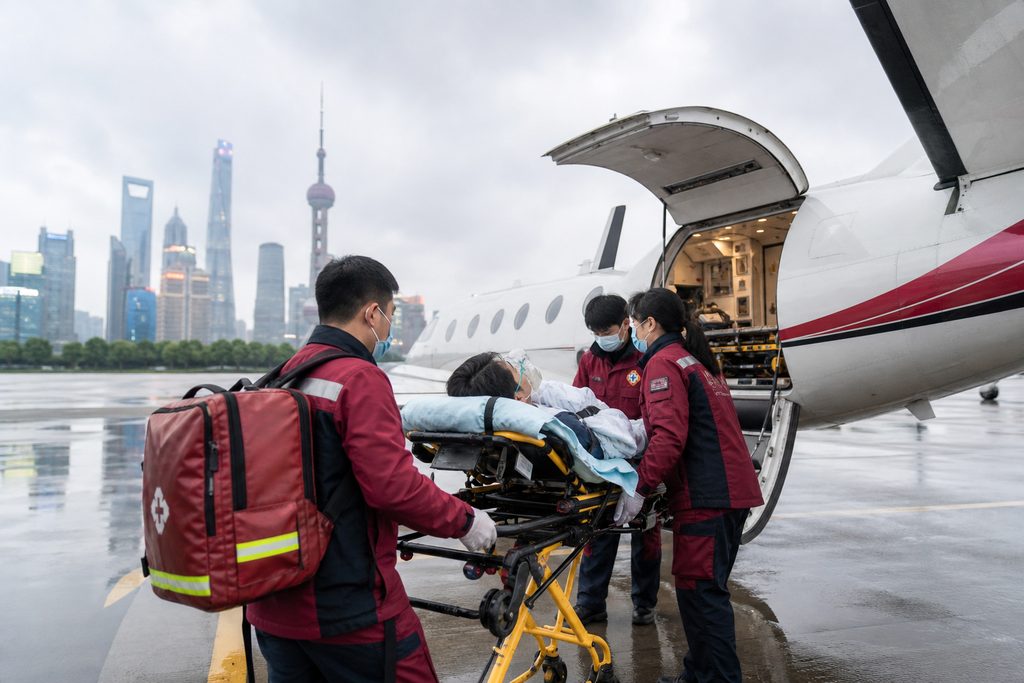
Second, you engage a medical transport provider. The market splits into two tiers: dedicated air ambulances and commercial medical escorts. An air ambulance is a private jet configured as a flying ICU. It carries a physician, a critical care nurse, ventilators, monitoring equipment, and medications. It can land at smaller airports closer to the patient. The cost for a private air ambulance China to home country price ranges from $120,000 to $180,000 for a flight to the US East Coast, and $80,000 to $130,000 for Europe. These are real numbers from case data, not brochure estimates.
A commercial medical escort is far cheaper. A critical care nurse or doctor books two adjacent seats on a commercial flight—one for the patient on a stretcher or in a reclining seat, one for the escort. Oxygen, suction, and monitoring equipment come onboard as medical baggage. The patient must be stable enough to tolerate a commercial cabin environment. This option typically costs $15,000 to $40,000. It is how most insured expatriates travel.
Understanding Medical Evacuation from China Cost: What You Actually Pay For
The headline number for a medical evacuation from China cost breaks down into four components. Knowing them helps you challenge inflated quotes.
| Cost Component | Air Ambulance | Commercial Escort | What Drives the Price |
|---|---|---|---|
| Aircraft / Seats | $50,000–$90,000 | $3,000–$12,000 | Distance, fuel stops, repositioning fees |
| Medical Crew | $20,000–$40,000 | $5,000–$15,000 | Crew size, specialty (ICU vs general), duration |
| Ground Ambulances | $3,000–$8,000 | $2,000–$5,000 | Two legs: bedside-to-airport, airport-to-hospital |
| Coordination & Permits | $5,000–$15,000 | $3,000–$8,000 | Overflight permits, landing slots, visa logistics |
These figures assume a departure from Shanghai to a major city in Western Europe or the continental United States. Flights to Australia, the Middle East, or within Asia shift the numbers. A repatriation to Singapore, for instance, can run $35,000 to $55,000 by air ambulance.
Insurance changes the equation entirely. Many international health plans include emergency medical evacuation benefits with a lifetime cap—often $250,000 to $1,000,000. But activation requires pre-authorization. The insurer must agree that the local care is inadequate. They will want documentation: medical records, a letter from the treating physician, and a recommendation from their own medical director. This process can take 24 to 72 hours. In a true emergency, that is an eternity. Some families pay upfront and fight for reimbursement later. That is a $100,000 gamble.
What to Do If Chinese Hospital Care Is Inadequate: A Decision Framework
The moment you realize what to do if Chinese hospital care is inadequate, you face three choices. Each has different risk profiles, timelines, and costs. There is no universal right answer.
Option 1: Transfer to a top-tier Chinese hospital. This is the fastest path to better care. A high-speed train or short domestic flight can move a patient from a provincial hospital to a Fudan-ranked center in hours, not days. The cost is minimal—typically $500 to $2,000 for a domestic medical transfer. The receiving hospital will have English-speaking staff if you choose a private international wing. This option keeps the patient in the same medical record ecosystem and avoids the physiological stress of a long-haul flight. It is the right call when the clinical gap is about expertise, not systemic issues.
Option 2: Commercial medical escort repatriation. Best for stable patients who need ongoing care but can tolerate a 10- to 14-hour commercial flight. The patient travels with a dedicated medical professional, but shares the aircraft with other passengers. This is the most common path for insured expatriates with conditions like stable fractures, recovering cardiac events, or controlled infections.
Option 3: Dedicated air ambulance. Required for ICU-level patients: those on ventilators, requiring continuous IV medications, or with conditions that could deteriorate at cabin altitude. A pressurized cabin at sea-level equivalent is non-negotiable for certain neurological or respiratory cases. This is the fastest and most expensive path. It is also the only option when the patient cannot sit upright or requires isolation.
Booking Emergency Medical Repatriation from China: The Operational Sequence
When you need to book emergency medical repatriation China, the process is not like booking a flight online. It is a coordinated medical operation that typically takes 24 to 96 hours from decision to wheels-up. Here is the actual sequence, based on cases we have tracked.
Hour 0–6: Clinical assessment and decision. The treating physician, receiving physician, and transport medical director must agree on three things: the patient’s current stability, the required level of in-flight care, and the destination facility’s readiness to accept. Without all three aligned, the transport stalls. This is where families often hit a wall. Chinese physicians may not be comfortable communicating directly with foreign counterparts. A bilingual coordinator who understands clinical terminology—not just conversational Mandarin—bridges this gap.
Hour 6–24: Logistics and permits. The transport provider files flight plans, secures overflight and landing permits, arranges ground ambulances at both ends, and confirms visa status. For patients on Chinese visas, overstaying due to hospitalization is common. The S2 visa, used for private affairs including medical treatment, may need extension or adjustment. This is not a medical visa—China does not have a dedicated medical visa category—but it is the applicable short-stay category for treatment. The transport coordinator and the receiving hospital’s international office handle this. It is tedious but routine.
Hour 24–48: Bedside preparation. The transport team arrives at the Chinese hospital. They review the chart, stabilize lines and tubes for transport, and brief the family. The patient is transferred to a transport stretcher and moved to the waiting ground ambulance. This is the most dangerous phase. Lines get pulled. Monitors alarm. The team must be prepared for a bedside emergency before the patient ever reaches the aircraft.
Hour 48–72: Flight and handoff. The aircraft departs. In-flight care continues—ventilation, sedation, monitoring, medication titration. The receiving ground ambulance meets the aircraft at the destination airport. The patient is transferred directly to the receiving hospital’s ICU or ward. The transport team provides a verbal report and written transfer summary. The handoff is complete.
International Medical Transport Out of China Fast: When Speed Is Everything
Some cases do not allow 72 hours. A rapidly expanding aortic dissection. An intracranial hemorrhage with rising ICP. A neonate with a congenital defect requiring surgery unavailable locally. In these scenarios, international medical transport out of China fast becomes the overriding priority. Every hour of delay increases morbidity.
Speed depends on three factors, in descending order of importance: aircraft availability, permit processing, and payment clearance. A dedicated air ambulance operator with a jet positioned in Asia can reach Shanghai within 6 to 8 hours of activation. Operators with aircraft based in Europe or the US need 18 to 24 hours for repositioning. This is why some families and insurers maintain retainer agreements with providers who guarantee regional availability. It is also why knowing which operators have aircraft in Asia—not just sales offices—matters.
Permits for medical flights are expedited in most countries, including China, when the case is documented as life-threatening. The Civil Aviation Administration of China (CAAC) has a process for emergency medical flight approvals. It still takes hours, not minutes. A good transport provider has relationships with the relevant authorities and can push permits through faster than a family calling cold. This is not about connections in a corrupt sense. It is about knowing exactly which form, which office, and which phone number.
Payment is the wildcard. Most air ambulance operators require payment or a guarantee of payment before wheels-up. If insurance pre-authorization is pending, the family must bridge the gap. Some operators accept a credit card hold for the full amount. Others require a wire transfer. In a speed-critical case, having a financial plan ready—whether insurance, credit, or cash—is as important as having the medical records.
Practical Considerations: Documentation, Visas, and What Gets Overlooked
The medical logistics consume everyone’s attention. Then the small things cause delays. A missing passport. An expired visa. Medical records that cannot leave the hospital. These are not hypotheticals.
Medical records. Chinese hospitals are not required to release original medical records to patients. They typically provide a discharge summary and copies of key test results. For an evacuation, you need at minimum: the admission note, all imaging reports (preferably the DICOM files on a CD or USB), lab results, medication administration records, and the physician’s transfer summary. Request these early. If the hospital resists, a formal request from the receiving physician often unlocks them. Our team has spent hours negotiating this single issue. It is the most common preventable delay.
Visa status. If the patient overstayed their visa due to hospitalization, the PSB (Public Security Bureau) exit-entry administration must issue an extension or a departure permit. This requires the hospital to provide a certification of hospitalization. Get this document before discharge. Leaving the hospital without it and trying to resolve the visa later at the airport is a recipe for a denied exit.
Payment to the Chinese hospital. Chinese hospitals typically require full payment before releasing medical records or allowing discharge. Even if the patient has insurance, the hospital may demand a cash deposit settlement. Expect this. Have a method to pay—WeChat Pay, Alipay, UnionPay, or a wire transfer that clears quickly. International credit cards are not universally accepted at public hospitals.
Family logistics. If a family member is traveling with the patient on a commercial escort, they need their own ticket, visa, and COVID-era documentation if applicable. On an air ambulance, one family member can usually accompany the patient at no additional cost. Confirm this with the provider. Do not assume.
Frequently Asked Questions
Yes. You pay out of pocket. Most air ambulance operators require payment or a binding guarantee before departure. Costs range from $80,000 to $180,000 for long-haul flights. Some operators offer financing or accept credit card holds. But without insurance, the financial burden is entirely yours. Reimbursement from a travel policy or employer plan after the fact is possible but never guaranteed.
A hospital cannot hold you against your will. But they can refuse to sign a fit-to-fly certificate. Without that certificate, no reputable air ambulance operator will transport you—it is a clinical and liability requirement. If the hospital believes you are leaving against medical advice, they will document that. The solution is to have the receiving physician abroad speak directly with the treating physician in China. When two doctors agree on a transfer plan, the certificate almost always follows.
Ask for their air operator certificate (AOC) and medical transport accreditation. EURAMI and CAMTS are the two major international accrediting bodies for air medical transport. A legitimate provider will list their accreditation on their website and provide it on request. Also ask: where is their aircraft based right now? Who is the medical director? What is the crew configuration for this specific flight? Vague answers are a red flag.
In many cases, yes. China’s top-tier hospitals—particularly those in the Fudan Top 100 rankings—deliver outcomes comparable to Western centers in cardiology, oncology, orthopedics, and neurosurgery. A domestic transfer takes hours, costs under $2,000, and avoids the physiological stress of a long-haul flight. The question is whether the specific care you need is available at a Chinese center and whether you can navigate the language and cultural barriers to access it. If the answer is yes, staying is often the medically safer path.
Practical but important. If you are evacuated, someone must check out of your hotel or apartment, settle the bill, and pack your belongings. Your passport and valuables must come with you or be secured. Some medical transport coordinators can arrange for a local agent to handle this. Most cannot. Have a plan—a colleague, a friend, or a consular officer who can help. This is the kind of detail that causes real distress in an already overwhelming situation.
Your Next Step
The decision to evacuate is never purely medical. It is medical, financial, logistical, and emotional all
For more medical information and treatment options in China, visit tochinamed.com (ToChinaMed).