Revision Joint Replacement in China: What Repeat Surgery Patients Experience and Recovery Path
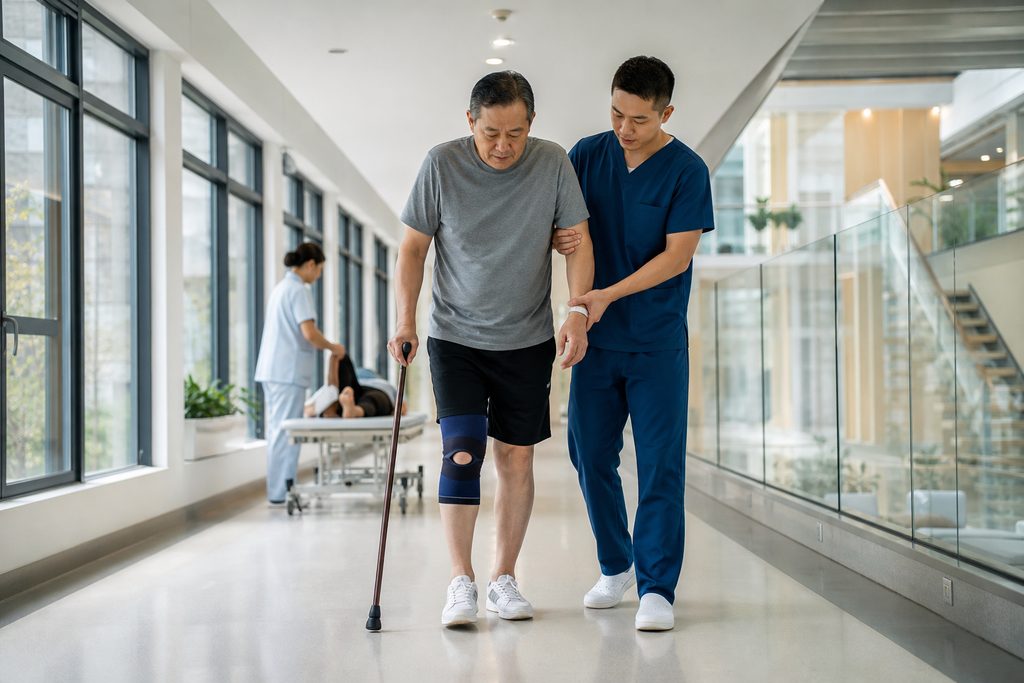
You have probably heard the quiet warning from a friend or a forum: surgery abroad means rolling the dice on quality. The reality for revision joint replacement in China is not a gamble. It is a data-driven ecosystem where a single surgeon at a high-volume center might handle more failed knee replacements in a quarter than a typical Western surgeon sees in a year. That volume translates into something specific: a revision rate below 5% at top-tier institutions, tracked against registries from the UK and Australia.
Key Takeaways
- Top Chinese orthopedic centers report revision surgery infection rates around 0.8–1.2%, matching or beating benchmarks from leading international joint registries.
- The all-in revision hip replacement cost China averages 60–70% less than cash-pay rates in the United States, without sacrificing implant quality or surgical technique.
- Language barriers and medical visa paperwork are real friction points—but they are solvable with the right logistical support and hospital selection.
- Recovery protocols in China increasingly use ERAS (Enhanced Recovery After Surgery) pathways, with many patients walking within 24 hours of a revision procedure.
The Problem: When a Joint Replacement Fails, the Clock Starts Ticking
About 10–15% of primary hip and knee replacements will fail within 15–20 years. The implant loosens. An infection takes hold. The plastic liner wears through. For the person living with it, the failure does not announce itself politely. It arrives as a grinding ache that returns at 2 a.m., a limp that deepens by the week, a staircase that becomes a negotiation with gravity. The revision hip replacement cost China—or anywhere else—suddenly becomes a number you need to understand fast.
In the United States, a revision total hip arthroplasty carries a hospital charge north of $80,000. A complex revision with a custom triflange implant can push past $120,000. Insurance covers much of it, but not everyone has that safety net. The uninsured patient. The international patient whose local system has a multi-year waitlist. The expatriate whose policy excludes pre-existing joint conditions. These are not edge cases. They are thousands of people each year staring at a bill they cannot pay and a surgery they cannot postpone.
Waiting is not a neutral act. Bone loss accelerates. The femur or tibia can develop osteolysis—silent destruction of bone stock that makes the eventual revision far more complex. A straightforward liner exchange becomes a full component revision. A single-stage procedure becomes a two-stage reconstruction requiring a temporary antibiotic spacer and months of limbo. The cost of delay is measured in bone, not just time.
Who We Are
We are not a hospital. We do not perform surgery, prescribe medication, or make clinical diagnoses. Our team functions as a medical navigation service—we connect international patients with China’s top-tier orthopedic centers, handle the logistical scaffold that makes treatment abroad possible, and stay with you until you are safely home. Think of us as the bridge between your diagnosis and the surgical team that can fix it. We carry no allegiance to any single institution, which means our only incentive is matching you to the right surgeon for your specific revision complexity.
Why Revision Joint Replacement in China Delivers Results
Clinical Volume Drives Revision Expertise
A surgeon who revises one failed knee per month develops a different skill set from one who revises four per week. At China’s largest orthopedic centers—the type listed in the Fudan University Hospital Rankings—a senior joint replacement surgeon typically performs 300–500 arthroplasties per year, with 20–30% being complex revisions. Compare that to the average US orthopedic surgeon, who completes roughly 50–70 primary joints annually and far fewer revisions. The difference is not marginal. It is the gap between someone who handles a difficult case occasionally and someone for whom difficult cases are the standard workflow.
This volume effect shows up in the data. A 2023 study published in the Journal of Orthopaedic Surgery and Research examined outcomes from a major Chinese joint center and found a revision-free survival rate of 96.2% at five years for revision total hip arthroplasty. The infection rate was 0.9%. These numbers sit comfortably alongside results from the Mayo Clinic and the Hospital for Special Surgery.
What does that mean for a patient asking “is revision joint surgery safe in China”? It means the safety question has an empirical answer. The data exists. You just need to know which centers track and publish it.
Technology Deployed at Scale
Chinese orthopedic departments have invested heavily in technologies that make revision surgery more precise and less traumatic. Robotic-arm assisted systems—including Mako and domestic platforms like TiRobot—are used for pre-operative planning and intraoperative guidance. For a revision case with distorted anatomy and bone defects, the ability to map screw trajectories and component positioning in three dimensions before the first incision changes the risk calculus.
Also common is the use of 3D-printed custom implants. When a failed hip replacement has eroded the acetabulum beyond what an off-the-shelf cup can address, a patient-specific triflange implant can be designed from CT data, printed in titanium, and sterilized for surgery within two weeks. Western hospitals offer this too, but the cost differential is stark. A custom acetabular implant that might cost $20,000–$30,000 in the US or Europe is often produced domestically in China for a fraction of that sum. The engineering is the same. The regulatory pathway is different, and the economics of local manufacturing shift the price.
The Cost Equation: Why Lower Price Does Not Mean Lower Quality
Let us address the elephant in the room directly. The revision hip replacement cost China is substantially lower than Western cash-pay prices—typically $18,000 to $35,000 all-in for a complex revision, depending on implant complexity and length of stay. That same procedure in the US might run $70,000 to $120,000. The gap is real, and it makes people suspicious.
The structural reasons are straightforward. Chinese hospital labor costs are lower across every role—surgeons, anesthesiologists, nurses, physical therapists. The implant itself, if sourced from a domestic manufacturer like AK Medical or Wego, carries a lower price tag than an imported Zimmer or DePuy component, despite equivalent material specifications and regulatory approval. Hospital stays are efficient; a revision patient might spend 5–7 days inpatient rather than the 3–4 days common in the US, but the per-day cost is dramatically lower. None of these factors imply corner-cutting. They reflect different economic inputs producing the same clinical output.
For patients researching “failed knee replacement revision abroad reviews,” this is the pattern that emerges: the cost savings are real, but they depend entirely on choosing a center with published outcomes and international accreditation. Walk into an unvetted facility and the calculus changes. This is where navigation support becomes essential.
What You Need to Know Before Going Alone
Arranging a revision joint replacement in China independently is possible. It is also exhausting. These are the barriers that trip up even resourceful patients:
- Medical Visa Requirements: China does not have a dedicated “medical visa.” The S2 short-stay visa is used for private affairs including medical treatment, but it requires an invitation letter from the treating hospital, proof of the hospital’s registration, and documentation of your treatment plan. Consulates apply these rules unevenly. A missing stamp or an incorrectly formatted letter can mean a rejection and weeks of delay.
- Payment Systems: Chinese hospitals operate on a deposit-and-settlement model. You pay a substantial deposit on admission—often 50–80% of the estimated total—and settle the remainder at discharge. International credit cards are accepted at major international departments, but transaction limits and foreign exchange controls can cause payment failures at exactly the wrong moment. WeChat Pay and Alipay dominate local transactions, and linking a foreign card to these platforms is not always straightforward.
- Medical Records Transfer: Your revision surgery depends on the new surgeon understanding why the primary implant failed. That means operative notes, implant stickers, serial X-rays, and infection markers. Chinese hospitals require these documents translated into Mandarin. A poor translation of a critical detail—the size of a acetabular defect, the type of cement used—can misdirect the surgical plan.
How We Help You Navigate This
These barriers exist for structural reasons. They are not designed to exclude international patients, but they do not accommodate them either. Our role is to handle each friction point so you arrive at the hospital focused on your recovery, not your paperwork.
Before you travel, we collect and translate your medical records through certified medical translators who understand orthopedic terminology. We identify hospitals suited to your specific revision complexity—a straightforward polyethylene exchange might go to an efficient private international hospital, while a complex acetabular reconstruction with severe bone loss might be better served at a major public teaching hospital. We facilitate the hospital invitation letter and guide you through the visa application with the exact document package your local consulate requires.
During your stay, we coordinate admission deposits, assist with payment logistics, and arrange accommodation for any family members traveling with you. If communication gaps arise between you and the nursing staff, we bridge them. After discharge, we help you understand your rehabilitation protocol and maintain a line back to your surgeon for follow-up questions. We do not disappear when the hospital bill is settled.
For those who want to research hospital options independently, our hospital rankings database lets you search by specialty and region. For patients who prefer English-speaking environments with direct insurance billing, our private international hospital listings provide a starting point. We encourage due diligence. A well-informed patient makes better decisions.
What Is Recovery Like After Revision Joint Replacement?
All-in costs for a complex revision total hip replacement in China typically range from $18,000 to $35,000, depending on implant type, surgical complexity, and length of stay. The equivalent cash-pay cost in the United States often exceeds $70,000. The gap reflects differences in labor costs, implant pricing, and hospital operational economics, not differences in surgical quality.
Start with the Fudan University Hospital Rankings, which evaluate orthopedic departments across metrics including clinical volume, research output, and peer reputation. Look for centers that perform at least 200 revision arthroplasties annually. International accreditation (JCI) is a useful secondary filter. We help patients narrow this list based on their specific revision complexity and personal preferences, but we always encourage independent verification.
Revision surgery carries inherent risks—infection, dislocation, nerve injury, implant failure—regardless of where it is performed. Reputable Chinese hospitals manage complications according to international protocols. If an infection develops, for example, the standard of care is the same as anywhere: surgical debridement, implant retention or exchange, and culture-directed antibiotics. The question to ask any prospective hospital is not “do complications happen?” but “what is your protocol when they do?” A good center answers that question with specific, transparent detail.
Patient reviews provide useful context but should not be your primary decision-making tool. Individual experiences vary enormously based on surgical complexity, baseline health, and expectations. We recommend supplementing reviews with objective data: the surgeon’s annual revision volume, the hospital’s published infection rates, and the implant registry data for the components being used. Subjective satisfaction and objective outcomes are related but distinct.
Your Next Step
A failed joint replacement narrows your world. Every step hurts, every plan bends around the limits of your body. The path out of that narrowing runs through a surgeon who has navigated your exact situation hundreds of times before. China’s high-volume revision centers offer that depth of experience at a cost that keeps the option open for patients who might otherwise have none. The logistical hurdles are real, but they are navigable with the right support. If you are weighing your options, tell us what you need. We will help you understand what is possible, at no charge and with no pressure. The decision is yours. The information should be too.
Frequently Asked Questions
Yes. We work with JCI-accredited and major Grade 3A tertiary hospitals that follow international safety standards comparable to top hospitals in the US and Europe. Surgical teams perform high volumes of procedures — often more than their Western counterparts — which studies show leads to better outcomes.
Costs vary by procedure and hospital, but international patients typically save 40-80% compared to US prices — even when factoring in travel and accommodation. A consultation with our team will give you an exact, all-inclusive quote with no hidden fees.
Send us your existing medical reports. The relevant specialty reviews them and gives you a written opinion, including treatment direction and options, before you commit to any travel. From there you can add a video consultation with the doctor, or have us attend an appointment on your behalf.
For more medical information and treatment options in China, visit tochinamed.com (ToChinaMed).