First Affiliated Hospital Zhejiang University Review: Hangzhou Medical Leader Analyzed
Key Takeaways
- The First Affiliated Hospital, Zhejiang University School of Medicine handles over 5 million outpatient visits annually, ranking it among the highest-volume medical centers globally.
- International patient pricing typically ranges 50-70% below comparable US hospital cash-pay rates for complex surgical procedures, though transparent price lists are not published online.
- The hospital holds Joint Commission International (JCI) accreditation, but its international patient department is not a concierge service — independent navigation requires significant Mandarin fluency.
- A successful treatment journey here depends less on finding a top surgeon and more on solving the logistical puzzle: medical records translation, payment systems, and post-operative visa extensions.
The Problem: When Your Home Country Tells You to Wait
Waiting 18 weeks for a cancer resection is not a minor inconvenience. It is a clinical risk. In Canada, the median wait time from specialist referral to treatment across 12 specialties reached 27.7 weeks in 2023, according to the Fraser Institute. The UK’s NHS reported that over 7.6 million people sat on waiting lists in early 2024, with more than 400,000 waiting over a year. For a patient with a growing malignancy or a deteriorating cardiac valve, these numbers are not statistics. They are a countdown.
The private alternatives are not always better. A self-paying cardiac bypass in the United States can exceed $120,000. Even with insurance, deductibles and out-of-network charges routinely push bills past $20,000. So patients start searching. They type phrases into Google at 2 a.m. — phrases like “First Affiliated Hospital Zhejiang University international patient price” — not because they want to travel to China, but because they feel trapped between two unacceptable options: wait and worry, or go bankrupt.
Who We Are
We are ToChinaMed, an independent medical information platform. We do not schedule surgeries. We do not collect referral fees from hospitals. We do not recommend one hospital over another. What we do is provide the data, the context, and the honest operational reality that international patients need before making a decision that carries both clinical and financial weight. Think of us as your pre-travel intelligence briefing. You would not board a plane without knowing the weather at your destination. You should not choose a hospital without understanding what actually happens on the ground.
First Affiliated Hospital Zhejiang University Review: Hangzhou Medical Leader in Context
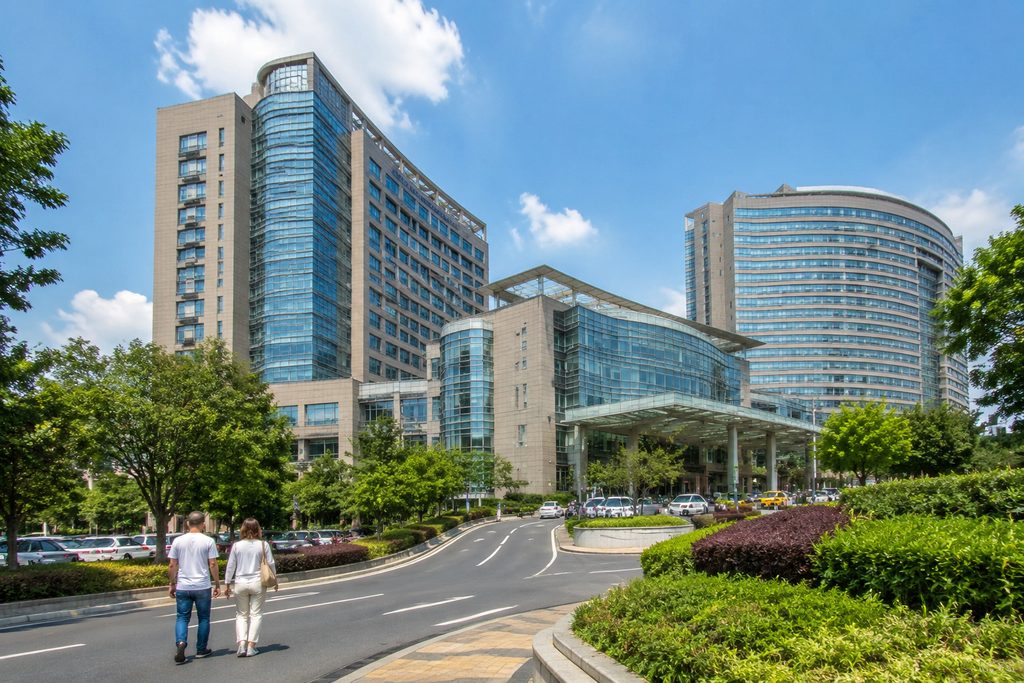
The First Affiliated Hospital of Zhejiang University School of Medicine — often called Zhejiang First Hospital or simply FAHZU — sits in Hangzhou, a city of 12 million people about an hour by high-speed train from Shanghai. The hospital was founded in 1947. Today it operates multiple campuses with over 3,500 beds. The numbers tell a story of scale that few Western institutions can match.
In China’s most authoritative hospital ranking system — the Fudan University Hospital Rankings — FAHZU consistently places within the national top 10-15 for overall clinical strength. Its infectious disease department, led by the nationally renowned researcher Li Lanjuan, has held the number one position in China for years. Hepatobiliary surgery, organ transplantation, and general surgery all rank within the top 10 nationally. This is not a niche clinic. This is a full-spectrum academic medical center that trains thousands of residents and publishes extensively in international journals.
But rankings only answer one question: how good is this hospital by domestic standards? The question international patients actually need answered is different. They need to know: is First Affiliated Hospital Hangzhou good for foreigners?
Why This Hospital Delivers Results
Clinical Volume That Builds Procedural Muscle Memory
Volume is not a vanity metric. In complex surgery, it correlates directly with lower complication rates and shorter lengths of stay. A 2020 study published in The Lancet examining over 2 million surgical patients across multiple countries found that hospitals performing fewer than 50 esophagectomies per year had significantly higher 30-day mortality rates than high-volume centers. FAHZU’s surgical teams operate at volumes that are hard to grasp from a Western perspective.
The hepatobiliary and pancreatic surgery department performs over 2,000 complex liver resections annually. The organ transplantation center has completed more than 3,500 kidney transplants and over 1,500 liver transplants. For comparison, many respected US academic centers perform 80-150 liver transplants per year. When a surgeon has done a procedure 500 times, the 501st case is not a special event. It is Tuesday.
Technology Infrastructure That Rivals Any Top JCI Hospital Hangzhou Medical Tourism Cost Can Access
FAHZU was an early adopter of the Da Vinci robotic surgical system and now operates multiple robotic surgery platforms across urology, thoracic, and general surgery. Its imaging center houses 3.0T MRI machines, dual-source CT scanners, and PET-CT — the same equipment you would find at Massachusetts General or Charité Berlin. The difference is throughput. These machines run extended hours, six days a week. A PET-CT scan that requires a three-week wait in Vancouver can often be completed within 48 hours here.
The hospital achieved JCI accreditation — the international gold standard for hospital quality and patient safety — and maintains it through rigorous re-accreditation cycles. This matters. JCI standards cover everything from surgical site marking protocols to medication reconciliation processes. It is the same accreditation held by Bumrungrad International in Bangkok and Clemenceau Medical Center in Beirut. For a patient asking “is First Affiliated Hospital Hangzhou good for foreigners,” the JCI certificate provides a verifiable, third-party answer.
The Cost Equation: Why the First Affiliated Hospital Zhejiang University International Patient Price Is Lower
Let us address the question that brings most international patients to this page. The First Affiliated Hospital Zhejiang University international patient price structure is not published as a menu. Chinese public hospitals do not operate that way. But based on aggregated patient cases and publicly available provincial pricing guidelines, the pattern is clear.
A total knee replacement that bills at $35,000-$50,000 in the US before insurance typically costs $12,000-$18,000 at FAHZU as a cash-paying international patient. A laparoscopic cholecystectomy: $1,500-$3,000 versus $10,000-$20,000 in the US. Complex liver resection: $15,000-$25,000 compared to $60,000-$120,000. These are not promotional discounts. They are structural price differences driven by lower labor costs, higher patient throughput, and a regulatory environment that caps certain hospital charges. The clinical outcomes for these procedures are comparable — and for high-volume surgeries like liver resection, sometimes superior in complication rate metrics.
The Reality Check: What You Need to Know Before Going Alone
We have described the strengths. Now we owe you honesty about the friction. Many patients arrive with a referral letter and a translation app, believing they can navigate this hospital independently. Some succeed. Most encounter barriers they did not anticipate.
- Language Is Not a Minor Inconvenience: While senior physicians often speak functional medical English, the nurses, administrative staff, billing department, and pharmacy operate almost entirely in Mandarin. Informed consent forms are in Chinese. Post-operative instructions are in Chinese. A misunderstanding about medication dosage or follow-up scheduling is not a theoretical risk.
- Payment Systems Are Fundamentally Different: FAHZU requires upfront deposit payments for inpatient stays. International credit cards sometimes fail on the hospital’s payment terminals. WeChat Pay and Alipay dominate, but linking a foreign bank card to these platforms is not always straightforward. Wire transfers are possible but slow. The Zhejiang University hospital international patient department contact can provide guidance, but they are not a financial concierge.
- Medical Records Translation Is Your Responsibility: The hospital will request your existing imaging, pathology slides, and clinical summaries. They need these translated into Chinese by a certified medical translator. If you arrive with English-only records, expect delays. The hospital does not provide this translation service internally.
How We Help You Navigate This
These barriers exist because China’s public hospital system was built to serve a domestic population of 1.4 billion people, not to accommodate international medical tourists. The infrastructure is world-class. The administrative layer around it was not designed with foreigners in mind. This is where a guide becomes essential.
Our team helps you prepare before you ever book a flight. We review your existing medical records and identify precisely which documents need certified translation. We help you understand the realistic cost range for your specific procedure — not a vague estimate, but a data-backed projection based on published provincial pricing standards and recent patient cases. We explain how to contact the Zhejiang University hospital international patient department contact point effectively: what information they need, what questions to ask, and what response timeline to expect.
During treatment, we help bridge the communication gaps that clinical staff do not have time to handle. After discharge, we guide you through the visa extension process if your recovery requires a longer stay, and we help you understand your follow-up imaging and medication regimen so nothing gets lost in translation.
For patients considering broader options beyond a single institution, our hospital rankings database allows you to search by specialty and compare top-tier public hospitals across China. If you prefer an English-speaking environment with direct insurance billing, our private international hospital listings may be a better fit.
Frequently Asked Questions
There is no online booking portal for international patients. The process starts with contacting the International Medical Center or the specific department you need. You submit your medical records, imaging, and a treatment request letter. A department head reviews your case and determines whether they can accept you. If accepted, you receive a treatment plan and cost estimate. Only then do you schedule your arrival. The entire pre-approval process typically takes 2-4 weeks. This is not a system optimized for speed. It is optimized for clinical appropriateness.
Chinese law provides a framework for medical dispute resolution, but it operates differently from Western malpractice systems. Mediation through a hospital ethics committee or a local medical association is the first step. Litigation is possible but complex for foreign nationals. The practical reality: choose a high-volume, JCI-accredited hospital precisely because their protocols are designed to prevent adverse events. Ask about complication rates for your specific procedure during the pre-approval process. A department that refuses to share this data is a red flag.
Most international insurance plans treat FAHZU as an out-of-network provider, if they recognize it at all. You will almost certainly need to pay upfront and seek reimbursement. Before committing, send your insurer the hospital’s full name in Chinese (浙江大学医学院附属第一医院) and the proposed treatment plan. Get pre-authorization in writing. Do not rely on verbal assurances from a call center agent.
The clinical care is excellent. The patient experience without language support is difficult. The International Medical Center has English-speaking coordinators, but their availability is limited. For a short outpatient consultation, you can manage with a translator. For a multi-week inpatient surgical stay, independent navigation is exhausting and risky. Bring a fluent Mandarin speaker or work with a service that provides this support.
For certain cancers — particularly hepatocellular carcinoma, gastric cancer, and nasopharyngeal carcinoma — FAHZU is among the best in the world, not just in China. These are cancers with high incidence in East Asian populations, and Chinese oncologists have accumulated enormous clinical experience treating them. For other cancers like melanoma or prostate cancer, Western centers may have deeper expertise. The Fudan hospital rankings let you search by oncology subspecialty to compare FAHZU against other top Chinese cancer centers like Fudan University Shanghai Cancer Center or Sun Yat-sen University Cancer Center.
Your Next Step
The First Affiliated Hospital of Zhejiang University is not the right choice for every international patient. It is the right choice for patients who need high-volume surgical expertise at a cost significantly below Western private-pay rates, and who are willing to navigate — or pay someone to navigate — the logistical complexity that comes with China’s public hospital system. The clinical quality is real. The barriers are real too. Neither should be underestimated.
If you are considering treatment here and want to understand the full picture before making contact with the hospital, we can help. Tell us what you need — we will help you find the right option at no charge.
For more medical information and treatment options in China, visit tochinamed.com (ToChinaMed).