Surgery Cost vs Waiting Time Trade-Off: UK NHS Queue vs China Immediate Payment
Key Takeaways
- NHS orthopaedic waiting lists have surged past 800,000 in England alone, with some patients facing over 18 months for a hip replacement as of early 2025.
- Paying for private surgery in China eliminates the queue entirely—most procedures are scheduled within one to two weeks of your initial consultation.
- The cost of private surgery China vs NHS waiting time trade-off is not just financial; it involves weighing progressive joint damage and lost quality of life against a one-time payment typically 50-70% lower than UK private rates.
- Navigating cross-border payment systems and medical visa requirements remains the single biggest barrier for international patients acting independently.
The Problem: When the Queue Becomes the Diagnosis
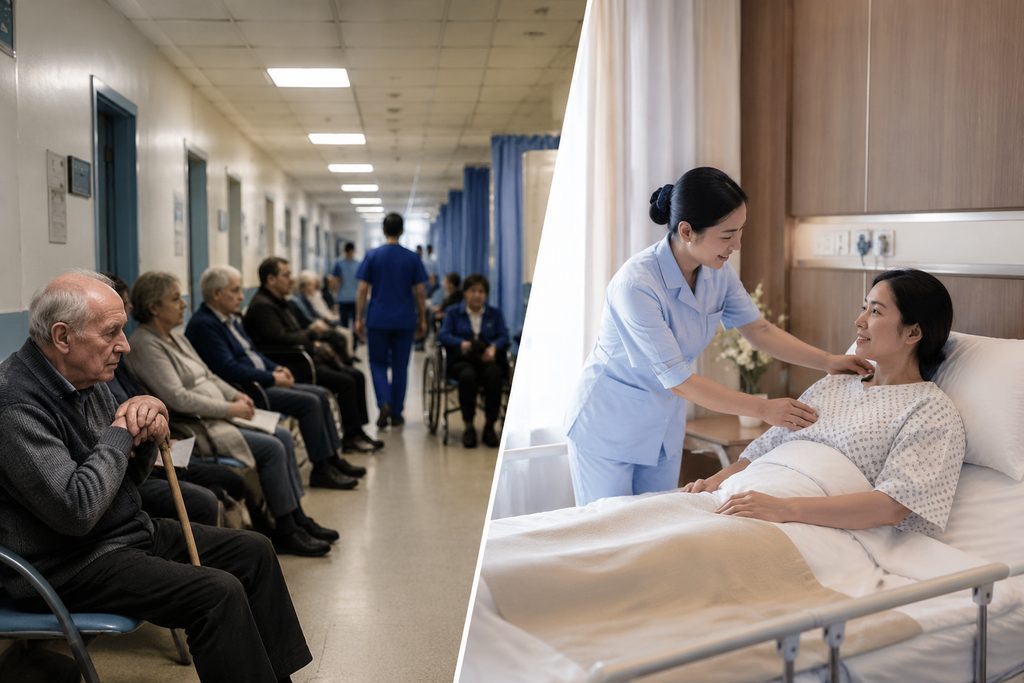
You have probably heard the stories. A neighbour waits two years for a new knee. A colleague’s hip pain gets so bad they cannot climb stairs, yet their surgery date keeps getting pushed back. These are not anomalies. They are the structural reality of the UK’s National Health Service in 2025. The most recent NHS England data paints a grim picture: the waiting list for trauma and orthopaedics has ballooned to over 800,000 cases. For a standard hip replacement, the national target is 18 weeks, but the reality on the ground in many trusts is a wait stretching to 18 months or longer.
That is not just discomfort. That is pathology in motion. A joint that degrades for an extra year does not stay static. Muscles atrophy. Compensatory gait patterns damage the opposite hip and the spine. A patient who could have had a straightforward procedure in month three becomes a complex revision case in month eighteen. The queue itself inflicts harm. So the question shifts. It stops being “Can I afford to go private abroad?” and becomes “Can I afford to wait?”
Who We Are
We are not a hospital. We do not employ surgeons, we do not set prices, and we do not receive commissions from any medical facility. Our team functions as a dedicated information and logistics platform for international patients seeking treatment in China. We help you identify the right public teaching hospital or accredited private international facility based on your specific clinical needs. Then we guide you through the non-clinical architecture: medical invitation letters for your visa, certified translation of records, payment logistics, and post-operative recovery planning. We bridge the gap between your decision and the operating theatre door.
Why Paying for Immediate Surgery in China Changes the Equation
The standard narrative suggests a clean binary: wait for free care at home, or pay a fortune for private care in London. That binary is false. A third path exists, and it is one that thousands of medical travellers are already taking. The cost of private surgery China vs NHS waiting time is not a theoretical comparison. It is a calculation being made right now in living rooms across Manchester, Birmingham, and Glasgow.
The Real Cost of Waiting: How Long Is the NHS Waiting List for Hip Replacement in 2025?
Let us ground this in numbers. As of February 2025, the NHS waiting list for trauma and orthopaedics in England sits at approximately 810,000. Within that, roughly 40% of patients have already waited beyond the 18-week constitutional target. For major joint replacements specifically, the median wait in several large NHS trusts now exceeds 12 months. Some patients in the Southwest and Northeast regions report waiting 20 months for a first consultation with an orthopaedic consultant. That is before they even get on the surgical list. The clinical implications are severe. A 2023 study from the University of Edinburgh tracked hip osteoarthritis patients on extended waiting lists and found measurable declines in quadriceps strength and aerobic capacity over just six months. The body does not pause while the system catches up.
Clinical Volume Drives Better Outcomes
This is the part that surprises most Western patients. A top-tier Chinese orthopaedic surgeon at a major public teaching hospital—think Peking University Third Hospital or Shanghai Sixth People’s Hospital—performs between 400 and 600 joint replacements per year. The average UK orthopaedic surgeon performs roughly 80 to 120. This is not a reflection of individual skill. It is a function of system design. Chinese public hospitals operate on high-volume, high-efficiency surgical schedules that prioritize rapid patient turnover without compromising sterility or implant quality.
Volume matters because joint replacement is a procedure where outcomes correlate directly with repetition. A 2022 meta-analysis published in The Lancet Rheumatology found that surgeons performing more than 200 total hip arthroplasties annually had significantly lower rates of dislocation, infection, and revision at five years compared to low-volume surgeons. When you book orthopaedic surgery China fast track, you are not just buying speed. You are accessing a clinical ecosystem built around repetition and refinement.
Technology Integration Without the Wait for Approval
Chinese orthopaedic departments have adopted robotic-assisted surgery platforms—such as the Mako system and locally developed alternatives like the TiRobot—at a pace that outstrips most NHS trusts. A patient needing a unicompartmental knee replacement can receive robotic-arm-assisted surgery that maps the joint in real time, preserving healthy bone and soft tissue. In the UK, access to robotic orthopaedics remains patchy and often restricted to private hospitals. In China, it is increasingly standard for complex primary and revision cases at university-affiliated hospitals. The technology is not experimental. It is routine.
The Financial Comparison: Is It Worth Paying for Surgery Abroad to Avoid the NHS Queue?
Here is where the trade-off crystallizes. A private total hip replacement in the UK costs between £12,000 and £16,000. A private total knee replacement runs £13,000 to £17,000. In China, the same procedures at a top-tier public hospital’s international medical centre or a JCI-accredited private international hospital cost between £6,000 and £9,000. That includes the implant, hospital stay, surgeon’s fees, and anaesthesia. Even after adding flights, accommodation for a companion, and two weeks of post-operative recovery in a serviced apartment, the total outlay rarely exceeds £12,000.
So the question becomes: is it worth paying for surgery abroad to avoid the NHS queue? If the alternative is waiting 18 months in escalating pain, losing mobility, and potentially compromising your surgical outcome, the financial calculus shifts. You are not just buying a procedure. You are buying back a year of your life. And you are doing it at roughly half to two-thirds the cost of UK private care.
What You Need to Know Before Going Alone
The logic is sound. The execution is where things get difficult. We have seen patients try to arrange this independently, and the friction points are predictable. Here is what you face if you go it alone.
- Medical Visa Requirements: China does not issue a standard “medical tourist” visa on demand. You need a formal medical invitation letter from a licensed hospital, stamped and verified. You need a confirmed treatment plan and proof of sufficient funds. Consulates in the UK are increasingly scrutinizing these applications. A missing stamp or an incorrectly formatted letter can mean a rejection and a wasted month.
- Payment Systems That Exclude Foreigners: Chinese public hospitals operate on a domestic payment infrastructure. WeChat Pay and Alipay dominate. International credit cards are often not accepted at the cashier’s office. Bank transfers from UK accounts to Chinese hospital accounts can trigger compliance flags on both ends. The hospital needs payment before scheduling. You need a way to move money that does not freeze mid-transaction.
- Medical Records and Imaging Compatibility: Your NHS MRI and X-ray files need to be formatted, translated, and reviewed by the Chinese surgical team before they will even offer a surgical plan. This is not a simple email attachment. DICOM files must be transferred securely. Radiology reports need certified medical translation. A single missing sequence can delay your surgical clearance by weeks.
How We Help You Navigate This
These barriers are not designed to exclude you. They are simply the byproducts of a healthcare system built for a domestic population of 1.4 billion people. Our job is to make that system legible to you.
We start with your records. You send us your imaging and clinical history. We coordinate certified medical translation and transfer the files to the orthopaedic departments best matched to your condition—not just any hospital, but the specific team with the highest volume and best outcomes for your exact procedure. We secure the medical invitation letter from the hospital, ensuring it meets consular requirements. We walk you through the visa application step by step. Once you land, we have already arranged your airport transfer, your hospital registration, and your companion’s accommodation. After discharge, we coordinate follow-up imaging and physiotherapy clearance before you fly home. You focus on recovery. We handle the rest.
This is what medical tourism China surgery packages no waiting list should look like. Not a glossy brochure with a bundled price, but a transparent, step-by-step logistical pathway that puts you in the operating room weeks after you make the decision—not years.
Frequently Asked Questions
This is the question that keeps people up at night. The answer is that continuity of care must be built into the plan before you leave China. We ensure your UK GP and any local orthopaedic consultant receive a complete operative note, implant stickers, and post-operative protocol in English before you depart. Chinese surgeons at major centres are accustomed to coordinating follow-up care with international colleagues. They expect to provide records that meet UK standards. If a complication arises—infection, stiffness, implant concern—your UK orthopaedic team takes over management using the documentation we have already transferred. You are not abandoned. You are handed over.
The knee surgery China price immediate appointment model works because Chinese hospitals quote a bundled surgical package once your case is reviewed. The price you receive covers the implant, theatre time, surgeon’s fee, anaesthesia, and inpatient stay. What it does not cover are pre-existing conditions that require additional medical management during your stay. If you have uncontrolled diabetes or cardiac issues, those must be stabilized first, which may add cost. We flag these possibilities during the initial review so you are not surprised. Transparency is the only way this works.
Yes. Top Chinese orthopaedic centres use the same implant systems you would receive in a UK private hospital—Zimmer Biomet, Stryker, DePuy Synthes, Smith & Nephew. These are multinational manufacturers with identical product lines. The implants are not “Chinese versions.” They are the same components, often from the same production batch, used in London and Manchester operating theatres. The difference is not the hardware. It is the cost structure of the hospital that implants it.
Revision cases are more complex, and they demand a surgeon who sees a high volume of them. This is where Chinese high-volume centres have a distinct advantage. A revision specialist at a major orthopaedic hospital in China may perform 100 to 150 revisions annually. In the UK, a revision surgeon might do 20 to 30. If you have a failed implant, infection, or periprosthetic fracture, the volume differential matters even more than it does for primary cases. We connect you specifically with revision teams, not general orthopaedic departments.
Your Next Step
The cost of private surgery China vs NHS waiting time is not an abstract economic comparison. It is a decision about how much of your mobility, your independence, and your pain-free years you are willing to surrender to a queue. The NHS will get to you eventually. The question is what condition you will be in when it does. If you want to understand your options—without pressure, without a sales pitch—we are here to help you map the path. A year from now, you could be telling a very different story about your recovery.
For more medical information and treatment options in China, visit tochinamed.com (ToChinaMed).