What to Expect During Knee Replacement Surgery in China: A Day-by-Day Hospital Timeline
Key Takeaways
- Top Chinese orthopedic centers perform 200-500 knee replacements per surgeon annually, a volume linked to fewer complications and faster recovery.
- A complete knee replacement surgery cost in China typically ranges from $12,000 to $20,000, often 60-75% less than the US cash price for a comparable implant and hospital stay.
- The standard hospital stay for knee surgery in China is 4 to 7 days, but this hinges on a strict in-hospital rehabilitation protocol that starts within hours of the operation.
- Navigating the visa process and post-operative logistics alone is the primary barrier—not the quality of the surgery itself.
The Problem: When the Wait and the Price Tag Both Hurt
A knee replacement is not a lifestyle choice. It is the endpoint of years of eroded cartilage, sleepless nights, and a shrinking world where stairs become obstacles. You are ready to fix it. And then you face the numbers. In the United States, a total knee arthroplasty carries a cash price that often lands between $35,000 and $50,000. In Canada or the UK, the clinical need is not debated, but the queue is. Waiting 18 to 24 months for a public-system slot is common. During that wait, muscle atrophy deepens. The joint stiffens further. The surgery, when it finally happens, becomes harder and the recovery longer.
That is a structural failure, not a personal one. The demand for orthopedic surgery is surging globally. Aging populations in the West are colliding with health systems that ration care through time. About 1 in 5 patients waiting more than a year for a knee replacement report their pain becoming “unbearable” before they reach the operating table. You need a different timeline. You need a system built for volume and precision without the financial wreckage.
Who We Are
We are not a hospital. We do not perform surgeries, interpret MRIs, or prescribe rehabilitation protocols. We are a medical concierge and information platform based in China. Our team acts as your logistical architects. We bridge the structural gap between you and China’s top-tier orthopedic centers. We handle the visa guidance, the hospital shortlisting based on your specific clinical needs, the interpreter coordination, and the post-operative accommodation planning. We connect you with the expertise. You remain in control of every clinical decision with your surgeon. Our role is to make the path smooth, transparent, and safe.
Why a Chinese Orthopedic Center Delivers Results
International patients often ask us a blunt question: is the quality of a knee replacement surgery cost China offers a reflection of its quality? The short answer is no. The long answer lies in volume, technology, and the economics of focused factories.
Volume Drives Surgical Precision
There is a well-documented relationship between surgical volume and patient outcomes in joint arthroplasty. A study in The Journal of Bone and Joint Surgery found that hospitals performing more than 200 total knee replacements annually had significantly lower rates of 90-day complications. Many urban Chinese orthopedic hospitals operate at a scale that is difficult to find elsewhere. A senior surgeon at a top-tier center here will routinely perform 300 to 500 knee replacements in a year. Compare that to the average US orthopedic surgeon, who performs roughly 60 to 65 per year. This is not about innate skill. It is about repetition. A surgeon who sees complex varus deformities and severe osteoarthritis daily develops an instinct for soft tissue balancing that a lower-volume surgeon cannot replicate at the same speed.
Technology Without the Wait
The tools are equivalent to any Western academic medical center. Computer-assisted navigation systems, robotic-arm assisted surgery platforms like Mako, and 3D-printed patient-specific cutting guides are standard in the best knee surgery hospital China has to offer. But the crucial difference is access. A patient needing robotic-assisted surgery in a Western public system might wait extra months for a slot on the machine. In a high-volume Chinese center, the technology is integrated into the daily workflow. The barrier is not the queue. The barrier is knowing which hospital has the specific platform your case requires. That is where pre-travel planning with a guide matters.
The Structural Cost Advantage
Let us address the obvious question. How can a surgery using the same Stryker or Zimmer Biomet implant cost a fraction of the price? The savings do not come from cutting corners on the implant. The implant itself is a global product with a relatively fixed cost. The savings come from three areas. First, hospital construction and operational costs are lower. Second, and most significantly, labor costs for the surgical team, anesthesiologists, and nursing staff are vastly lower—without a corresponding drop in training quality. Third, the high-volume model spreads fixed costs over more cases. You are not paying for the empty operating room down the hall. You are paying for a system running at high efficiency.
What to Expect After Knee Replacement Surgery in China: Day by Day
This is the core of what international patients need to visualize. The timeline is structured and aggressive. Chinese rehabilitation philosophy for knee replacement emphasizes immediate mobilization. This is not a suggestion. It is a protocol. The goal is to prevent deep vein thrombosis, reduce swelling, and regain range of motion before scar tissue locks the joint.
Day 0: Surgery Day
You will arrive at the operating theater after a spinal or general anesthetic. The procedure itself takes 60 to 90 minutes. A tourniquet is used to minimize blood loss. The surgeon removes the damaged cartilage and bone, then fixes the metal alloy components to the femur and tibia, often with bone cement. A plastic insert is placed between them. You will wake up in the post-anesthesia care unit. Your leg will be wrapped in a bulky dressing. A drain may be in place. The medical team will check the nerve block’s effectiveness. You will not walk today. But you will begin ankle pumps and static quadriceps contractions within a few hours to activate the muscle pump.
Day 1: The First Steps
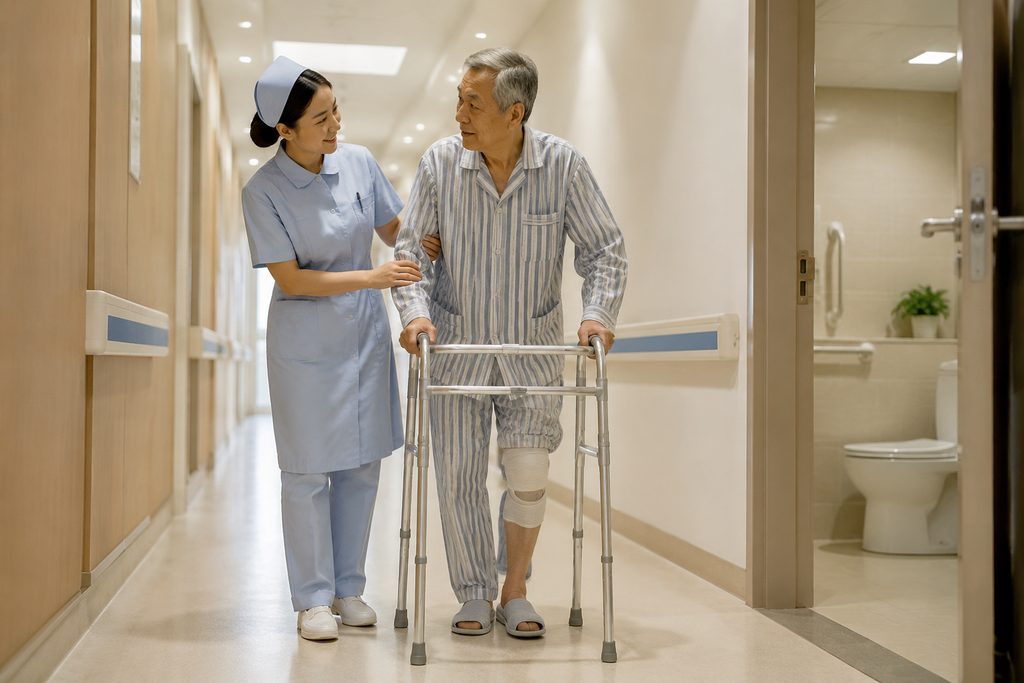
This is the day that often surprises our patients. The drain comes out. The physiotherapist arrives. You will sit on the edge of the bed. And then, with a walking frame, you will stand. You will take a few steps. It is painful. The team will manage this with ice and medication. The goal is not distance. The goal is to prove to your body—and your nervous system—that the new joint works. You will start continuous passive motion (CPM) machine therapy if your surgeon uses it, which bends and straightens the knee for you while you lie in bed. The target is 70 to 90 degrees of flexion within the first 24 to 48 hours.
Day 2-3: Building the Routine
The knee replacement recovery timeline hospital stay China follows a pattern of escalating activity. By day two, you will be walking to the bathroom with assistance. The intravenous lines usually come out. You switch to oral pain relief. Physiotherapy sessions happen twice a day. You will practice getting in and out of a chair. You will learn how to navigate stairs using a specific technique. The physiotherapist will push your knee into deeper flexion. It is uncomfortable. But every degree gained here is a degree you do not have to fight for later. Swelling peaks around day three. The protocol here is RICE: Rest, Ice, Compression, Elevation. The nursing team is relentless about this.
Day 4-5: Independence and Discharge Planning
By day four, most patients are independent with their walking frame on the ward. The focus shifts to discharge criteria. Can you get in and out of bed alone? Can you walk 50 meters on a flat surface? Is your wound clean and dry? Is your knee bending past 90 degrees? If yes, discharge planning accelerates. This is where the medical tourism knee replacement packages China offers become relevant. A well-structured package will not just cover the hospital. It will include a transition to a rehabilitation hotel or a serviced apartment with step-free access, daily nursing visits, and continued physiotherapy. Discharge from the acute hospital usually happens between day 4 and day 7.
Day 6-7 and Beyond: The Transition
You leave the hospital. But you do not leave the care pathway. The first two weeks after discharge are the highest risk period for complications like infection or stiffness. A good package will have arranged for a physiotherapist to visit your accommodation daily. You will continue the exercise program. You will transition from a walker to crutches. The staples or sutures come out around day 10 to 14. You should not fly long-haul immediately. Most surgeons recommend waiting at least 10 to 14 days post-surgery for a short-haul flight, and ideally 4 to 6 weeks for a trans-Pacific or trans-Atlantic flight to minimize the risk of deep vein thrombosis. We coordinate this entire post-hospital phase, ensuring you have a direct line back to your surgeon if anything feels wrong.
What You Need to Know Before Going Alone
The clinical pathway is robust. The administrative pathway, if you walk it alone, is full of friction. We see patients struggle with three specific barriers.
- Visa Navigation: China does not have a dedicated “medical visa” in the way some countries do. The applicable short-stay category is typically the S2 visa for private affairs, which requires supporting documentation from the hospital. The requirements shift based on the embassy. A generic invitation letter often fails. You need a specific format with the hospital’s official stamp, a clear treatment plan, and proof of financial coverage. Getting this right the first time avoids a rejected application and a delayed surgery date.
- Implant Selection and Cost Transparency: The knee replacement surgery cost China hospitals quote can be opaque. Some packages quote a base price for a standard implant, but if your anatomy requires a newer design or a constrained implant, the cost changes. You need someone who can read the Chinese-language quote line by line and verify the implant model against the surgeon’s plan. We do this. We ensure you know exactly what is being implanted and what you are paying for it.
- Post-Operative Logistics: Booking a rehabilitation-friendly hotel near the hospital is not as simple as using a booking site. You need a room with a walk-in shower, a raised toilet seat, and elevator access that actually works. You need to know where the nearest pharmacy is and which one stocks the specific low-molecular-weight heparin your surgeon prescribed. These are micro-logistical details that, if missed, turn a smooth recovery into a stressful scramble.
How We Help You Navigate This
Our process starts with your MRI and X-ray. We do not look at them clinically. We look at them logistically. A complex revision case needs a different hospital than a straightforward primary knee. We match your clinical data to the orthopedic departments with the highest volume in that specific procedure. We present you with a shortlist of the best knee surgery hospital China has for your particular condition—not a generic list, but a targeted one. We then facilitate the direct communication channel with the surgeon’s international patient coordinator. You ask the clinical questions. We handle the rest.
We guide the visa support letter process. We arrange the airport pickup with a vehicle large enough for a stiff leg. We book the pre-operative apartment and the post-operative recovery suite. We provide the interpreters who understand medical terminology—not just conversational Mandarin. And we stay with you through the recovery phase until you are cleared to fly home. We do not perform the surgery. We make sure everything around the surgery works so you can focus entirely on your rehabilitation exercises.
Frequently Asked Questions
Plan for 4 to 7 days in the acute care hospital. This is the standard for a primary total knee replacement without major complications. If you have significant comorbidities or if it is a complex revision, the stay may extend to 10 days. The discharge is not a fixed date on a calendar. It is criteria-based. You leave when you are medically stable, mobile, and your pain is controlled on oral medication.
No. The implants used in top-tier hospitals are the same globally recognized brands—Zimmer Biomet, Stryker, DePuy Synthes, Smith & Nephew. These are international medical device companies with strict regulatory standards. The cost difference is driven by lower hospital operational overheads and professional fees, not by using counterfeit or substandard materials. We always verify the implant registry and packaging with you before the procedure.
This is the most serious question, and it deserves a direct answer. A periprosthetic joint infection is a catastrophic complication wherever you have the surgery. The risk is roughly 1-2% globally. Before you leave China, your surgeon will provide a complete operative report, implant stickers with serial numbers, and a discharge summary in English. This allows your orthopedic surgeon at home to take over care seamlessly. The surgeon in China will also arrange a follow-up telehealth consultation. We ensure these handover documents are thorough. You are not abandoned once you board the plane.
Yes, and you should. Pre-habilitation improves outcomes. Your surgeon in China will send you a pre-op exercise protocol focusing on quadriceps strengthening and upper body conditioning for crutch use. The stronger your leg is before surgery, the easier the first stand will be on Day 1. We help translate and deliver this protocol to you weeks before your flight.
Your Next Step
A knee replacement is a major decision that reshapes your mobility for decades. Where you have it done reshapes the experience—the cost, the waiting, and the recovery support. The clinical infrastructure in China’s top orthopedic centers is world-class, built on a foundation of relentless surgical volume and rapid rehabilitation protocols. The challenge is not the medicine. The challenge is the bridge between your home and the operating theater. If you are considering this path, start with information. Look at the data. Compare the implant options. And if the logistical barriers seem too high to climb alone, that is exactly what our team is here to handle.
For more medical information and treatment options in China, visit tochinamed.com (ToChinaMed).