Hospital Pain Management in China: How Foreigners Get Relief and Communicate Pain
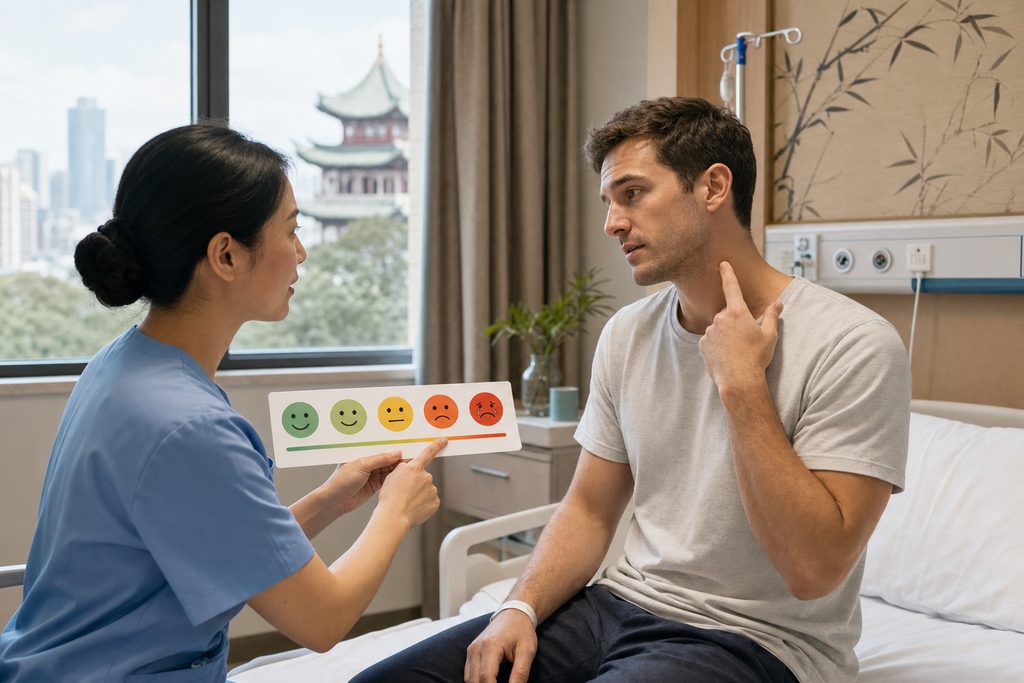
Pain is a universal experience. But describing it in a foreign country, where the medical culture, language, and even the pain scale are different, can leave you feeling stranded. You are not just battling physical discomfort. You are fighting to be understood. The question of pain management hospital China cost adds another layer of stress. Will you get effective relief? Will the bill be a second shock? Our team has guided hundreds of international patients through this exact scenario. We do not provide medical treatment. We are your logistical architects, bridging the gap between you and China’s top-tier pain specialists. We handle the complexity so you can focus on recovery.
Key Takeaways
- China’s top pain centers use a multidisciplinary model that often costs 50-70% less than comparable US programs, with transparent cash-pay pricing.
- The biggest barrier is not clinical quality—it is the communication gap. Using the wrong word for “pain” can lead to a completely different treatment path.
- Strict opioid regulations mean a foreigner cannot simply expect strong painkillers on demand; understanding the system is non-negotiable.
- You need a clear strategy for describing your pain, choosing the right hospital type, and navigating payment before you ever set foot in a consultation room.
The Problem: When Pain Gets Lost in Translation
Imagine sitting in a pristine Beijing consultation room. The doctor looks at you expectantly. You say, “The pain is sharp, like a knife.” The interpreter pauses. In Chinese medical terminology, a direct translation might be understood as a physical cut, not a neuropathic sensation. A study published in the Journal of Pain Research highlights how cultural and linguistic nuances directly impact pain assessment accuracy. For a foreigner, this is not a minor inconvenience. It is a critical failure point. Around 20% of international patients report that inadequate pain communication was their primary source of dissatisfaction during a hospital stay abroad. The result? Under-treatment, unnecessary diagnostic scans for the wrong thing, and prolonged suffering.
Standard Western pain scales, like the 0-10 Numeric Rating Scale, are used in China. But the cultural interpretation of a “7” can differ wildly. Add to this the anxiety around what pain management hospital China cost will be, and many patients clam up. They minimize their pain to avoid expensive interventions, or they exaggerate it, fearing they will not be taken seriously. Both paths lead away from genuine relief. The system has the clinical firepower to help you. The challenge is plugging into it correctly.
Who We Are
We are ToChinaMed, an independent medical information platform. We are not a hospital, and we do not charge patients for our guidance. Our mission is to provide objective, data-backed intelligence that helps you make informed decisions about seeking medical care in China. We maintain the most current English-language database of China’s top-ranked public and private international hospitals. Think of us as your research arm, your pre-travel briefing, and your cultural translator, all rolled into one. We connect you with the right information so you can approach your medical journey with clarity, not confusion.
Why China’s Pain Management Model Delivers Results
Pain management in China’s leading hospitals is not just about handing out pills. It is a structured, often aggressive, multi-modal approach. The structural reasons for this are compelling, and they directly address the dual concerns of efficacy and pain management hospital China cost.
The Volume-Expertise Connection in Interventional Pain
A top-tier pain specialist at a high-volume center like Beijing’s Xuanwu Hospital or Shanghai’s Sixth People’s Hospital performs an extraordinary number of procedures annually. A single attending physician might guide over 400 nerve blocks or radiofrequency ablations in a year. By comparison, a typical pain physician in a Western private practice might perform 50 to 100. This high case volume breeds a specific, hard-won pattern recognition. They have seen your particular pain presentation—whether it is post-herpetic neuralgia or a complex spinal facet joint issue—dozens of times. This clinical density directly translates to faster, more accurate interventional decisions. Fewer trial-and-error injections. More precise targeting.
Integrated Traditional Techniques as First-Line Tools
Western medicine often treats acupuncture as a complementary afterthought. In a Chinese pain management protocol, it is frequently a first-line, insurance-covered tool deployed alongside physiotherapy and pharmacology. This is not a cultural nod. It is a cost-containment and efficacy strategy. For conditions like chronic lower back pain or chemotherapy-induced peripheral neuropathy, integrating acupuncture early can reduce the need for escalating to stronger systemic medications. This integrated approach is a key reason why the overall pain management hospital China cost stays lower. You are paying for a bundle of effective, non-competing therapies, not a linear, expensive sequence of single treatments. Our team has seen patients reduce their reliance on oral analgesics by 30% within the first two weeks of an integrated inpatient program.
Rapid Access to Advanced Diagnostics
Waiting is painful. Literally. In many public health systems, waiting 6 weeks for an MRI to investigate persistent nerve pain is standard. In a Chinese top-tier hospital, the operational tempo is different. Imaging suites often run 12 hours a day, six days a week. It is common for an international patient to have a consultation, a 3-Tesla MRI, and a review of the images with a preliminary treatment plan within 24 to 48 hours. This diagnostic velocity prevents the spiral of chronicity. Pain that is treated within weeks of onset has a much higher chance of complete resolution than pain that has been allowed to carve deep neurological pathways for months. The system is built for speed, not just for the patient’s comfort, but because it demonstrably improves long-term outcomes.
How to Describe Pain to a Chinese Doctor
This is the single most actionable skill you can develop before your trip. The search for an English speaking pain specialist Beijing or Shanghai is valid, but even with a fluent doctor, you must transmit your internal experience with precision. Do not just say “it hurts.” Use a framework.
First, categorize the sensation. Doctors in China are trained to listen for specific descriptors. Is it suan (酸痛)? This is a deep, dull, aching soreness, often associated with muscle fatigue or a chronic joint condition. Is it zhang (胀痛)? This is a distending, pressure-like pain, common with inflammation or fluid buildup. Is it ci (刺痛)? A sharp, stabbing, needle-like pain, pointing toward nerve involvement. Simply learning these three words can bypass a 10-minute confusing exchange. Write them down. Point to them. Second, map the timeline. Draw a simple 24-hour clock on a piece of paper. Shade the hours when the pain is worst. Is it 3 a.m. inflammatory pain that wakes you? Or 4 p.m. mechanical fatigue pain? This visual tool transcends any language barrier.
Third, define the functional loss. Do not just rate your pain a 7. Say, “I cannot grip a coffee cup,” or “I cannot walk 200 meters without stopping.” Functional benchmarks are universal medical currency. A Chinese rehabilitation specialist will lock onto “cannot grip” faster than any numeric score.
What You Need to Know Before Going Alone
The clinical resources are world-class. The administrative pathway, however, is not designed for a solo foreign traveler. We have seen highly capable people get stuck on solvable problems. Here are the genuine barriers.
- Visa Category Precision: You cannot just fly in on a tourist (L) visa and register for a 2-week inpatient pain program. The appropriate short-stay category for private medical treatment is typically the S2 visa. The application requires a formal invitation letter or medical treatment confirmation from the hospital, stamped with the institution’s official seal. Embassy requirements shift, and a document mismatch means a rejected application and a delayed trip. We guide you on exactly which documentation package the specific consulate needs right now.
- Payment System Silos: A leading international medical tourism pain relief packages China provider might quote you a clear price. But what if you need an unexpected consultation with a neurologist? Many hospital payment systems are siloed. Your international credit card might work for the main hospitalization deposit but fail at the outpatient pharmacy or the rehabilitation department’s separate POS machine. WeChat Pay and Alipay dominate. A foreign card linked to these platforms often has a single-transaction limit of around 5,000 to 20,000 RMB, which is nowhere near enough for a hospital deposit. You need a strategy for large-sum domestic transfers before you are standing at the admissions desk in pain.
- Medical Records That Actually Work: Handing over a 100-page PDF of your medical history from home is not helpful. A Chinese specialist needs a concise, translated summary: timeline of the condition, key imaging findings, exact names and dosages of all previous medications (including generic names), and a list of failed treatments. Without this, the first expensive day of your program is wasted on re-establishing what you already know. We provide a standardized medical summary template that Chinese physicians find immediately actionable.
Navigating Medication: Can a Foreigner Get Strong Painkillers in China?
The direct answer to “can a foreigner get strong painkillers in China” is yes, but under a strictly controlled, diagnosis-driven protocol. China has one of the world’s tightest regulatory frameworks for opioids. You will not receive a prescription for oxycodone or morphine simply because you show an old script from home. The process is specific. A hospital-based pain specialist must issue a diagnosis that justifies the prescription. They will use a special “red prescription” form, which is tightly audited. For an inpatient, the medication is administered by nurses, often with a dual-signature verification. For an outpatient, you will typically receive only a 3 to 7-day supply at a time, requiring frequent follow-ups. This system is designed to prevent diversion and dependency, not to punish patients in genuine need. But if you walk in expecting the prescribing norms of a Western country, you will feel stonewalled. We prepare you for this reality. We explain the documentation required—imaging proof, nerve conduction studies, surgical history—that gives the Chinese physician the legal and clinical confidence to prescribe appropriately. The medication is available. The pathway to it is just different.
Understanding the Cost Structure
Let’s address the central question of pain management hospital China cost directly. A comprehensive, multi-week outpatient interdisciplinary pain program at a top-tier public hospital might range from 15,000 to 40,000 RMB. A similar program in the US, even with insurance, could leave you with a co-pay in excess of $10,000. An international patient pain management Shanghai price at a premium private hospital like Jiahui or United Family will be higher, reflecting the hotel-like amenities and full English-language administrative support. Here, a specialist consultation fee is typically 1,500 to 3,000 RMB, and an epidural steroid injection might cost 8,000 to 15,000 RMB. These are all-in cash prices. The transparency can be startling. You know the cost before the needle touches your skin.
The reason for the value is structural, not a discount on quality. Lower labor costs for nursing and support staff, high patient throughput, and a government-mandated focus on cost-effectiveness in public institutions all compress the price. The private international hospitals benchmark their prices against regional competitors like Singapore and Thailand, not New York or London. This is why many medical tourism pain relief packages China offer a compelling financial proposition. You are accessing board-certified specialists, often trained in the US or Europe, within a system that has a fundamentally different cost base. For a deeper look at how hospital rankings reflect clinical quality, our database of the top 100 hospitals in China provides a detailed, department-by-department breakdown.
How We Help You Navigate This
We do not book appointments for you. We do not take a commission from any hospital. What we do is give you the precise map you need to navigate this journey independently and confidently. You might come to us overwhelmed by the options, unsure if you need a public medical giant or a boutique international clinic. We help you answer that question based on your specific pain condition, your budget, and your communication needs.
We can show you how to find an English speaking pain specialist Beijing or Shanghai by pointing you to the specific departments and physicians who publish in international journals and run accredited international medical centers. We explain the visa documentation you need, the payment system workarounds, and how to have your medical records translated into a format that a Chinese specialist can absorb in under 90 seconds. Our role ends where the clinical interaction begins, but we ensure you walk into that room prepared, informed, and fully in control of the non-medical aspects of your care. If you are comparing options, our guide to China’s top 50 private international hospitals is a practical starting point for understanding the landscape of English-friendly facilities.
Frequently Asked Questions
Yes, if you communicate it in their clinical language. Pain medicine in China has evolved significantly, and specialists at top centers are fully trained in recognizing neuropathic and centralized pain syndromes. The key is to describe the functional impact and use the specific sensory descriptors they are trained to identify, rather than relying solely on an emotional expression of distress.
No. A legitimate medical tourism pain relief packages China provider structures the program as a baseline, but clinical reality dictates changes. If a planned series of nerve blocks is ineffective after the first trial, the specialist will pivot. You pay for the services actually delivered, not a rigid pre-set menu. Always confirm this flexibility before committing to any program, and we can advise you on what questions to ask.
The active pharmaceutical ingredients are the same—morphine, oxycodone, fentanyl, gabapentin, pregabalin. The brand names may differ, and the available delivery systems (such as specific transdermal patches) might vary. A Chinese pain specialist will prescribe based on your diagnosis, and you can discuss equivalent medications if you have a known effective regimen from your home country.
This is a primary logistical hurdle. International bank transfers to the hospital’s account are the most reliable method for large deposits, but they take 3-5 business days. Some private international hospitals accept major credit cards for the full amount, but you must verify their limit. We guide you through setting up a payment pathway that ensures your admission is not delayed by a declined card.
Your Next Step
Pain demands a solution, not a bureaucratic battle. The expertise exists in China to diagnose and treat your condition with a speed and thoroughness that can feel impossible to find at home. The path to that relief is navigable, but it requires specific, practical knowledge that is not available on a hospital’s homepage. Start your research with a clear, objective foundation. Understand the landscape, the real costs, and the communication tools you will need. When you are ready to take the next step, we are here to provide the information that makes your decision a confident one.
For more medical information and treatment options in China, visit tochinamed.com (ToChinaMed).