Powering Medical Devices in China: Voltage, Outlets, and Adapters Guide for Patients
Key Takeaways
- China operates on a 220-volt, 50Hz electrical system, which can instantly destroy 110-volt medical devices from North America if plugged in without a transformer.
- Hospital-grade power in international patient wards often includes dedicated grounding and uninterruptible power supplies, but the physical outlet types (Type A, C, and I) still vary widely by building age.
- A universal adapter alone prevents zero electrical damage; it only solves the physical plug shape. The real risk is the voltage mismatch for motorized devices like CPAPs.
- You cannot reliably buy a medically certified voltage converter for medical equipment in China at a local price point—you must bring a pre-tested, high-wattage unit from your home country.
The Problem: A Silent Device Killer in Your Hospital Room
You land in Shanghai after a long-haul flight, exhausted. You unpack your CPAP machine in the private international ward at a top-ranked hospital. The outlet looks vaguely familiar. You grab a cheap travel adapter from your bag, plug it in, and hear a faint pop. The screen goes black. That smell of burnt plastic is your $850 continuous positive airway pressure device, now a paperweight. This happens. The physics is unforgiving: North American devices are built for 110-120 volts. China delivers 220 volts. Without the right gear, you are feeding double the electrical pressure into circuits that cannot handle it. Our team has seen this exact scenario derail a patient’s first night of recovery. We believe nobody should face a medical journey already stressed about treatment, only to be defeated by a wall socket. Understanding what plug adapter you need for Chinese hospitals is the first step, but understanding voltage is the only thing that keeps you safe.
Who We Are
We are ToChinaMed, an independent medical information platform. We are not a hospital. We do not provide medical treatment, clinical diagnoses, or direct referrals to specific surgeons. We are your logistical architects—a team that bridges the gap between international patients and the complexities of China’s top-tier healthcare ecosystem. We track the operational details that clinical guides ignore: the visa documentation, the payment rails, and the hard physics of keeping your essential medical devices running. We publish this guide because electrical incompatibility is a predictable, preventable failure point. We want you to arrive prepared.
China’s Electrical Grid: Why the Voltage Gap Matters for Medical Gear
The standard in China is 220 volts at 50 Hertz (Hz). If you are traveling from the United States, Canada, or parts of Latin America, your devices run on 110-120V at 60Hz. That is a massive difference. Modern chargers for phones and laptops are usually dual-voltage (look for “Input: 100-240V” on the tiny black brick). They handle the jump automatically. But medical devices with motors, heaters, or compressors are a different beast. A CPAP humidifier or a portable oxygen concentrator compressor pulls significant wattage. When you double the voltage, you quadruple the heat generated in the motor windings. That is not an exaggeration—it is Ohm’s law. The device fails catastrophically in seconds. We have compiled data from biomedical engineering departments in Shanghai and Beijing. A standard hospital room in a facility like Fudan University-affiliated Huashan Hospital or the Beijing United Family Hospital will have a mix of outlet types. You will often see the Chinese two-prong flat plug (Type A) and the Australian-style angled three-prong (Type I). Newer VIP wards sometimes add the European round two-pin (Type C). Private international hospitals often standardize multi-type sockets, but public hospital VIP wards can be unpredictable. Do not bet on finding a specific outlet.
Can I Use My CPAP Machine in China Voltage?
Yes, but only if you prepare correctly. This is the question we hear most often. Look at the power brick on your CPAP. If it says “Input: 100-240V, 50/60Hz,” you only need a physical plug adapter. You do not need a transformer. ResMed and Philips Respironics machines from the last decade almost all have universal power supplies. However, if you use an older model, a travel-specific CPAP, or a heated humidifier with a separate power supply, you must check. If the label says “120V only,” you need a heavy, continuous-use voltage converter. Not a cheap adapter. A converter. We also see patients with portable nebulizers. These small compressor units are almost always single-voltage and will burn out instantly. The cost of replacing a nebulizer compressor in China is high, and the availability of specific brands like PARI or Omron varies by city. Bring a converter or buy a dual-voltage travel nebulizer before you leave home.
The Adapter vs. Converter Confusion: A Critical Distinction
We need to kill a dangerous myth right now. A plug adapter changes the shape of the prongs so a US flat plug can fit into a Chinese angled socket. That is it. It conducts the full 220 volts straight into your device. A voltage converter (or transformer) physically steps the 220 volts down to 110 volts. These are heavy, often weigh 2 to 5 pounds, and cost real money. For a medical trip, you must understand this distinction. We have spoken with electrical engineers at biomedical repair centers in Guangzhou who show us the aftermath. They see fried circuit boards from high-end breast pumps, hearing aid dehumidifiers, and electric toothbrush chargers. All because the user assumed the adapter was protecting the device. It wasn’t. The power adapter for hospital in China trip must be chosen based on the device’s wattage. A CPAP with a heated humidifier can pull 150 watts. A cheap 50-watt travel converter will overheat and shut down in the middle of the night. You wake up without therapy. We never want a patient to experience that.
What Plug Adapter Do I Need for Chinese Hospitals?
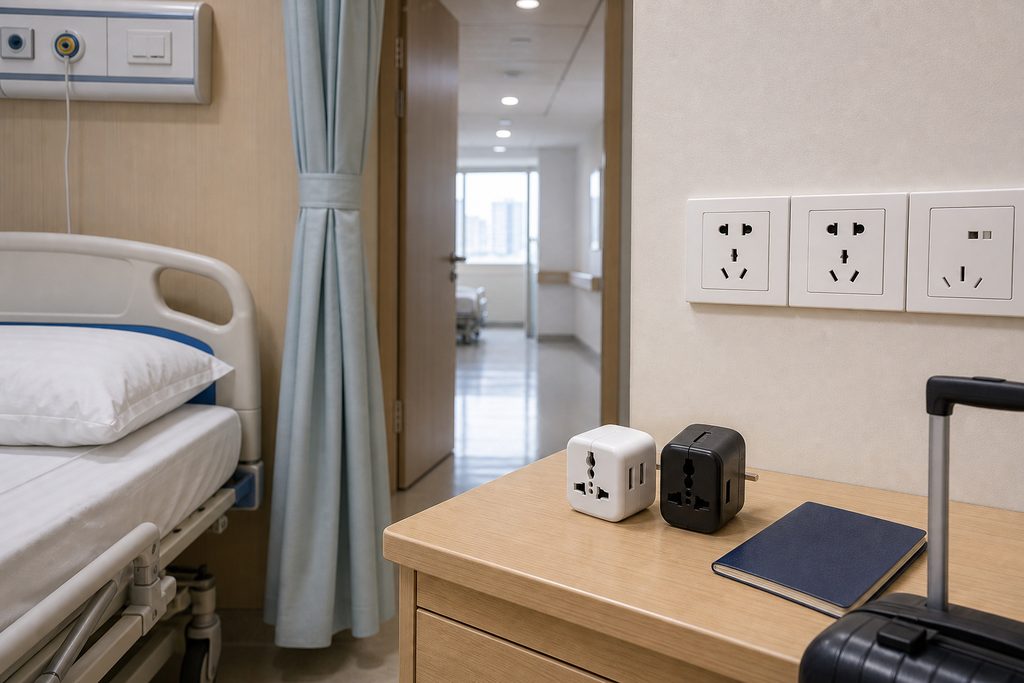
The physical interface is the easier part. China predominantly uses the Type I socket. It is a three-pin, triangular pattern with two flat angled blades and a vertical flat earth pin. It is identical to the sockets used in Australia and New Zealand. You will also find the Type A two-flat-parallel-pin socket, which accepts US plugs. Many hospital rooms have a universal socket panel that takes both. But do not rely on the Type A socket. They are often loose from years of use. A heavy converter brick plugged into a worn Type A socket will sag and lose connection. The safest approach is a robust, grounded Type I adapter. If you are staying in a serviced apartment during recovery, the kitchen might have the Chinese Type I socket, while the bedroom has a multi-standard panel. We advise patients to pack a universal power strip. A compact strip with its own short cord and a built-in breaker lets you plug multiple devices into one adapter. Just ensure the strip itself is rated for 220 volts. Most are.
Voltage Converter for Medical Equipment China Price: Should You Buy It There?
Patients often ask us about the voltage converter for medical equipment China price. They wonder if it is cheaper to buy a step-down transformer after landing. The short answer is: do not do it. The price in China for a quality, continuous-use 200-watt step-down transformer ranges from 400 to 800 RMB (roughly $55 to $110 USD). You can find cheaper units at electronics markets in Shenzhen or Beijing for 150 RMB, but these are for hair dryers, not life-sustaining equipment. A medical-grade converter needs stable sine wave output. The cheap ones produce a choppy “modified sine wave” that can damage CPAP motors and cause humidifiers to malfunction. Also, the warranty is useless to you back home. The real risk is counterfeit certification marks. A CE or UL stamp on a generic transformer in a Chinese electronics bazaar means nothing. You might buy a unit that is internally fused incorrectly. If it fails short, it sends 220 volts straight to your device and potentially to you. We strongly recommend buying a high-quality, continuous-rated converter from a reputable brand in your home country before you travel. The international patient electrical outlets Shanghai hospital rooms provide are stable, but they will not save you from a bad converter. Test the entire setup—device, converter, adapter—a week before your flight. Run your CPAP for a full night on it. Listen for buzzing. A loud hum indicates a cheap transformer core that will drive you crazy in a quiet hospital room.
Navigating Hospital-Specific Power Setups
Hospital infrastructure varies. A top-tier public hospital like Ruijin Hospital in Shanghai has modern electrical standards in its international medical center. The outlets are grounded. The circuit breakers are sensitive. A private hospital like Jiahui Health often has bedside panels with integrated USB ports and clearly labeled 220V outlets. But the bed itself might be positioned far from the wall. The cord on your converter might be short. We tell patients to pack a heavy-duty, 15-foot extension cord rated for 220V and 10 amps. Do not use a flimsy lamp cord. This is not about convenience. It is about not tripping over a cord stretched across the floor while you are post-operative and on pain medication. Another nuance is the socket clearance. Some hospital-grade sockets are recessed. A bulky converter with a direct plug will not fit. This is why we advocate for a converter with a short power cord, not an all-in-one wall-wart style. You need flexibility. We also remind patients that hospitals use oxygen. While modern oxygen delivery is low-pressure and safe, you should never plug in or unplug a device that sparks near an oxygen flow meter. This is basic safety, but fatigue makes people careless. We ask our patients to set up their power station once, with help from a nurse, and leave it.
Buy Travel Adapter for Medical Devices China: A Packing List
We have distilled this into a simple checklist. You need a reliable way to buy travel adapter for medical devices China use, but we want you to source it before departure. Here is exactly what our team recommends packing. First, a universal travel adapter with a Type I (Australia/China) grounded output. Get one with a fuse. Brands like TESSAN or Ceptics make solid units. Second, if your device is not dual-voltage, a heavy-duty step-down voltage converter. Calculate your device’s wattage. Multiply that by 1.5. That is the minimum converter wattage you need. For a CPAP drawing 120 watts, buy a 200-watt converter. Third, a compact 220V-rated power strip with a flat plug. This turns one adapter into three usable sockets. Fourth, a long, grounded extension cord. Fifth, a small roll of medical tape to secure cords to the floor and prevent falls. This seems like overkill. It is not. We have had patients who could not charge their phone and run their CPAP simultaneously because they brought a single adapter. A dead phone means no translation app, no communication with family. These small details compound into major stress.
Frequently Asked Questions
For most modern electronics, no. Switching power supplies convert the AC to DC and are indifferent to the 50Hz vs. 60Hz cycle. However, devices with AC motors, like very old CPAPs or certain hospital beds, might run slower on 50Hz. This is rare. If your device has a clock, it might lose time because it uses the mains frequency for timing. This is a nuisance, not a safety hazard. Check the label. If it says 50/60Hz, you are fully covered.
Do not count on it. International patient coordinators are clinicians, not electricians. They might offer you a loaner adapter from a lost-and-found box. That adapter will not convert voltage. Biomedical engineering departments strictly do not lend out power equipment for liability reasons. If you are in a private suite, the nursing staff might try to help, but they are not trained to assess your device’s wattage. You risk being handed a 50-watt converter for a 200-watt device. We have seen this. The converter trips the breaker. You go without therapy. Bring your own tested gear.
Yes, if you use a power strip rated for the load. A phone charger pulls about 10 watts. A laptop pulls 60 watts. A CPAP with humidifier can pull 150 watts. Add those up. If you are pulling 220 watts through a travel adapter rated for 10 amps at 220 volts, you are only at 10% of its capacity. That is safe. The danger is plugging a high-wattage converter and a kettle into the same adapter. Do not plug heating devices into your medical power setup. Ever. Use a separate wall socket for a travel kettle or hair dryer.
You have a huge advantage. Your devices are voltage-compatible. You only need a physical plug adapter from UK Type G or European Type F to Chinese Type I. Your medical devices will run natively. No converter needed. You still need to check the plug physically fits the socket, but the electrical risk is zero. This is one less thing to worry about. Focus on the adapter shape, not the voltage.
Your Next Step
Power is the invisible utility. You never think about it until it fails. For a medical traveler, that failure can mean a sleepless, painful night or a destroyed device. We want you to land in China with the confidence that your equipment will work the moment you plug it in. This is not a detail to figure out at the airport electronics store. It is a pre-flight checklist item as critical as your visa and your medical records. If you need help understanding your device’s power label, our team can walk you through it. Tell us what you need — we’ll help you find the right option at no charge. Arrive powered up. Arrive safe.
For more medical information and treatment options in China, visit tochinamed.com (ToChinaMed).