Hospital Bed and Linen Changes in China: Cleaning Schedules and What to Expect
In a 2023 survey by the Chinese Hospital Association, over 92% of tertiary hospitals reported strict adherence to twice-daily surface disinfection protocols. Compare that to a 2018 study in *Clinical Microbiology Reviews* which found that hospital-acquired infection rates can spike by 30% when environmental cleaning frequency drops below once per shift. The gap between protocol and perception is where anxiety lives. You’re not just wondering if the sheets are clean. You’re wondering if the system is safe.
We get that.
Our team operates at the intersection of international patient expectations and the operational realities of China’s best medical institutions. We are not a hospital. We do not provide clinical treatment. We are your logistical architects—translating standards, verifying credentials, and ensuring the environment you step into meets a benchmark you can trust before you ever pack a bag.
Understanding Hospital Room Cleaning Standards in China
The question “how often do hospitals change bed sheets in China” sits at the top of nearly every intake call we have. It’s a proxy for a deeper concern: Is the hygiene culture compatible with what I expect?
The short answer is daily. But the real answer is more layered.
China’s top-tier public hospitals and JCI-accredited international wings operate on a hierarchy of hygiene that rivals the best facilities in Singapore or Germany. The National Health Commission’s *Regulations for Hospital Infection Management* mandate terminal disinfection of surfaces after patient discharge and routine cleaning of occupied rooms no less than twice daily. Bed linens follow a strict daily change protocol in most surgical and internal medicine wards, with additional changes triggered by visible soiling.
But not all hospitals are created equal. A county-level public hospital in a third-tier city operates under the same national regulations but with vastly different enforcement rigor and resource allocation. That’s where the risk lives. You need to know the difference.
Daily Linen Protocols: What “Daily” Actually Means
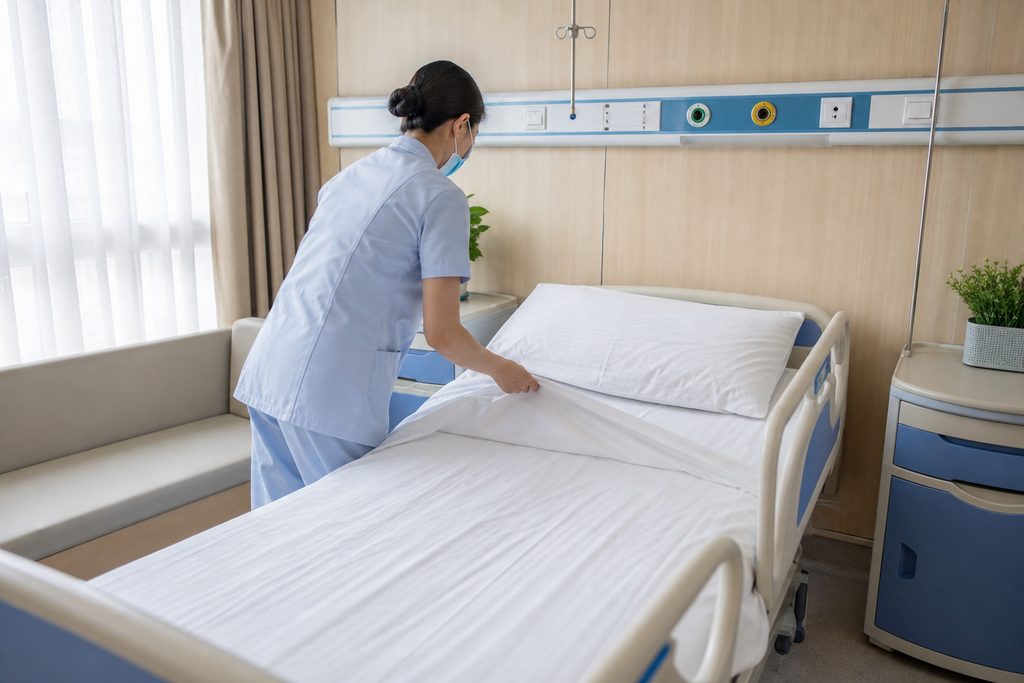
In a standard ward, housekeeping staff typically change bed sheets, pillowcases, and duvet covers between 7:00 AM and 9:00 AM. The used linen is bagged at the bedside into color-coded, leak-proof containers. Red bags for biohazardous materials. White bags for standard soiled linen. The bags are sealed and transported through dedicated soiled corridors to an in-house or contracted industrial laundry facility.
The washing process is where standards converge. Hospital linen hygiene protocols in China JCI-accredited facilities follow the same thermal disinfection parameters you’d find at Cedars-Sinai or Charité Berlin: a wash cycle at 71°C (160°F) for a minimum of 25 minutes, or a low-temperature chemical disinfection process using a registered hospital-grade disinfectant. The China CDC’s 2021 technical guidelines for hospital linen management specify a microbial count limit of ≤200 CFU/100cm² on cleaned textiles. That’s not a suggestion. It’s a measurable, auditable standard.
What you’ll notice as a patient is the rhythm. The morning change is predictable. If you’re post-operative, the nursing team coordinates the linen change with your wound assessment. You won’t be asked to vacate the bed. They work around you.
Surface Disinfection and Room Cleaning Schedules
Hospital room cleaning standards in China follow a frequency hierarchy based on risk zones. High-touch surfaces—bed rails, call buttons, over-bed tables, door handles—are wiped down with a quaternary ammonium compound or 500mg/L chlorine-based disinfectant at least twice per shift. Floors are wet-mopped with disinfectant solution once in the morning and once in the afternoon.
The patient bathroom is cleaned once daily in standard wards. In VIP and international wards, it’s often twice.
What’s different from some Western hospitals is the visibility of the process. Cleaning carts are a common sight in corridors during daytime hours. The staff wear identifiable uniforms. You’ll see them working. For some international patients, this transparency is reassuring. For others, the frequent presence of cleaning staff in the room feels intrusive. We tell our patients to expect it, and to communicate their preference. The nursing station can often adjust the timing to accommodate your rest schedule.
And here’s a detail that matters: in many Chinese hospitals, the patient’s family member or hired caregiver is expected to handle certain non-clinical cleaning tasks—wiping down the bedside cabinet, fetching hot water, managing personal waste. This is a cultural norm, not a failure of housekeeping. But if you’re a foreign patient traveling alone, it can feel like a gap in service. This is where choosing the right hospital tier makes all the difference.
VIP Hospital Room Package Price Shanghai and What You Get
If the standard ward dynamic sounds like a lot to manage, the VIP and international ward options in Shanghai offer a completely different experience—and a different price point.
VIP hospital room package prices in Shanghai range from approximately 1,500 RMB to 6,000 RMB per night (roughly $210 to $840 USD). That’s not an incidental upgrade. That’s a structural shift in how care is delivered.
What does that package typically include? A private room with an ensuite bathroom, a dedicated nursing team with English proficiency, an enhanced housekeeping schedule with on-demand linen changes, and meals that accommodate dietary restrictions. The room itself is more hotel than hospital: hardwood or vinyl plank flooring instead of institutional tile, a sofa bed for a companion, a flat-screen TV, and sometimes a small refrigerator.
The housekeeping standard in these units is closer to what you’d expect in a five-star hotel. The daily linen change is standard. But you can request a second change, and it will happen. Surfaces are disinfected three times daily. The bathroom is cleaned twice. The air is filtered through a dedicated HEPA unit in some facilities.
We’ve seen patients at Shanghai Huashan Hospital’s International Medical Center and Jiahui International Hospital report satisfaction scores on room cleanliness that match or exceed their experiences at private hospitals in their home countries. The cost is real. But for a two-week post-operative stay, the difference between a standard four-bed ward and a VIP suite is the difference between feeling like a patient and feeling like a person recovering.
What to Expect During a Hospital Stay in China as a Foreigner
Let’s walk through the first 24 hours.
You arrive on the ward. The head nurse or ward manager checks you in. Your bed is made with crisp, white linens—a visual signal of cleanliness that’s deliberately maintained. The over-bed table is bare and wiped down. The bathroom has a fresh roll of toilet paper and a small bar of soap. You’ll likely need to bring your own towel, though VIP wards usually provide them.
Within the first hour, a nursing assistant will take your vital signs. The housekeeping staff will not enter during clinical procedures. There’s a choreography to it.
Meal times are fixed. Breakfast at 7:00 AM, lunch at 11:30 AM, dinner at 5:00 PM. The food arrives on a tray. You eat at your bedside. The tray is collected within 30 minutes of the meal ending. The over-bed table is wiped down immediately after.
What surprises many Western patients is the frequency of human presence. Nurses round frequently. Doctors round in teams, often in the morning. Family members of other patients may be in the corridor. It’s not quiet. It’s not private in the way a single-occupancy room in a US hospital is private. Unless you’re in a VIP suite, you’ll share a room with two to three other patients. Curtains provide visual privacy. They do not provide soundproofing.
We tell our patients this upfront. The best hospital housekeeping services in Beijing medical tourism cater to exactly this concern: private rooms, English-speaking staff, and housekeeping schedules that you control. Facilities like Beijing United Family Hospital and OASIS International Hospital have built their reputations on this predictability. If the uncertainty of a standard ward feels like too much, these options exist. They cost more. But the value is in the peace of mind.
How We Help You Match the Right Environment to Your Needs
We don’t clean rooms. We don’t change sheets. What we do is make sure you know exactly what environment you’re choosing before you arrive.
That starts with understanding your non-negotiables. Do you need a private bathroom? Is daily linen change sufficient, or do you require on-demand service? Are you traveling with a companion who will stay in the room? These questions shape the hospital recommendation.
We connect you with facilities that match your hygiene and comfort expectations, drawing from both the public hospital VIP wards and the private international hospital sector. We verify JCI accreditation status, review patient satisfaction data where available, and provide you with a clear, written summary of what the room, the cleaning schedule, and the nursing workflow will look like.
One patient we worked with—a 67-year-old Canadian undergoing a hip replacement—told us his biggest fear wasn’t the surgery. It was the shared bathroom. We directed him to a private international hospital in Shanghai where every room is a single suite with an ensuite. His surgery cost more than it would have at a public hospital. But he told us afterward: “I recovered faster because I slept better.” That’s not clinical data. But it’s real.
Frequently Asked Questions
Yes, in accredited facilities. The standard thermal disinfection cycle runs at 71°C for 25 minutes or uses a validated chemical alternative. JCI-accredited hospitals in China follow the same linen hygiene protocols required in the US and Europe. The China CDC publishes enforceable microbial limits for cleaned hospital textiles.
In VIP and international wards, yes—usually at no additional charge. In standard public hospital wards, you can request an extra change, but it may not happen the same day unless there is a medical reason or visible soiling. Housekeeping resources in standard wards are scheduled tightly. We recommend clarifying this with the nursing station on admission day.
Speak to the head nurse immediately. In our experience, most issues are resolved within hours. If the problem persists, request a room transfer. In private international hospitals, this is straightforward. In busy public hospitals, transfers depend on bed availability. We advise our patients on how to escalate effectively and can intervene on their behalf if communication breaks down.
In standard wards, yes—towels, toilet paper, soap, and slippers are typically not provided or are minimal. VIP and international wards usually supply towels, basic toiletries, and sometimes a welcome kit. We provide a packing checklist tailored to your specific hospital before you travel.
Look for JCI accreditation. It’s the most reliable external validation of hospital-wide hygiene and safety protocols. You can verify a hospital’s JCI status on the JCI website. We also review a facility’s infection control audit history and patient-reported outcomes where available. Not all excellent hospitals are JCI-accredited—some top public hospitals follow equally rigorous national standards without the international certification—but JCI status removes guesswork.
A clean room does not guarantee a good outcome. But a dirty room almost certainly compromises one. The standards exist. The protocols are written. The enforcement, as in any country, varies by institution. Your job is not to audit the system. Your job is to choose a facility where the system audits itself. That’s what we help you do. If you’re considering treatment in China and want to understand what your hospital stay will actually look like—from the sheets to the surgery—start with a conversation. We’ll help you find the right option at no charge.
For more medical information and treatment options in China, visit tochinamed.com (ToChinaMed).