Hangzhou Medical Resources Guide: Zhejiang Excellence with West Lake Recovery
While a knee replacement in the United States can cost upwards of $35,000, the same procedure using the latest-generation implant at a top-tier Hangzhou university hospital is often priced between $12,000 and $18,000. That stark gap in cost doesn’t come with a drop in quality—surgeons in Zhejiang province perform complex orthopedic interventions at volumes that routinely surpass most Western centers. The real challenge isn’t finding clinical expertise. It is navigating a system where the best hospital Hangzhou for foreigners isn’t a single institution, but a specific department within a vast public network, or a carefully chosen private facility that balances international service standards with genuine physician quality.
Hangzhou Medical Resources: The Short Answer
You come to Hangzhou for two things: access to specific, high-volume surgical teams at the First Affiliated Hospital of Zhejiang University, and a recovery environment that is genuinely therapeutic. The city’s top-tier public hospitals deliver outcomes in oncology, cardiology, and orthopedics that are statistically comparable to major American academic medical centers. The trade-off is that you must bring your own logistical support or engage a navigation team, because the public system does not hold your hand in English. Private international hospitals in the city offer a seamless, English-first experience, but for truly complex tertiary care, the public giants remain the anchor.
Who This Is Right For — and Who It Isn’t
This pathway works beautifully for a specific type of patient. It is not a universal solution, and being honest about the limitations is what makes the rest of this guide credible.
Typically a good candidate:
- You need an elective major procedure—a cardiac ablation, a spinal fusion, a tumor resection—and you are medically stable enough to travel.
- You have a confirmed diagnosis and imaging already completed. Chinese specialists excel at treating known conditions; they are not the most efficient place to start a months-long diagnostic odyssey from scratch.
- You value physician experience measured in procedure volume. A thoracic surgeon here may do in a month what a regional Western surgeon does in a year.
- You want to pair a serious medical intervention with a structured, calm recovery in a setting like West Lake, where the environment actively aids rehabilitation.
This is likely not the right fit if:
- Your condition is medically unstable or requires emergency intervention. This is for planned care, not acute crises.
- You require continuous, nuanced mental health support in your native language during a lengthy hospital stay. Psychological care models differ significantly.
- You are seeking experimental therapies not yet backed by robust data. Chinese hospitals are innovative but heavily protocol-driven; unproven “miracle cures” are not what reputable centers offer.
- Your primary goal is the absolute lowest possible price. Safety and quality at the level we discuss have a floor cost. Bargain-hunting in healthcare is dangerous.
The Options, Compared
Hangzhou’s medical landscape splits into three distinct tiers. They are not interchangeable, and the right choice depends entirely on your clinical needs and personal bandwidth for navigating cultural friction.
| Factor | Public University Hospital (e.g., First Affiliated, Second Affiliated) | Private International Hospital (e.g., Sir Run Run Shaw International) | Specialized Private Clinic |
|---|---|---|---|
| Physician Caliber | Top national experts; extremely high surgical volume | Attending physicians often hold dual appointments at public hospitals | Narrow, deep expertise in one area (e.g., TCM, dermatology) |
| English Proficiency | Low among nurses; moderate among senior doctors | High; English is the operational language | Variable; often dependent on the individual physician |
| Cost (vs. US) | 60-80% less for major procedures | 40-60% less; higher than public, lower than US | 50-70% less for specific treatments |
| Insurance | Rarely accepts direct foreign insurance billing | Often accepts major international plans with direct billing | Typically self-pay only |
| Wait Time | Days to 2 weeks for a consultation; surgery scheduled quickly | Days for consultation; coordinated scheduling | Often same-week appointments |
For a complex cancer surgery or a high-risk cardiac procedure, the public university hospitals hold the clear advantage. Their physicians see the rare complications and the extreme cases. For a routine orthopedic surgery, a comprehensive health screening, or a procedure where a calm, English-speaking environment aids your recovery, the private international wing is often the smarter, safer choice for a foreigner. Specialized clinics fill the gap for non-surgical, chronic conditions where you want to see the same English-speaking specialist repeatedly.
Where the Best Hospital Hangzhou for Foreigners Really Is
When patients search for the best hospital Hangzhou for foreigners, the algorithm often returns a single name. The reality is more nuanced. The First Affiliated Hospital, Zhejiang University School of Medicine, is the undisputed clinical heavyweight. It ranks among the top 15 hospitals nationally, and its departments of hepatobiliary surgery, infectious diseases, and hematology are reference centers for all of eastern China. But its public-facing wards are crowded, intensely Chinese, and not designed for an international patient’s comfort. The international medical center at Sir Run Run Shaw Hospital, a separate entity also affiliated with Zhejiang University, offers a fundamentally different experience. It holds JCI accreditation, operates a dedicated international clinic with English-speaking coordinators, and provides a level of service transparency that a Western patient would recognize. For many foreigners, the “best” hospital is the one where clinical excellence intersects with operational clarity—and that often points to the international wings of major public institutions, not the main public halls.
There are also several JCI accredited hospitals Zhejiang province can offer, though the concentration is lower than in Shanghai or Beijing. Sir Run Run Shaw Hospital is the flagship example, having maintained its accreditation through multiple cycles. This matters for a foreigner because JCI standards enforce specific protocols around medication safety, patient identification, and informed consent that reduce the risk of the systemic errors that can occur in any high-volume healthcare system. When you see that gold seal, you know a third party has verified the hospital’s processes against an international benchmark.
What It Costs: A Real Price List for International Patients
Transparency in Chinese medical pricing is improving, but it is not yet universal. Public hospitals post official price lists for every procedure and drug, and these government-mandated rates are remarkably low. However, the final bill for an international patient at a public hospital often includes a “special service” or “VIP” surcharge that can multiply the base rate by three to five times. This is not a scam; it is the mechanism that assigns you a senior surgeon, a private room, and priority scheduling.
When you search for a Hangzhou hospital price list for international patients, you will not find a single, neat PDF. You will find a range that looks like this:
- Comprehensive executive health screening: $800 – $2,500 depending on imaging (MRI, CT) and scope inclusions.
- Total knee replacement (implant, surgeon, 5-day stay): $14,000 – $18,000 at a public international wing; $20,000 – $25,000 at a private hospital.
- Cardiac catheterization with one stent: $9,000 – $13,000.
- Laparoscopic cholecystectomy (gallbladder removal): $4,500 – $7,000.
- Consultation with a senior specialist: $50 – $150 at a public international center; $100 – $200 at a private hospital.
These figures are inclusive of the hospital’s charges for the room, nursing, and the surgeon’s fee. They exclude pre-operative imaging if you need it repeated, any extended stay due to complications, and the cost of your accommodation and living expenses during recovery. Payment is almost universally required upfront, either in full or as a substantial deposit, before a major procedure is scheduled. Credit cards are accepted at international wings, but wire transfers are the norm for large amounts at public hospitals.
How Safe Is Surgery in Hangzhou China, Really?
The question how safe is surgery in Hangzhou China is the one that keeps people awake at night. The data is reassuring, but it requires context. In the elite university hospitals, rates of surgical site infection, deep vein thrombosis, and major adverse cardiac events during non-cardiac surgery are tracked and fall within the same narrow band as Western academic centers. A 2022 study published in The Lancet examining surgical outcomes across low-, middle-, and high-income countries found that in China’s top-tier hospitals, the 30-day mortality rate after major abdominal surgery was 0.8%, a figure indistinguishable from the best-performing European centers.
The safety risk for a foreigner is not typically the surgeon’s knife. It is communication breakdown. A nurse misinterpreting a pain score. A delay in recognizing an allergic reaction because the patient cannot describe it. A medication error at shift change because the chart is not in English. These are the vulnerabilities. They are mitigated almost entirely by two things: being in an international wing where nursing staff are bilingual, and having a dedicated interpreter or navigator who is physically present during your inpatient stay, not just reachable by phone. The surgery itself, in the hands of a high-volume Hangzhou surgeon, is the safest part of the whole process.
Zhejiang Province Medical Tourism Packages: The West Lake Recovery Factor
The concept of Zhejiang province medical tourism packages is still maturing. It is not yet the polished, all-inclusive industry you find in Thailand or South Korea. What exists is a more bespoke reality. Several private facilitators and the international departments of hospitals can assemble a coordinated plan that includes your airport pickup, initial consultation, hospital admission, and then a critical phase that is uniquely Hangzhou: the post-operative recovery by West Lake.
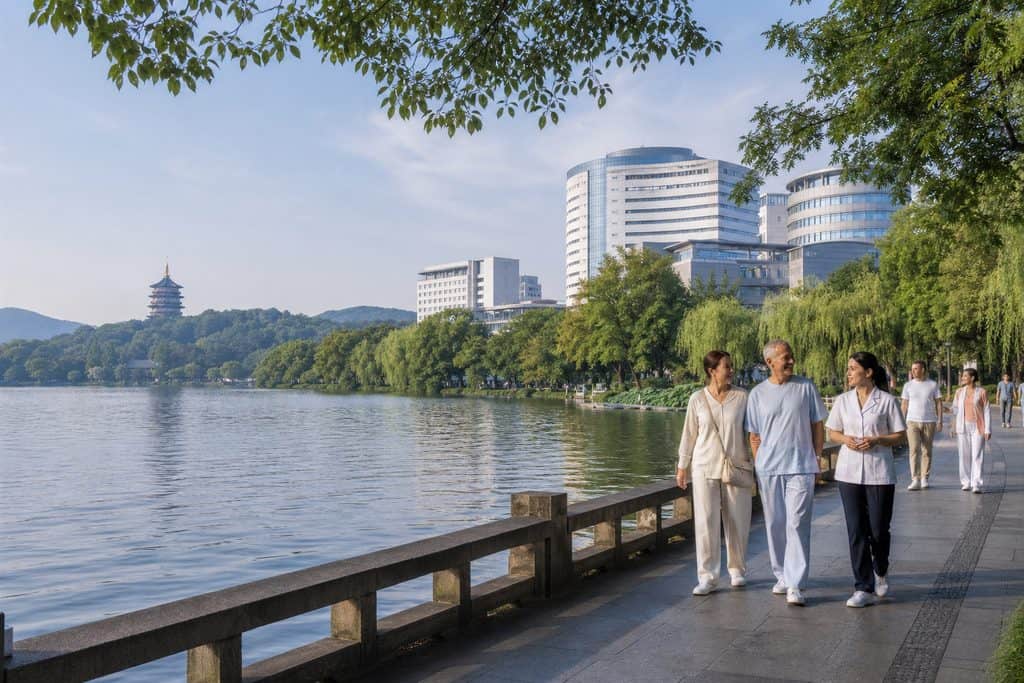
There is a genuine medical logic to this. Recovery from major surgery is not just about wound healing. It is about gradual mobilization, stress reduction, and clean air. Hangzhou’s West Lake scenic area offers flat, shaded walking paths that are perfect for the incremental ambulation required after a joint replacement or cardiac surgery. The city has a concentration of high-end hotels that are accustomed to guests with special needs, and the cost of a suite with a lake view is a fraction of what you would pay in Geneva or Boston. You can book medical checkup Hangzhou with West Lake recovery by contacting the international medical center directly; they can often arrange a package where your pre-op screening is completed in two intensive days, your procedure is scheduled shortly after, and your hotel recovery is mapped out with outpatient physiotherapy sessions three times a week. It is not a product you buy off a shelf. It is a timeline you co-design.
Practical Considerations: Visas, Records, and Payment
The logistics are manageable, but they require precision. First, your visa. For medical travel, the applicable short-stay category is typically the S2 visa, which covers private affairs including medical treatment. You will need an invitation letter from the hospital, a detailed treatment plan, and proof of financial means. Our team guides patients through the exact documentation required by the Chinese embassy or consulate in their home country, as requirements can shift. A tourist visa is not appropriate for a planned surgery and can create serious problems if complications extend your stay.
Medical records must be translated into Mandarin Chinese before you arrive. This is non-negotiable. A surgeon will not rely on a verbal summary of your MRI; they need the original images on a CD or a secure cloud link, and a written report they can read. The same applies to your pathology slides if you are coming for oncology care. Budget $300-$600 for professional medical translation. It is the highest-return investment you will make in the entire process.
Payment is almost always via wire transfer to the hospital’s account before admission, or a credit card deposit of 50-70% of the estimated total. Personal checks are not accepted. International health insurance with out-of-network benefits can sometimes reimburse you after the fact, but you must pay the hospital first. Get a detailed, itemized invoice in both Chinese and English before you leave the hospital; this is essential for any insurance claim.
Frequently Asked Questions
You can, but you will likely spend hours in a crowded hall and see a junior doctor, not the senior specialist you researched. The public walk-in system is not designed for foreigners. You must go through the international medical center or have a navigation team pre-book you with a named, senior physician. Without this, you are rolling dice with your time and your care.
This is the weakest link in the cross-border chain. Chinese surgeons will provide a detailed discharge summary and operative note in English, but they will not manage your long-term follow-up. You must have a physician at home who agrees in advance to receive you back. For orthopedic surgeries, this is usually straightforward—your local orthopedist can review X-rays. For complex oncology, it is harder, and you should have the follow-up plan documented and accepted by your home physician before you book the flight to Hangzhou.
For the most part, yes. The same Stryker, Medtronic, and Johnson & Johnson implants used in American operating rooms are used in Hangzhou’s top hospitals. Pharmaceuticals are a mix of Western originals and high-quality Chinese generic equivalents. If a specific brand-name drug is critical to your protocol, you must confirm its availability explicitly. Do not assume. Your navigation team can verify this with the hospital pharmacy before you commit.
The hospital has the clinical capability to manage it. What it may lack is the legal and communicative framework you are used to. Chinese hospitals are not litigious environments, and the concept of a “sentinel event” review is not as formalized as in JCI-accredited Western hospitals. This is a hard truth. The practical protection is to be in an international wing with JCI accreditation, where adverse event protocols are documented and audited. It’s also why we insist patients understand that medical travel carries inherent risks that no facilitator can eliminate.
Your Next Step
Hangzhou offers a rare combination: deep clinical expertise in specific, high-stakes specialties, and a recovery environment that genuinely contributes to healing. The path is there, but it is not marked in English. Our team at ToChinaMed does not provide medical care, make diagnoses, or operate any hospital. We are an independent information platform that helps you understand your options, connect with the right department, and prepare the logistical groundwork so you can focus on your health. If you are considering a procedure in Zhejiang province and want to understand whether it makes sense for your specific situation, tell us what you need—we will help you map out the possibilities at no charge.
For more medical information and treatment options in China, visit tochinamed.com (ToChinaMed).