Post-Abdominal Surgery Recovery in China: Incision Care, Lifting Limits, and Diet Progression
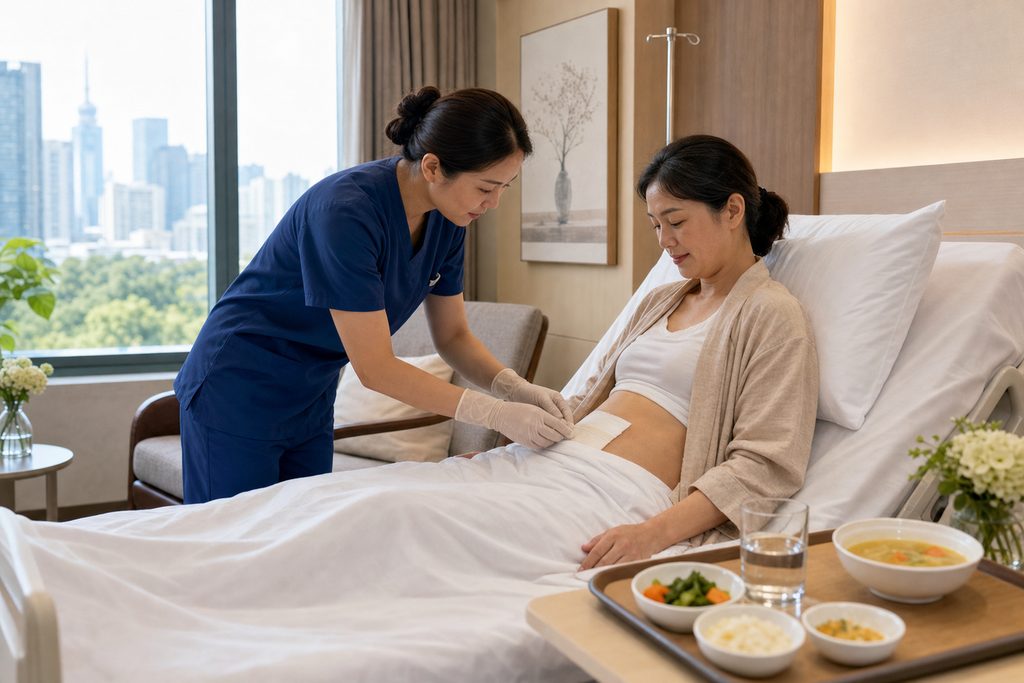
Key Takeaways
- China’s top surgical centers discharge over 8,000 abdominal surgery patients annually, developing highly refined, protocol-driven recovery pathways that directly reduce complication rates.
- Patients often face a confusing post-discharge gap in their home countries, where coordinated incision care and dietary guidance can be fragmented; structured recovery packages in China bridge this gap with nurse-led daily oversight.
- Resuming weightlifting after a laparotomy is not a linear timeline—fascial healing takes a full 6 to 12 months, and returning too early risks incisional hernia, a complication seen in up to 15% of patients who disregard lifting limits.
- International patients must understand that the S2 visa category applies for short-term medical stays; we handle the documentation from the treating hospital so your application reflects the true purpose of your visit accurately.
The Problem: The Post-Discharge Void Nobody Warns You About
You survived the surgery. The tumor was resected cleanly, or the obstruction was cleared. Then, 72 hours later, you are handed a printed sheet of generic instructions and discharged. This is where the real risk begins. Studies published in the Journal of Gastrointestinal Surgery indicate that unplanned readmission rates after major abdominal surgery hover between 11% and 15% in Western healthcare systems, with wound complications and ileus—a temporary paralysis of the bowel—leading the causes. The data points to a broken transition. The hospital’s high-acuity monitoring stops, but the patient’s biological healing is just entering its most delicate phase.
What does that feel like on the ground? You stare at your incision, unsure if the redness is normal inflammation or an early surgical site infection. Your appetite is absent, but you know you need protein to rebuild the abdominal wall. You feel well enough to pick up your toddler, but a quiet voice warns you that one wrong move could rip internal sutures. The gap between “surgery complete” and “life resumed” is where anxiety lives. And for international patients considering an abdominal surgery recovery package China cost analysis, that gap gets wider—add flight clearance, language barriers, and unfamiliar food to the mix.
Who We Are
We are not surgeons. We do not hold a scalpel, nor do we prescribe medication. We are your logistical architects at ToChinaMed. Our team sits between you and the complexity of China’s top-tier hospital system. We translate medical records, secure the correct visa documentation, match your clinical needs to the right department—whether that is a high-volume public general surgery unit in a Fudan-ranked hospital or a private international wing with English-speaking nursing teams—and build a recovery timeline that makes sense. Think of us as the people who make sure your focus stays on healing, while we handle the friction.
Why a Structured Recovery in China Delivers Better Outcomes
Healing is not a passive process. It requires active monitoring, rapid intervention when a wound leaks, and a diet that evolves with your gut function. China’s surgical ecosystem, particularly in cities like Beijing and Shanghai, has scaled this to a level that is difficult to replicate in outpatient Western settings.
Clinical Volume Drives Incision Mastery
A senior wound care nurse in a major Chinese teaching hospital will see more complex abdominal closures in one month than a community nurse in the UK or US sees in a year. This volume translates into pattern recognition. They can spot a “smoldering” deep incisional infection—often missed by junior staff—before it erupts. When you book abdominal incision healing treatment abroad, you are not just buying a room; you are buying access to eyes that have seen thousands of healing trajectories. The protocols here are rigid for a reason. A 2022 observational study from a Shanghai surgical center reported a superficial surgical site infection rate of just 2.1% in elective laparotomies when a strict, bundled post-operative wound-care package was followed, compared to global benchmarks that often sit above 5%.
Diet Progression as a Clinical Tool
The question of what to eat after stomach surgery in China is not answered with a pamphlet. It is a staged, ingredient-specific progression. Immediately post-op, patients often receive “liu shi”—a thin rice gruel that provides easily absorbed carbohydrates without taxing a sluggish gut. This is not comfort food; it is a deliberate strategy to prevent catabolism. As bowel sounds return, the diet shifts to finely chopped proteins and soft vegetables, often incorporating traditional ingredients like Chinese yam, which is prized in clinical nutrition here for its mucilage content that soothes the gastric lining. This is not alternative medicine. It is functional nutrition integrated into the surgical ward’s daily routine. Dietitians adjust the meal plan daily based on abdominal distension and stool consistency. That level of granularity is rare in standard post-discharge care.
Cost Structure Without Quality Compromise
Let us address the elephant in the room. When patients first research an abdominal surgery recovery package China cost, they often assume lower prices signal lower standards. The structural reality is different. The cost of private nursing labor, hospital accommodation, and sterile consumables in China is significantly lower than in the US or Western Europe—not because of corner-cutting, but because of different economic baselines. A full day of one-on-one nursing care in a private Beijing hospital may cost less than a standard insurance copay for a 15-minute clinic visit in the US. This allows for extended inpatient recovery stays. Instead of being rushed out on day three, patients can remain under medical observation for a week or more, ensuring the incision is sealed, the diet is tolerated, and mobility is restored safely. That extended monitoring window is the single biggest factor in catching complications early.
What You Need to Know Before Going Alone
The path to recovery here is smooth only if the pre-arrival logistics are solid. Attempting this independently introduces friction that can delay care or invalidate your visa status.
- Visa Precision: The S2 visa is the standard short-stay category for private medical treatment. It requires an invitation letter or documentation from the treating hospital. Applying with a tourist (L) visa while intending to undergo a structured recovery program is a violation of the terms. We ensure your documentation from the hospital clearly states the medical necessity, supporting a legitimate S2 application.
- Payment Rails: International credit cards do not always work seamlessly with hospital payment portals. Large transactions often trigger fraud blocks. We guide you through setting up WeChat Pay or Alipay linked to your foreign card, or facilitate direct bank transfers to the hospital’s international department, so your admission is never delayed by a frozen card.
- Medical Translation Precision: “Advance diet as tolerated” is a common Western discharge instruction. In a Chinese recovery setting, your diet orders are specific: “Semi-liquid diet, 200ml per meal, 6 meals daily.” Nuance matters. Our bilingual case managers ensure the surgeon’s actual intent—not a machine-translated approximation—is what the nursing station executes.
How We Navigate the Recovery Timeline With You
We start working long before you land. After you submit your medical records and tell us what you need, we match your surgical history with a department that specializes in your condition. We do not just send you to “a good hospital.” We look at the Fudan hospital rankings and the private international hospital networks to find the unit that handles your specific procedure at the highest volume.
Once you arrive, our team meets you at the hospital. We handle the registration, verify the admission deposit, and sit with you during the nursing intake. That intake is critical. The nurse needs to know your baseline pain level, your allergies, and your mobility status. We make sure nothing is lost in translation. During the recovery phase, we check in daily. Not as medical providers, but as your advocates. If the diet progression is moving too fast and causing bloating, we relay that to the dietitian. If your incision dressing needs a change and you are anxious about the pain, we ensure the nurse understands your anxiety threshold.
When it is time to think about leaving, the question of “when can I travel after abdominal surgery China” becomes central. We coordinate with your surgeon to get a fit-to-fly certificate. The general rule for a laparotomy is no long-haul flight for 10 to 14 days post-discharge, provided there is no ileus and the wound is dry. But every case is different. We also prepare a detailed handover document in English for your primary care physician back home—medication list, suture type, recommended activity progression, and red flags to watch for.
Frequently Asked Questions
This is the question surgeons dread most, because the answer is longer than anyone wants to hear. For the first 6 weeks, do not lift anything heavier than 4.5 kilograms (10 pounds)—roughly the weight of a gallon of milk. This protects the fascial layer, which regains only about 50% of its original tensile strength during this period. Between 6 and 12 weeks, you can gradually increase, but avoid heavy compound lifts like deadlifts or squats that spike intra-abdominal pressure. Full, unrestricted heavy lifting is generally not advised until 6 months post-op, and some hernia prevention specialists recommend waiting a full year. Rushing this timeline is the most common cause of incisional hernia, which then requires another surgery to repair.
Costs vary by hospital tier, room type, and length of stay, but a structured recovery package often bundles the surgeon’s follow-up fees, daily nursing wound care, dietitian consultations, and private room accommodation. This bundled approach can be significantly more affordable than paying for equivalent private-duty nursing and extended hospital stays in the US. We can provide a detailed cost breakdown once we understand your specific surgical history and recovery needs. The value lies in the inclusion of daily, hands-on wound assessment—something that is rarely covered in standard post-discharge care elsewhere.
Start with clear liquids and easily digested carbohydrates like congee. As your gut wakes up, you will transition to soft, high-protein foods—steamed fish, silken tofu, and finely minced chicken. Your clinical team will monitor your tolerance. The goal is to hit a minimum of 1.2 to 1.5 grams of protein per kilogram of body weight daily to supply the amino acids your abdominal wall needs to rebuild collagen. Avoid raw vegetables and high-fiber grains initially; they require too much mechanical digestion and can cause bloating against a fresh incision.
Beijing is home to several institutions with dedicated international medical centers. Public academic hospitals like Peking Union Medical College Hospital (PUMCH) have a long-established international department staffed with English-speaking physicians and nurses who are accustomed to Western expectations for communication and pain management. On the private side, facilities like Beijing United Family Hospital offer hotel-like recovery suites, direct insurance billing, and a nursing model that mirrors Western post-operative protocols. The best choice depends on the complexity of your surgery and your insurance coverage; we help you compare both options against your clinical needs.
Yes. If you are struggling with a non-healing surgical wound, a persistent seroma, or a wound infection that your local team cannot resolve, you can travel for dedicated wound management. This requires a referral that explains the wound history, any cultures taken, and the antibiotic history. We connect you with wound care specialists who use advanced dressings—like silver-impregnated foam or negative-pressure wound therapy—that may not be readily available in your home setting. The S2 visa pathway works for this type of follow-up care as well.
Your Next Step
Recovery is not a passive waiting game. It is a structured, active process that demands the right environment, the right nutrition, and the right nursing eyes on your incision every single day. Whether you are planning surgery or struggling with a difficult recovery at home, having a team that speaks the language—clinically and culturally—changes the trajectory of healing. We are here to build that bridge, without pressure and without inflated promises.
Looking for a specific surgeon or a structured recovery program in China? Tell us what you need — we will help you find the right option at no charge.
For more medical information and treatment options in China, visit tochinamed.com (ToChinaMed).