Hospital Accommodation in China: On-Campus vs Nearby Hotel for Family
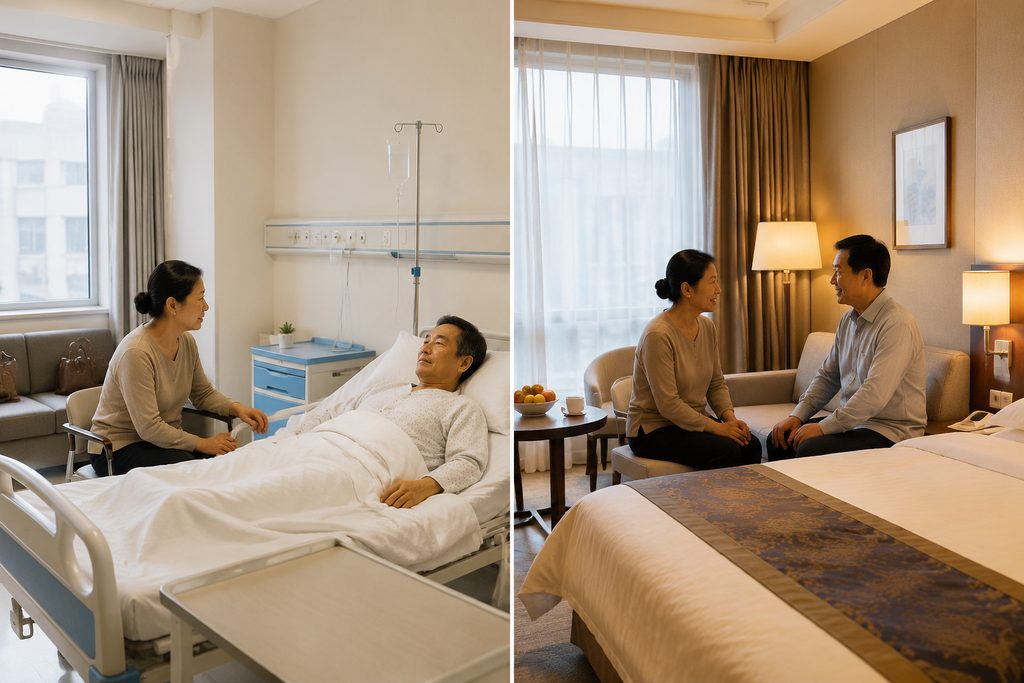
When Sarah landed in Shanghai with her husband and a suitcase full of anxiety, she had already spent weeks researching his liver cancer treatment at a top-ranked hospital. What she had not researched was where she would sleep. The hospital’s international patient coordinator had mentioned something about a “family room,” but the details were vague. Was it a fold-out chair in the corner of a shared ward? A private suite with a kitchenette? And what would it cost for the three weeks they expected to stay? Sarah is not alone in this uncertainty. For international patients traveling to China for medical care, the question of where family members will stay is often an afterthought — until it becomes the most pressing logistical headache of the entire trip. Understanding China hospital accommodation for family cost and what those costs actually buy you makes the difference between a stressful recovery and a supported one.
Key Takeaways
- On-campus family rooms in Chinese public hospitals range from approximately ¥200-800 ($28-110) per night — significantly less than equivalent accommodations in the US or Europe, but availability is limited and varies wildly by hospital tier and location.
- Private international hospitals in China often include family accommodation as a standard part of inpatient packages, with dedicated suites designed for a companion to stay comfortably alongside the patient.
- Many top-tier Chinese public hospitals have strict visitation hours and do not allow overnight family stays in standard wards — booking on-campus accommodation is not a luxury; it is often the only way to remain physically present after 8 PM.
- Nearby hotels can offer more comfort and privacy, but you will trade proximity for space — and during Shanghai’s humid summers or Beijing’s freezing winters, a 15-minute walk to the hospital feels much longer when you are exhausted and worried.
The Problem: Your Loved One Is Hospitalized in a Foreign Country — Where Do You Sleep?
Approximately 100,000 international patients seek medical treatment in China each year, according to data from the National Health Commission, and that number has been climbing steadily since visa policies were relaxed for medical tourists from Southeast Asia, the Middle East, and Eastern Europe. For every one of those patients, there is at least one family member — often more — who needs a place to stay for days, weeks, or even months. The assumption that Chinese hospitals function like Western ones, with pull-out couches and generous visiting hours, collapses quickly upon arrival.
Most public hospitals in China were not designed with family cohabitation in mind. The standard inpatient ward houses three to six patients. Space is tight. A thin curtain separates beds, not families. Overnight stays by relatives in these wards are generally prohibited — both by hospital policy and by the sheer lack of physical room. Yet family presence during treatment is not a sentimental luxury. A 2022 meta-analysis published in the *Journal of Clinical Nursing* found that family presence during hospitalization reduced patient anxiety scores by an average of 23% and was associated with shorter length of stay in surgical patients. The need is real. The infrastructure does not always cooperate. That tension is what makes this topic urgent for anyone planning medical travel to China.
Who We Are
We are ToChinaMed, an independent medical information platform. We do not treat patients. We do not book hospital rooms or collect referral fees. Our team researches, verifies, and publishes practical guidance for international patients and their families navigating the Chinese healthcare system. Think of us as the research arm you did not know you needed — the people who call hospitals to confirm whether “family room” means a private suite or a cot in the hallway, so you do not have to find out the hard way. Everything we publish is based on direct inquiry, published hospital data, and interviews with international patient coordinators. No commissions. No preferred partnerships. Just information you can act on.
On-Campus Family Accommodation: What It Actually Means in Chinese Hospitals
The term “on-campus family accommodation” covers a surprisingly wide spectrum in China. At one end, you have the international VIP wards of major public hospitals like Huashan Hospital in Shanghai or Peking Union Medical College Hospital in Beijing. These wards function almost like hotels embedded within the hospital. At the other end, you have basic dormitory-style rooms in older hospital buildings that were originally built for visiting medical students and have since been repurposed.
VIP and International Wards: The Gold Standard for Family Stays
If you are looking for a genuine family room hospital China price that includes space for a companion to sleep, eat, and store belongings, the VIP and international wards are where you will find it. These wards typically offer private patient rooms with an attached companion area — sometimes a separate small room, sometimes a defined sleeping area with a daybed or pull-out couch. Bathrooms are private. Some units include a small refrigerator, a kettle, and basic toiletries.
The cost varies significantly by city and hospital prestige. In Shanghai’s top-tier public hospitals, a VIP single room with family accommodation runs between ¥1,500 and ¥3,000 ($205-410) per night. In Beijing, expect similar pricing at hospitals like Peking University Third Hospital or China-Japan Friendship Hospital. These rates cover the room, nursing care, and basic meals for the patient — the family member’s meals are usually extra. Compared to a US hospital private room, which averages $1,800-2,500 per night without any companion accommodation, the value proposition is stark.
But here is the catch: these rooms are scarce. A major hospital might have 20 VIP beds and 1,200 standard ward beds. International patients compete with domestic patients who have private insurance or the ability to pay out-of-pocket. Booking one requires advance coordination — sometimes months ahead — and a deposit that can range from ¥10,000 to ¥50,000 ($1,370-6,850) depending on the expected length of stay.
Standard On-Campus Guesthouses and Dormitories
Many large Chinese hospitals operate guesthouses on or immediately adjacent to their campuses. These are not luxurious. They are functional. A room at the Shanghai Cancer Hospital guesthouse, for example, costs approximately ¥200-400 ($28-55) per night. You get a bed, a desk, a private or shared bathroom, and a five-minute walk to the inpatient building. No kitchen. No frills. But at 2 AM when you want to check on your spouse, you are there in under three minutes.
These guesthouses are often booked through the hospital’s logistics office, not through online travel platforms. English-language booking support is inconsistent. Some hospitals list their guesthouses on Chinese apps like Ctrip; others require a Chinese-speaking staff member to call and reserve on your behalf. This is one of those friction points where having a local coordinator — whether through a medical concierge service or a bilingual friend — changes the experience from maddening to manageable.
Nearby Hotels: Comfort, Privacy, and a Commute
Choosing a hotel near hospitals in Shanghai for families means trading proximity for space and amenities. Shanghai has no shortage of international hotel brands. The challenge is location. Hospitals cluster in specific districts — Xuhui for many top-tier facilities, Pudong for newer international hospitals — and not every neighborhood has a Marriott or a serviced apartment building within walking distance.
What You Pay and What You Get
A mid-range hotel room near Zhongshan Hospital in Shanghai’s Xuhui District runs ¥400-700 ($55-96) per night. For that, you get a clean room, daily housekeeping, WiFi, and a breakfast buffet. A serviced apartment with a kitchenette — far more practical for stays longer than a week — costs ¥600-1,200 ($82-165) per night. These apartments, offered by chains like Ascott and Somerset, provide separate living and sleeping areas, in-unit laundry, and grocery delivery access. For a family of three accompanying a patient, this setup can feel closer to normal life than a hospital guesthouse ever could.
The trade-off is the walk or taxi ride. In Shanghai’s summer, when humidity pushes the heat index above 40°C (104°F), a 15-minute walk to the hospital leaves you drenched and depleted before you even reach your loved one’s bedside. In Beijing’s January, when temperatures drop to -10°C (14°F), that same walk is an endurance test. These are not trivial considerations. They affect how often you visit, how long you stay, and how much energy you have left for the emotional work of supporting a sick family member.
Booking Strategies That Actually Work
International hotel chains allow online booking with English interfaces. That is the easy part. The harder part is negotiating extended-stay rates for medical visits. Most hotels offer corporate rates for stays of seven nights or longer, but these are rarely advertised. You have to ask — and asking in English to a front desk that operates primarily in Mandarin is hit-or-miss. Some international patient coordinators at private hospitals have standing relationships with nearby hotels and can secure rates 20-30% below published prices. Public hospitals generally do not offer this service.
Can Family Stay with the Patient in a Chinese Hospital? The Real Answer
The short answer to “can family stay with patient in Chinese hospital” is: it depends entirely on the ward type. In a standard multi-bed ward, the answer is almost always no for overnight stays. Visiting hours are typically 3 PM to 8 PM, sometimes shorter. One family member may be allowed at the bedside during those hours. After 8 PM, the ward doors close and non-patients are expected to leave.
In a VIP or international single room, the answer is usually yes — one family member can stay overnight, and sometimes two in larger suites. These rooms are designed for it. The hospital charges for the room, not per occupant, so the companion stays at no additional room charge beyond the base rate. Meals for the companion are extra, typically ¥50-100 ($7-14) per day if ordered through the hospital kitchen.
Private international hospitals — such as Jiahui International Hospital in Shanghai, United Family Healthcare in Beijing, or Raffles Hospital in various cities — operate under different rules entirely. These facilities were built with Western patient expectations in mind. Private rooms are standard, not premium. Family zones with sofa beds, work desks, and private bathrooms are integrated into the room design. Overnight stays by one or two family members are permitted and expected. The cost is higher — inpatient rooms at these hospitals range from ¥2,500 to ¥6,000 ($340-820) per night — but the family accommodation is baked into the price, not bolted on as an afterthought.
Medical Tourism China Family Accommodation Packages: What Exists and What Does Not
The phrase “medical tourism China family accommodation packages” suggests a level of productization that does not quite exist yet in the Chinese market — at least not in the way it does in Thailand, Singapore, or South Korea. Those countries have mature medical tourism industries with bundled packages that include airport pickup, hospital room, companion hotel, translation services, and even post-operative sightseeing. China’s medical tourism infrastructure is younger and more fragmented.
What does exist are ad hoc packages assembled by international patient centers at major hospitals and by independent medical concierge services. A typical package for a cancer surgery patient at a Shanghai public hospital might include: VIP ward booking for 10-14 days, airport transfer, daily English-speaking coordinator check-ins, and a recommended hotel list with negotiated rates. The total cost for the non-medical components — accommodation, logistics, translation — runs between ¥30,000 and ¥80,000 ($4,100-11,000) depending on length of stay and level of service. The medical costs are separate and paid directly to the hospital.
Private international hospitals offer more standardized packages. Jiahui’s international patient program, for instance, provides bundled pricing for common procedures like orthopedic surgery or maternity care that includes the hospital room, meals, nursing care, and family accommodation. These packages are priced in RMB and can often be paid via international insurance or wire transfer. Transparency is higher. Surprises are fewer. The trade-off is that private hospitals in China, while excellent for many procedures, may not have the same depth of subspecialty expertise for complex conditions that you find at the top-ranked public hospitals on the Fudan University Hospital Rankings.
What You Need to Know Before Booking Anything
Accommodation decisions ripple into every other part of the medical travel experience. A few realities that rarely appear in glossy brochures:
- Deposit requirements can be steep: Public hospital VIP wards often require a deposit equal to 50-100% of the estimated total stay cost, paid upfront via wire transfer or in person. International credit cards are accepted at major hospitals but not universally. Have a backup payment method.
- Communication gaps persist: Even in VIP wards, the night-shift nurses may speak limited English. If you are staying in a nearby hotel and something happens at 2 AM, you need a way to reach the ward and communicate clearly. A translation app on your phone is a bare minimum; a 24/7 bilingual coordinator is better.
- Hospital guesthouses are not hotels: They may not provide daily linen changes, toiletries, or WiFi. Some do. Some do not. Ask for a detailed list of amenities before booking, and pack accordingly. A portable WiFi device or a Chinese SIM card with data solves the connectivity problem affordably.
- Location matters more than you think: A hotel that looks close on a map may be separated from the hospital by an eight-lane road with no pedestrian crossing. Google Maps is unreliable in China. Use Baidu Maps or Amap with Chinese-language input to check actual walking routes, or ask your coordinator to verify.
How We Help You Navigate This
Our team at ToChinaMed spends a lot of time on the phone with hospital international patient centers, asking the questions that patients do not know to ask. Is the family room in the same building as the ward, or a separate building? Does the guesthouse have an elevator — critical if the accompanying family member is elderly? What is the exact cancellation policy if the surgery date shifts? These details are rarely published online. They matter enormously.
We maintain updated information on accommodation options at the hospitals on the Fudan University Hospital Rankings and the Top 50 Private International Hospitals in China. Our free consultation service connects you with this information — not to sell you a room, but to help you understand your options so you can make an informed choice. We do not take commissions from hospitals or hotels. We do not push one facility over another. We answer questions and point you toward verified information.
If you are deep in the planning process — or just starting to research — tell us what you need. We will help you find the right information at no charge.
Frequently Asked Questions
How much does a family room in a Chinese hospital actually cost?
In public hospitals, VIP single rooms with family accommodation range from ¥1,500 to ¥3,000 ($205-410) per night in Shanghai and Beijing, and ¥800 to ¥1,800 ($110-250) in second-tier cities. Hospital guesthouses cost ¥200-800 ($28-110) per night. Private international hospitals charge ¥2,500 to ¥6,000 ($340-820) per night for rooms that include companion sleeping areas as standard. These are out-of-pocket prices; international insurance may cover a portion depending on your policy.
Can two family members stay overnight in a Chinese hospital room?
In VIP wards at public hospitals, the official policy usually permits one overnight companion. A second family member may be allowed during the day but asked to leave after visiting hours. Private international hospitals are more flexible — some suites can accommodate two companions, especially in maternity or pediatric units. Always confirm the specific hospital’s policy in writing before booking, as enforcement varies by ward and head nurse.
What if the patient needs a family member present for medical translation or care assistance?
Hospitals with international patient centers typically provide some level of translation support during daytime hours, but this is not 24/7 and may not cover every interaction with nurses, dietitians, or pharmacists. If the patient requires constant communication support or physical assistance with feeding, mobility, or toileting, you should make the case for an overnight companion when booking the room. Hospitals are more likely to approve exceptions when the need is documented as medical rather than emotional. Hiring a private caregiver through the hospital’s nursing department is another option — costs range from ¥300-600 ($41-82) per day — and this can reduce the burden on family members staying nearby.
Are there long-stay apartment options near Chinese hospitals for families staying more than a month?
Yes. Serviced apartments in Shanghai, Beijing, and Guangzhou offer monthly rates that are significantly lower than nightly hotel rates — typically ¥15,000-30,000 ($2,050-4,100) per month for a one-bedroom unit near a major hospital district. These apartments include kitchens, washing machines, and WiFi. Booking platforms like Ziroom and Lianjia handle longer-term rentals, but their interfaces are primarily in Chinese. Some medical concierge services can assist with finding and securing these rentals. For stays longer than six weeks, a serviced apartment almost always beats a hotel on cost and livability.
Your Next Step
Choosing where your family will stay during medical treatment in China is not a trivial detail to sort out at the last minute. It shapes
For more medical information and treatment options in China, visit tochinamed.com (ToChinaMed).