Remote Second Opinion from Chinese Hospitals: Process, Costs, and What to Expect in 2025
Key Takeaways
- A remote second opinion from a Chinese hospital typically costs between $200 and $800—roughly 70-90% less than equivalent U.S. consultations, with report turnaround in 5-10 business days.
- China’s top-tier hospitals handle patient volumes that dwarf Western institutions. A senior oncologist at Fudan University Cancer Hospital may review more complex cases in a month than a regional U.S. specialist sees in a year.
- Language barriers and fragmented digital systems remain real obstacles. Most Chinese hospital portals operate exclusively in Mandarin, and medical record formatting standards differ from Western norms.
- You do not need to travel. The entire process—from record submission to receiving the written opinion—can be completed remotely, provided your documentation is properly prepared and translated.
The Problem: When Your Diagnosis Doesn’t Sit Right
Approximately 1 in 5 patients who seek a second opinion receive a materially different diagnosis or treatment plan. That statistic comes from a 2017 Mayo Clinic study published in the Journal of Evaluation in Clinical Practice, and it has not budged much since. The researchers found that 21% of patients walked away with a distinctly revised prognosis or therapeutic recommendation. For cancer patients, the stakes are sharper: a 2020 study from the University of Michigan Rogel Cancer Center found that second-opinion breast cancer patients saw changes in their surgical approach 43% of the time.
But here is where it gets uncomfortable. Getting that second look often means waiting. In Canada, the median wait time to see a specialist after a general practitioner referral reached 27.7 weeks in 2023, per the Fraser Institute. The UK’s NHS target is 18 weeks from referral to treatment, yet nearly a third of patients wait longer. In the U.S., seeing a sub-specialist at a major academic center can take two to four months—longer if you live outside a major metropolitan area.
And the financial math is brutal. An out-of-network second opinion consultation at a top U.S. cancer center can run $2,000 to $5,000 before any testing. Add pathology re-review, imaging reinterpretation, and genetic profiling, and the bill climbs fast. For international patients without U.S. insurance, those numbers are simply non-negotiable.
Who We Are
We are not a hospital. We do not employ doctors, issue clinical diagnoses, or provide medical treatment of any kind. ToChinaMed is an independent medical information platform—our team acts as logistical architects for international patients who want to access Chinese medical expertise. We bridge the gap between you and China’s top-tier hospitals, helping you navigate documentation requirements, translation standards, and the submission process for remote consultations. We do not charge patients for this guidance, and we are not affiliated with any single hospital. Our goal is straightforward: make China’s medical resources legible and accessible to people who need them.
How a Second Opinion from Chinese Hospital Online Actually Works
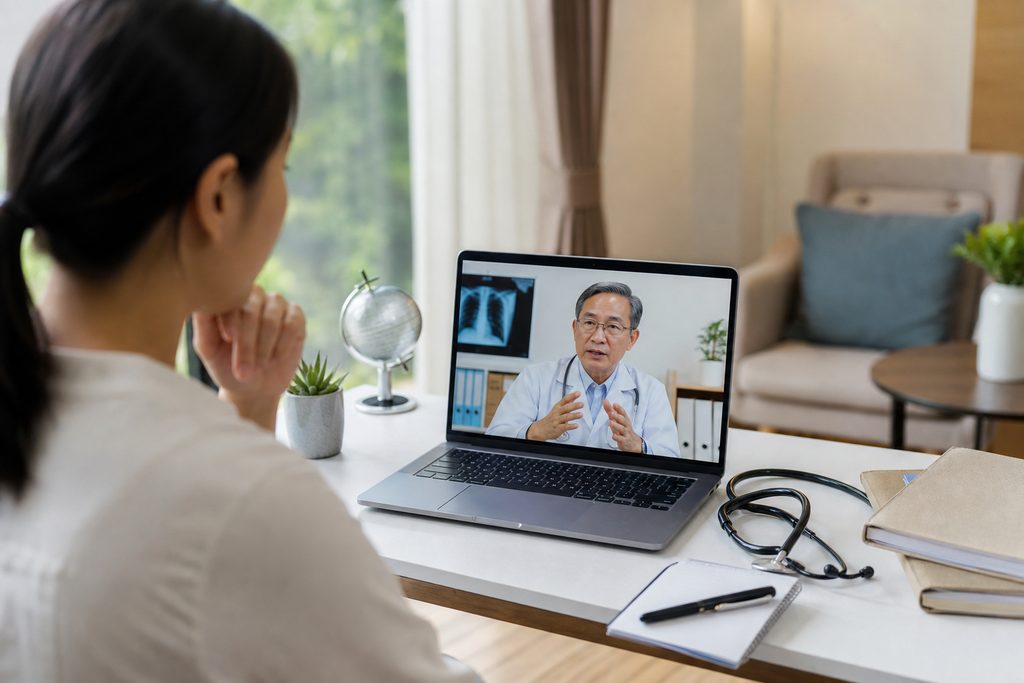
The phrase “remote consultation” conjures images of Zoom calls with doctors, but that is rarely how it plays out with Chinese hospitals. Most institutions conduct what is called a “written consultation” or “record review consultation.” You submit your complete medical dossier—imaging files, pathology slides, surgical notes, lab results, current treatment regimen—and a senior specialist reviews everything asynchronously. You receive a formal written report, often stamped with the hospital’s official seal. Some hospitals offer a follow-up video call; many do not. The process is document-driven, not conversation-driven.
This matters because it shapes what you get. You are not purchasing a relationship with a doctor. You are purchasing a rigorous, evidence-based review of your case by a specialist who likely sees a higher volume of your condition than most Western physicians ever will. The output is a detailed report: confirmation of your diagnosis, alternative interpretations, treatment recommendations with supporting clinical evidence, and sometimes a direct critique of your current plan.
Why Chinese Hospitals Deliver Results Worth Considering
Volume Creates Pattern Recognition No Textbook Can Match
Consider the numbers. Fudan University Cancer Hospital in Shanghai treats over 150,000 cancer patients annually. Its thoracic surgery department alone performs more than 8,000 lung cancer resections per year. By comparison, MD Anderson Cancer Center in Houston—widely considered the top U.S. cancer hospital—reports approximately 30,000 new patient visits annually across all cancer types. The clinical volume at a major Chinese center is simply in a different order of magnitude.
Why does volume matter for a remote second opinion? Because rare presentations become routine when your patient pool is large enough. A Chinese thoracic oncologist might see three cases of pulmonary sarcomatoid carcinoma in a single month. A U.S. community oncologist might encounter that diagnosis twice in an entire career. When you ask for a second opinion from Chinese hospital online, you are tapping into pattern recognition built on sheer repetition. The specialist reading your file has almost certainly seen your situation before—multiple times.
Technology Infrastructure Built for Speed and Scale
Chinese hospitals have invested heavily in digital infrastructure over the past decade, driven partly by government mandates and partly by sheer patient volume. The average turnaround time for a CT scan report at a major Chinese hospital is under 24 hours. AI-assisted imaging analysis is deployed routinely: at Zhongshan Hospital in Shanghai, an AI system pre-screens chest CTs for pulmonary nodules before a radiologist ever looks at them, flagging suspicious findings with sensitivity rates above 95% in published studies.
For remote second opinions, this infrastructure means your DICOM imaging files get processed quickly. Many hospitals now accept cloud-based submissions through secure portals, though—and this is important—most portals operate in Mandarin. We help patients navigate this step, ensuring files are formatted correctly and uploaded to the right department.
Also relevant: China’s digital health card platform has streamlined how medical records are stored and shared across institutions, which accelerates the internal routing of your submitted documents once they arrive.
Cost Structure: Why Remote Consultation China Hospital Cost Is So Much Lower
Let us address the elephant directly. A remote consultation China hospital cost typically ranges from $200 to $800, depending on the hospital tier and specialty. A written second opinion from a senior oncologist at a top-tier Fudan-affiliated hospital might run ¥2,000-3,000 RMB ($280-$420). Add translation and documentation preparation services, and you might land between $500 and $800 all-in.
Compare that to a U.S. academic medical center, where a second opinion consultation alone—before any record review or testing—starts around $800 and easily reaches $2,500 for complex cases. MD Anderson’s online second opinion program for international patients starts at approximately $3,000 and can exceed $6,000 depending on the complexity.
The structural reasons for this gap are not mysterious. Chinese physician salaries are lower, hospital administrative overhead is leaner, and the volume-driven model spreads fixed costs across more patients. Lower cost does not imply lower quality—it reflects fundamentally different healthcare economics. Clinical outcomes at China’s top hospitals, particularly in surgical oncology and interventional cardiology, are comparable to Western benchmarks. A 2022 study in The Lancet Oncology found that five-year survival rates for gastric cancer patients treated at Fudan University Cancer Hospital were statistically equivalent to those at top Japanese and Korean centers, and superior to most Western cohorts.
What You Need to Know Before You Try This Alone
We are transparent about the friction points because pretending they do not exist helps no one. Here is what makes this genuinely difficult to navigate independently:
- Language and Documentation Standards: Chinese hospitals require medical records in Mandarin. Not “preferably”—it is mandatory. Your pathology report, surgical notes, and imaging summaries must be professionally translated, not run through Google Translate. Medical terminology does not translate cleanly. A mistranslated “clear margins” versus “involved margins” changes everything. Translation services add $100-$300 to your total cost and take 3-5 business days.
- Fragmented Hospital Systems: There is no single “Chinese hospital portal” where you upload records and get a second opinion. Each hospital operates its own system. Some accept email submissions with specific formatting requirements. Others require registration on a Mandarin-language platform with Chinese ID verification. A few top institutions now have international patient departments with English-speaking coordinators, but they are the exception, not the rule.
- Payment Channels: Most Chinese hospitals do not accept international credit cards directly. Payment typically routes through UnionPay, Alipay, or WeChat Pay—platforms that require a Chinese bank account or specific international setup. Wire transfers are possible but slow, adding 3-7 business days and intermediary bank fees.
How We Help You Navigate This
We do not submit records for you—we show you exactly how to do it and connect you with the right department. Our team has mapped the remote consultation pathways for over 30 top-tier Chinese hospitals, including those ranked in the Fudan Hospital Rankings Top 100. We know which hospitals accept remote second opinion requests, which departments offer English-language coordination, what documentation each requires, and what the current fee schedules look like.
The process we guide patients through looks like this: First, we help you identify the right hospital and department for your specific condition—not just any top hospital, but the one with demonstrated expertise in your diagnosis. A hospital that excels in liver cancer surgery may not be the best choice for a brain tumor second opinion. Then we walk you through document preparation: what to include, what format, what translation standard is acceptable. We provide templates for the submission cover letter that Chinese hospital administrators expect. Once your materials are ready, we direct you to the correct submission channel—whether that is an international patient coordinator’s direct email, a secure upload portal, or a specific WeChat-based submission system.
After submission, we help you interpret the timeline. Most hospitals quote 5-10 business days for a written report, but complex cases involving multidisciplinary review can take longer. If follow-up questions arise—the reviewing doctor wants additional imaging, or the report contains terminology you need clarified—we help facilitate that communication loop.
For patients considering traveling to China for treatment after receiving their remote opinion, we can point you toward private international hospitals in China that offer English-language services and direct insurance billing, or help you understand the differences between public and private care pathways.
Frequently Asked Questions
Yes. Most major Chinese hospitals now offer remote record review services specifically for international patients. You submit your translated medical records, imaging files, and a summary of your current situation. A senior specialist reviews everything and issues a formal written opinion. No travel is required. The entire interaction is document-based—you receive a report, not a live consultation in most cases.
The online medical second opinion China price typically falls between $200 and $800 for the hospital’s review fee. Translation services add $100-$300. If you use a third-party facilitation service, expect additional coordination fees. The total all-in cost rarely exceeds $1,000 for a single-specialist review. Multidisciplinary team reviews—where multiple specialists weigh in—can run higher, sometimes reaching $1,500-$2,000, but those are typically reserved for exceptionally complex cases.
The best hospitals in China for remote diagnosis depend entirely on your condition. For oncology, Fudan University Cancer Hospital (Shanghai) and Peking University Cancer Hospital are top choices. For cardiology and cardiac surgery, Fuwai Hospital (Beijing) and Zhongshan Hospital (Shanghai) lead the field. For neurology and neurosurgery, Beijing Tiantan Hospital and Huashan Hospital (Shanghai) are the reference institutions. Our hospital rankings database allows you to search by specialty and department, which is a more useful approach than looking at overall hospital prestige.
This happens regularly—and it is precisely why you seek a second opinion. The report you receive is a clinical document, not a prescription. You take it back to your treating physician and discuss the differences. Sometimes the Chinese specialist identifies a surgical approach your local team considered too high-risk. Sometimes they recommend a different chemotherapy regimen based on genetic markers your initial workup did not test for. The value is in the comparison. You and your treating doctor decide what to act on.
Chinese hospitals assign remote second opinion cases to attending physicians at the associate professor level or above—equivalent to senior consultants in Western systems. These are not residents or fellows. You can request the reviewing doctor’s credentials and publication record. Most top-tier Chinese specialists have trained internationally, publish in English-language journals, and hold leadership positions in their departments. If a hospital cannot tell you who will review your case, that is a red flag.
Your Next Step
A remote second opinion is not a substitute for your relationship with your treating physician. It is a tool—one that costs a few hundred dollars and takes about two weeks, and one that might confirm your current path or reveal a better one. The data says roughly one in five patients who seek a second look end up with a meaningfully different plan. Those odds justify the effort.
If you want to explore this further, we can help you identify the right hospital and department for your specific diagnosis, at no cost. Tell us what you need—we will point you in the right direction.
For more medical information and treatment options in China, visit tochinamed.com (ToChinaMed).