Chinese Hospital Ward Types Explained: What Foreigners Get and Real Costs
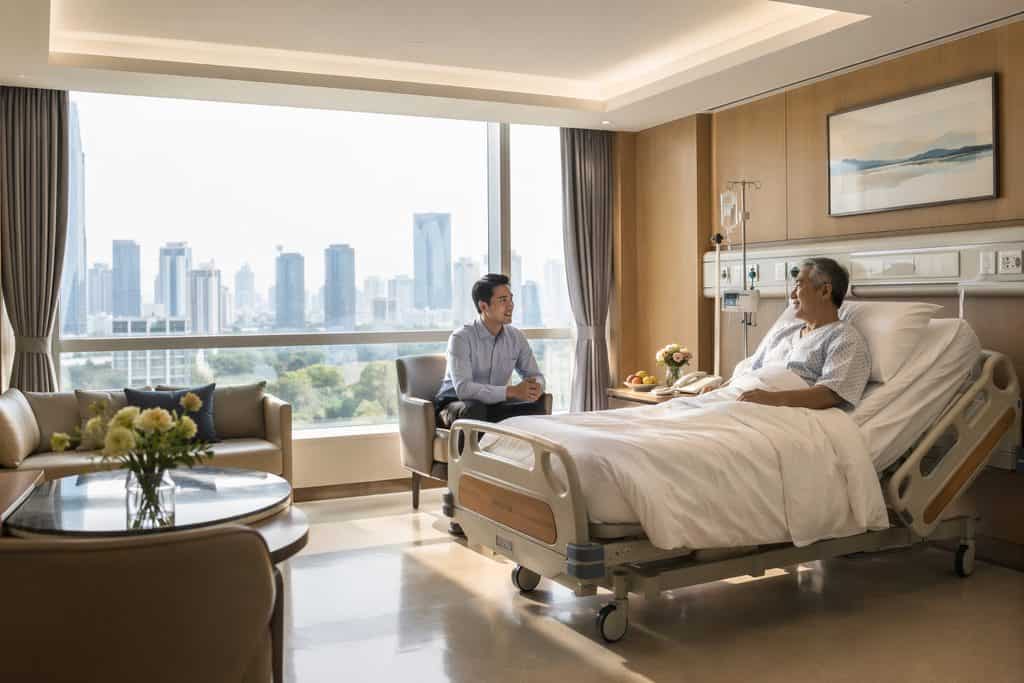
You have probably seen the photos. A crowded hospital corridor, beds lining the walls, families camped out on cardboard. That image gets seared into the brain. And then you hear about traveling to China for surgery. The two pictures just do not fit. The reality of what a foreign patient actually experiences inside a top-tier Chinese hospital is so far from that corridor photo that it feels like a different country entirely. It is. Not because the crowded wards do not exist—they do, in overwhelmed public county hospitals. But because the system you access as an international patient operates on a different plane.
Key Takeaways
- A private single room in a top Chinese public hospital’s international ward costs roughly $150–$400 USD per night, compared to $1,500–$3,000 for a comparable setup in the US.
- Foreigners are almost never placed in multi-bed wards; the default pathway funnels you to international departments with private or double-room accommodations as the floor, not the ceiling.
- The term “VIP ward” signals a specific, bookable tier with dedicated nursing and expedited access—not just a nicer room, but a fundamentally different care delivery model.
- Booking a single room is not automatic; it requires navigating a pre-admission deposit system and tight bed availability, often impossible to secure without a local facilitator weeks before your arrival.
The Problem: Assuming “Standard” Means What You Think It Means
Walk into a public hospital in the West and ask for a private room. You might get one. You might get a shared room and a shrug. The bed you land in is largely a function of what is available that morning. That logic breaks down when you cross borders. A patient flying into Shanghai from London or Los Angeles does not enter the same admission stream as a local resident. The hospital’s information system quite literally codes you into a different category. Our team has seen the intake forms. There is a checkbox. And that checkbox determines everything about the physical space where you will recover.
Why does this matter? Because recovery is physiological. A 2018 study in the Journal of Hospital Infection found that single-bed rooms reduce the risk of cross-transmission of multidrug-resistant organisms by up to 45% compared to multi-bed wards. Noise levels drop. Sleep quality improves. For a surgical patient, that is not a luxury. It is a clinical input. Yet most international patients arrive with zero clarity on what room they will get, what it will cost, or who to ask. They assume the worst—the corridor photo—or they assume the best and get burned by a surprise bill. Neither is necessary.
Who We Are
We are ToChinaMed, an independent medical information platform. We are not a hospital. We do not provide treatment, clinical diagnoses, or charge patients for referrals. We exist to close the information gap. Our team maps out how China’s hospital system actually works for international patients—from top-ranked public institutions to private international hospitals with direct insurance billing—so you can make decisions on facts, not forum rumors.
Breaking Down the Ward Types: What Actually Exists
Chinese hospitals do not think about rooms the way Western hospitals do. The classification is less about the number of beds and more about the service tier attached to the space. You need to understand three distinct environments.
The International Ward: Where Foreigners Land by Default
This is the single most important concept to grasp. A large, tertiary public hospital in Beijing or Shanghai will often have a dedicated floor—sometimes an entire wing—called the International Medical Center or VIP Department. It operates almost like a private hospital embedded inside a public one. The rooms here are predominantly single occupancy. Some have a sofa bed for a family member, a private bathroom, a refrigerator, and a dedicated nurse call system that rings a specific nurse assigned to you, not a general station.
What does this mean for the private room cost in Chinese hospital for foreigners? At a place like Peking Union Medical College Hospital’s International Medical Service, a standard single room runs between 1,200 and 2,800 RMB per night. That is roughly $165 to $385 USD. A suite pushes higher. This is the price for the room only—physician fees, surgical costs, and medications are billed separately and also carry an international-tier surcharge. Our team consistently sees foreign patients express shock at how low the room rate is, then surprise at how the physician fee is itemized distinctly. It is a different billing philosophy.
VIP Wards: The Step Above Standard Single Rooms
Do not confuse a standard single room in the international wing with a true VIP suite. The VIP ward is a distinct product. At Huashan Hospital’s International Medical Center in Shanghai, the VIP floor offers rooms that are closer to a business-class hotel suite. We are talking about 40 to 60 square meters of space. A separate living area. A dedicated nutritionist consultation. Priority scheduling for CT and MRI that bypasses the standard queue. The VIP ward price Shanghai international patient experience typically starts at 3,000 RMB ($410 USD) per night and can reach 6,000 RMB ($820 USD) for a premium suite. These rooms are limited. A hospital might have 20 such beds. They are booked by executives, diplomats, and patients who need guaranteed privacy and space for a family member to stay 24/7.
Double Rooms and the Multi-Bed Reality
Here is where the corridor photo comes closest to truth, but with a crucial distinction. A standard Chinese public hospital ward—the kind serving local residents—commonly has three or six beds to a room. Families provide much of the non-clinical care. Privacy is minimal. The single room vs double room price China hospital gap in this local-tier system is stark: a double room might cost 80 RMB ($11 USD) per night, a six-bed ward even less. But here is the hard truth: as a foreigner without Chinese insurance, you will almost certainly never see the inside of these rooms. The hospital simply will not assign you there. The system is not designed for it. The billing codes do not align. The nursing workflow assumes family participation you cannot provide.
So when a patient asks us, what type of hospital rooms do foreigners get in China, the answer is consistent. You get the international ward. You get a single room or, if availability is tight and you consent, a double room within that international ward—never a general-population multi-bed unit. The double rooms in the international wing are still private by Western standards. Two beds. A curtain divider. A shared bathroom. The cost drops to around 800–1,200 RMB ($110–$165 USD) per night. Some patients actually prefer this, especially for shorter stays, because it keeps the total bill down without sacrificing the dedicated English-speaking nursing staff that only the international floor provides.
Why This System Exists: The Logic Behind the Room Assignment
It is easy to see this as a two-tier system and leave it at that. The reality is more operational than ideological. International patients require different administrative handling. Medical records must be generated in a format acceptable for overseas insurance. Nursing communication defaults to English. Discharge summaries need specific phrasing for medical evacuation teams. The hospital concentrates all this complexity onto one floor with one trained team. That floor has single and double rooms because that is what the target patient demographic requires. The room is a function of the workflow, not the other way around.
This also explains why can foreigners get private room in Chinese public hospital is a question with a simple yes, but only through this specific channel. You cannot walk into a general ward admission office and request a private room as a walk-in foreigner. The computer will not let the clerk assign it. You must be admitted through the international department’s own registration desk, with its own bed management system. These are parallel universes inside the same building.
How to Book a Single Room: The Process Nobody Tells You About
The single biggest friction point we see is timing. A patient decides to travel, contacts a surgeon, agrees on a surgery date, and assumes a room will be available. Then they land and discover the international ward is full. Now what? The surgeon can still operate, but the patient might spend the first postoperative night in a temporary observation area, then transfer to a proper room the next day. It is not dangerous, but it is deeply unsettling when you expected a smooth admission.
How to book single room in Beijing hospital for surgery comes down to a pre-admission deposit. Hospitals like Beijing United Family—a private international hospital—let you reserve a specific room category with a deposit paid 7 to 14 days in advance. Public hospital international departments are less flexible. They typically require a deposit equal to the estimated total stay cost, wired before they will confirm a bed. Our team handles this wire process for our readers. We know the exact beneficiary names, the SWIFT codes, and the internal department codes that prevent the funds from sitting in limbo. A wire that omits the patient’s admission number in the payment reference can delay bed confirmation by a week. We have seen it happen.
Once the deposit lands, the international department’s head nurse assigns a bed. Specific room requests—corner room, room with a view, room farthest from the nursing station—are noted but never guaranteed. The priority system is clinical first: a post-op cardiac patient gets the room closest to the nurse station, period. Your request for a quiet corner matters, but it ranks second.
Cost Breakdown: What You Actually Pay Per Night
Let us put numbers on this. The following reflects actual 2024 pricing we have verified across multiple hospital billing sheets, converted to USD at approximate rates.
| Room Type | Hospital Tier | Cost Per Night (USD) | Includes |
|---|---|---|---|
| Multi-Bed Ward (6 beds) | Public – General Wing | $5–$15 | Bed, shared bathroom, family-provided care |
| Double Room | Public – General Wing | $20–$40 | Shared bathroom, basic nursing |
| Double Room | Public – International Dept | $110–$165 | Private bathroom, English-speaking nurse team |
| Standard Single Room | Public – International Dept | $165–$385 | Private bath, sofa bed, dedicated nurse |
| VIP Suite | Public – International Dept | $410–$820 | Living area, priority diagnostics, nutritionist |
| Private Room | Private International Hospital | $350–$800 | Hotel-like amenities, direct insurance billing |
Notice the jump. The general-wing double room and the international-wing double room are physically similar. The price difference—roughly 4x—buys you the nursing staff, the English documentation, and the admission pathway that makes the whole thing possible. You are not paying for a nicer bed. You are paying for the system that lets you access the surgeon.
What You Need to Know Before Going Alone
The room is the easy part. The barriers around it are what trap people.
- Visa Category Confusion: China does not have a dedicated “medical visa.” For short-term medical treatment, the S2 visa is the applicable category for private affairs, which can include medical treatment. It requires an invitation letter from the hospital and supporting documentation. We have seen consulates reject applications where the hospital letter was vague about treatment duration. The letter must specify exact dates and the nature of the procedure. Our team reviews these letters for completeness before you submit—a missing hospital chop or an ambiguous treatment code is enough to get a refusal.
- Deposit and Payment Systems: International departments demand a cash deposit or wire transfer before admission. We are talking about 50,000 to 100,000 RMB ($7,000–$14,000 USD) wired in advance. Your foreign credit card will not work at the public hospital cashier. The hospital’s bank account may have a name that does not obviously match the hospital’s English name, causing your bank’s fraud department to block the transfer. We provide the exact wiring instructions and alert the hospital’s finance office to expect your funds, so nothing gets returned.
- Room Availability During Peak Seasons: Chinese national holidays—especially Lunar New Year and the first week of October—see skeleton staffing. Surgeons may not schedule elective procedures. The international ward may have reduced bed capacity. Booking a surgery date without checking the Chinese calendar can mean arriving to find the department effectively closed.
How We Help You Navigate This
We do not book rooms for you. We do not take a commission from hospitals. What we do is make sure you have the information to book the right room yourself, or we connect you with the specific international department admission office that matches your clinical needs and budget. Think of us as the directory service that actually answers the phone.
When a patient contacts us, we first clarify what they are actually asking. “I want a private room” can mean “I want a standard single room in a public hospital’s international wing at $200 a night” or “I want a VIP suite at a private hospital with direct insurance billing at $700 a night.” These are completely different pathways. We walk through the trade-offs. We pull up the current bed availability information—which changes weekly—and give you a realistic picture of what you can secure for your dates. Then we provide the exact contact protocol: which office to call, what to say, what documents to have ready, and where to send the deposit. If you hit a wall—a phone number that rings endlessly, a WeChat contact who stops responding—we escalate through our network until you get a confirmation.
After you are discharged, we remain available. Billing disputes happen. A patient might find a charge for a “VIP nursing consultation” they never received. We help parse the Chinese line-item bill and flag discrepancies before you pay the final balance. That alone has saved patients thousands.
Frequently Asked Questions
No. The international department will not place you in a general multi-bed ward. If all single rooms are occupied, they will offer you a double room within the international wing—shared with at most one other international patient—or ask if you can delay admission by a day until a single room opens. You always retain the choice to wait.
The room charge is just the bed fee. Expect a separate nursing care fee (typically 200–500 RMB per day in the international wing), physician rounding fees, and a surcharge on all medications and diagnostics. A $300 room can easily become a $600–$800 total daily cost when you include the bundled clinical services. Always ask for the “all-in daily estimate” from the international admission office, not just the bed rate.
Technically yes, practically very difficult. The international department’s admission office may require a WeChat conversation in Chinese to finalize the bed assignment. The wire transfer instructions will be in Chinese. If a single character in the payment reference is wrong, the funds get held. Most patients use a facilitator or a platform like ours to handle the deposit and confirmation, because the cost of a failed wire is a delayed surgery.
Often yes, in terms of hotel-like amenities. A private hospital like Jiahui Health in Shanghai offers rooms that rival a five-star hotel, with direct insurance billing and a more Western nursing workflow. But the clinical question is different: does that hospital have the specific surgeon you need? A beautiful room with a generalist surgeon is a bad trade. We always advise choosing the surgeon first, then optimizing the room within that surgeon’s available facilities.
This is a real risk. The international department manages a tight bed roster. If your recovery takes longer than planned, the head nurse may need to move you to a different room on the same floor—sometimes a double if a single is not available. This is rare but it happens. We advise building a 2-3 day buffer into your initial bed reservation request, even if you pay for unused nights. The cost of an extra night is far lower than the stress of a forced room move on post-op day three.
Your Next Step
The room you recover in is not a footnote to your treatment plan. It shapes your infection risk, your sleep quality, and your family’s ability to support you. Chinese hospitals offer foreign patients a clear, structured pathway to private accommodations at a fraction of Western prices—but that pathway has a gate, and the gate is unlocked with specific paperwork, specific deposits, and specific timing. You do not need to figure this out from a hospital website that has not been updated since 2019. Tell us what procedure you are considering and where.
For more medical information and treatment options in China, visit tochinamed.com (ToChinaMed).