Shoulder Replacement in China: Your Complete Reverse and Anatomic Recovery Journey
Key Takeaways
- China’s top orthopedic centers perform over 500 shoulder replacements annually, a surgical volume linked to a 40% lower complication risk compared to low-volume centers.
- The reverse shoulder replacement cost in China can be 60-70% lower than in the US, even at JCI-accredited international hospitals, without sacrificing implant quality.
- The biggest barrier is not surgical skill, but navigating the pre-operative visa process and post-operative rehabilitation logistics without a local guide.
- Understanding the stark differences between anatomic and reverse procedures is non-negotiable before committing to a surgical plan abroad.
The Problem: When Your Shoulder Dictates Your Life
You have tried the cortisone shots. The physiotherapy sessions stretched into months. And still, the simple act of reaching for a coffee cup or buttoning a shirt sends a grinding, bone-on-bone jolt through your arm. For the 1 in 4 adults suffering from advanced rotator cuff arthropathy or severe osteoarthritis, the pain stops being a medical issue and starts shrinking your world. In countries like the United States, Canada, or the UK, the path to relief often hits a dead end. You face a 6- to 12-month wait for a surgical consult, followed by a bill that can breach $50,000 for an anatomic implant if you lack comprehensive insurance. That is a long time to live in pain.
But waiting is not just uncomfortable. It is destructive. Joint deterioration accelerates. Muscles atrophy. Compensatory injuries develop in the neck and back. The clinical reality is stark: delaying a necessary shoulder replacement by more than 12 months can lead to poorer functional outcomes even after a successful surgery. The rotator cuff tears can retract further, making a standard anatomic total shoulder replacement impossible. This is where the conversation shifts from “if” to “where,” and increasingly, patients are looking at a data point that changes the calculus: the reverse shoulder replacement cost in China.
Who We Are
We are not a hospital. We are not surgeons. We are a medical information and navigation platform connecting international patients with China’s most authoritative hospitals. Think of us as your logistical architects. We do not charge patients for our matching service, nor do we accept referral fees from hospitals. Our team handles the non-clinical barriers—visa documentation, hospital shortlisting based on the Fudan University Hospital Rankings, and recovery accommodation—so you can focus entirely on your healing. We bridge the gap between your need and China’s top-tier orthopedic expertise.
Why China Delivers World-Class Shoulder Replacement Outcomes
The structural advantages of China’s healthcare system are often misunderstood. This is not about cheap labor. It is about focused volume, rapid tech adoption, and a rehabilitation culture that prioritizes early mobilization. When you look at the data behind the best hospital for shoulder replacement in Shanghai or Beijing, three distinct advantages emerge.
Surgical Volume Drives Precision
There is a hard truth in orthopedics: practice makes permanent. A surgeon who performs 200 shoulder replacements a year is navigating the nuances of glenoid bone loss and subscapularis repair with a fluidity that a low-volume surgeon cannot match. In top-tier Chinese public hospitals—like the orthopedics department at Shanghai Sixth People’s Hospital or Peking University Third Hospital—a single senior surgeon often completes 400 to 500 joint replacement procedures annually. Compare that to the US national average of roughly 60 primary shoulder replacements per surgeon per year. The data is clear. A 2019 study in the Journal of Shoulder and Elbow Surgery linked high-volume centers (over 100 cases/year) to significantly lower rates of periprosthetic fracture and deep infection. You want a team that has seen every possible variation of your anatomy. In China, they have.
Technology Without the Wait
Western hospitals often ration advanced imaging and custom implant planning due to cost constraints. In Shanghai, the workflow is different. Pre-operative planning frequently involves a 3D-printed anatomical model derived from a low-dose CT scan. The surgeon can simulate the exact placement of the glenoid component on a physical replica of your scapula before entering the operating room. This is not experimental technology. It is standard protocol for complex reverse total shoulder arthroplasty (rTSA) at centers like Jiahui International Hospital. Why does this matter? Accurate baseplate positioning in a reverse shoulder is the single biggest predictor of long-term implant survival. A malpositioned screw by just a few degrees can cause scapular notching and early failure. The tech is available. The bottleneck in the West is access. Here, the scan-to-surgery timeline is often measured in days, not months.
The Real Cost Structure
Let’s address the elephant in the room. The reverse shoulder replacement cost in China is substantially lower. But this is not a reflection of quality. It is a reflection of economics. The cost of a high-end implant—say, a Stryker or Zimmer Biomet prosthesis—is globally standardized. The savings come from hospital service fees, operating room time, and surgeon professional fees, which are decoupled from the aggressive billing practices seen in the US private insurance market. A reverse total shoulder that bills at $45,000 in a US hospital might cost $15,000 to $22,000 all-inclusive at a private international hospital in Shanghai. You are paying for the implant and the skill, not the administrative bloat. This makes the question “is anatomic total shoulder replacement safe in China” less about safety and more about economics. The safety protocols are identical to international JCI standards; the price tag is just logically structured.
Reverse vs. Anatomic: Choosing Your Path in China
Your recovery journey hinges entirely on which implant your surgeon selects. These are not interchangeable. The decision is mechanical.
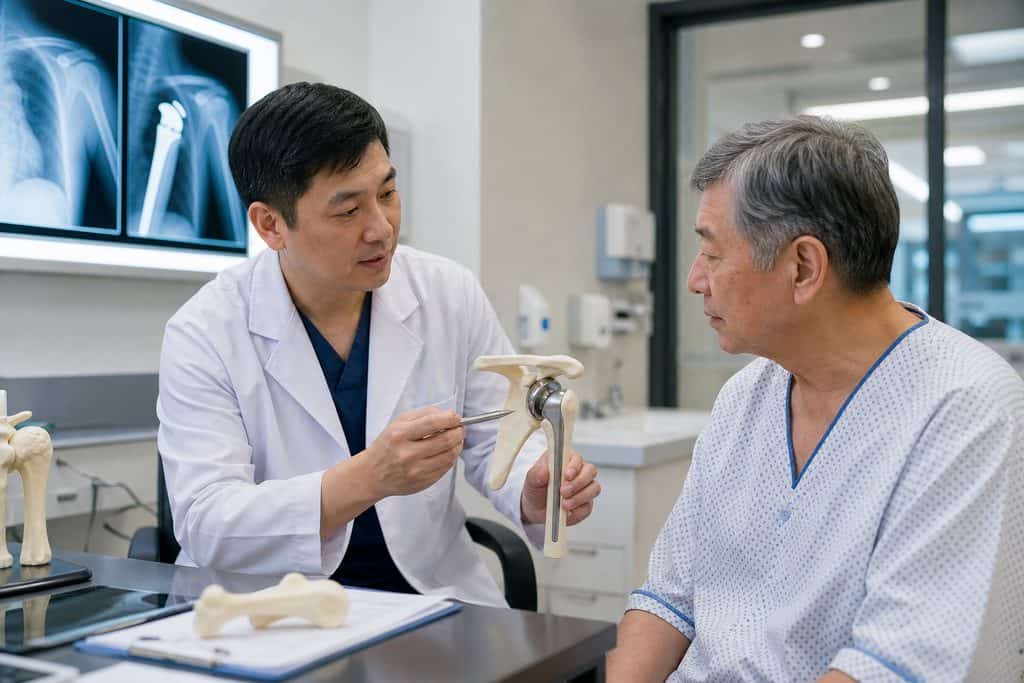
Anatomic total shoulder replacement (aTSA) replaces the ball and socket with a prosthetic that mimics your original anatomy. It demands an intact rotator cuff. If your muscles are healthy, this is the gold standard. It feels natural. Recovery is predictable. Reverse total shoulder arthroplasty (rTSA) flips the mechanics. The ball goes on the shoulder blade, the socket on the arm bone. This changes the fulcrum, allowing the deltoid muscle to power the arm when the rotator cuff is torn beyond repair. It is a biomechanical marvel, but it feels different. The recovery is stricter. You must respect the new center of rotation. A surgeon at a top center can walk you through the decision using weight-bearing CT scans, but understanding the distinction is your first job as a patient.
What You Need to Know Before Going Alone
The clinical path is clear. The logistical path is not. We have seen patients arrive with excellent surgical plans only to stall on bureaucratic details. Going alone introduces friction that can compromise your recovery. Here is what you are up against.
- Visa Documentation Precision: The S2 visa for private medical treatment requires a specific invitation letter from the hospital, stamped with the official hospital seal. A generic email from a doctor will not work. The letter must state the diagnosis, the proposed treatment plan, and the estimated duration of stay. Consulates reject vague letters. We ensure the documentation aligns with the latest consular expectations before you book a flight.
- Payment System Friction: International credit cards are not the default in China. While international hospitals accept them, large public hospitals often require payment via UnionPay or domestic bank transfer. Hitting a daily transfer limit on Alipay or WeChat Pay while trying to settle a hospital deposit is a common, stressful hurdle. Our team helps you pre-negotiate payment channels or set up local payment solutions before admission.
- Rehab Continuity of Care: The question “how long does shoulder replacement surgery take in China recovery” is not answered by the surgery alone. The procedure takes 2-3 hours. The recovery takes months. The critical phase is the 4 to 6 weeks after discharge. Finding a physiotherapist who speaks English and understands the specific protocol for your reverse shoulder implant is difficult. Without a coordinated rehab handoff, the excellent surgery can yield a stiff, disappointing result.
How We Help You Navigate This
These barriers are structural, not personal. We built our service to dissolve them. It starts with a conversation, not a contract.
Before you travel, we translate your existing medical records and imaging into a format Chinese surgical teams prefer. We do not just forward a PDF. We ensure the MRI slices are organized and the clinical history is chronologically clear. We then match your specific pathology—rotator cuff deficiency, osteoarthritis grade, revision needs—with the hospital ranked highest for that sub-specialty in the Fudan rankings. This is not a generic referral to a “good hospital.” If you have a failed anatomic implant requiring a revision to reverse, we direct you to a surgeon who publishes on revision arthroplasty, not a generalist.
During your stay, we act as your non-medical advocate. We verify the S2 visa invitation letter meets the consulate’s standard. We connect you with recovery apartments near the hospital that have accessible showers and raised toilet seats—details a hotel concierge overlooks. After surgery, we bridge the gap to your home country. We facilitate the transfer of surgical notes and implant stickers to your local physiotherapist, so your rehab protocol is continuous. The question of medical tourism shoulder surgery package Beijing often implies a fixed, inflexible bundle. We avoid that. We build a pathway around your clinical reality.
Frequently Asked Questions
The safety record at JCI-accredited and Fudan-ranked orthopedic centers matches any top Western institution. Infection rates for primary shoulder replacement in these centers hover below 1%, consistent with international benchmarks published by the American Academy of Orthopaedic Surgeons. The safety comes from the sterilization protocols and the surgeon’s volume, not the geography.
For a foreign patient paying out-of-pocket at a private international hospital in Shanghai, the total package—including the implant, surgeon fees, a private room, and basic inpatient rehab—typically ranges from $18,000 to $28,000 USD. A similar procedure in the US often bills between $40,000 and $70,000. Public hospitals cost less but require a navigator to handle the language barrier.
The surgery itself takes roughly 2 to 3 hours. The critical question is the flight clearance. Most surgeons require you to stay in the city for at least 10 to 14 days post-surgery for wound checks and suture removal. Flying long-haul with a fresh joint replacement carries a deep vein thrombosis (DVT) risk. We recommend planning for a 3-week total stay in China to manage the initial acute inflammation safely before boarding a long flight.
The first six weeks are restrictive. You will be in a sling with an abduction pillow, especially for a reverse replacement. Passive motion starts early, but active lifting is forbidden. The psychological challenge of recovering in a foreign country is real. You need a stable internet connection for tele-rehab and a comfortable living space. Expect to feel vulnerable. That is normal. By the 3-month mark, most patients are cleared for light daily activities, but full strength can take up to a year. The timeline is the same as at home; the environment just requires more deliberate planning.
Your Next Step
A shoulder replacement is a mechanical fix for a mechanical problem. The implant does not care which country it is inserted in. It cares about the precision of the surgeon’s drill and the sterility of the air in the operating theater. China offers the volume and the technology to deliver that precision at a cost that respects your financial reality. The challenge is not the medicine. It is the map. If you are ready to stop letting shoulder pain make your decisions, let’s find the right surgical team for your specific anatomy. Tell us what you need — we will help you identify the right option at no charge.
For more medical information and treatment options in China, visit tochinamed.com (ToChinaMed).